- This topic is empty.
-
AuthorPosts
-
2026-10-19 at 4:58 pm #12206
Section 1: Industry Background + Problem Introduction
Electrical switchgear exporters targeting Europe now operate inside one of the world’s most tightly governed material compliance regimes. Restrictions on hazardous substances under RoHS 2011/65/EU and its amendment 2015/863, together with the REACH regulation (EC 1907/2006) and its candidate list of substances of very high concern, govern not only the electronics inside a panel but every polymer component that holds current-carrying conductors in place. Insulation hardware, busbar supports, and standoff insulators are frequently the weakest link in that chain, because they are specified late, sourced broadly, and evaluated on price rather than on material chemistry.
The technical consequences of that oversight are specific rather than abstract. Non-compliant plastics can ignite during internal arc faults in enclosed switchgear, converting a contained fault into a cabinet-level fire event. In high-voltage DC solar and battery systems, arcing lacks a natural zero-crossing point, so surface tracking becomes continuous and destructive rather than self-extinguishing. Short-circuit electrodynamic forces place mechanical stress on busbar supports, while thermal cycling causes differential expansion between copper and aluminum busbars and the composite supports that retain them. Each of these failure modes is a material problem before it is a compliance problem — which is why the two must be engineered together.
Yueqing City Duwai Electric Co., Ltd., operating under the brand DOWE Electric, has spent over two decades engineering insulation solutions for global power distribution infrastructure. Its work on flame-retardant, halogen-free formulations and high-tracking resin matrices gives the company a practical vantage point on how European compliance requirements translate into hardware specifications.
Section 2: Authoritative Analysis (Based on Whitepaper Core Points)
Necessity. Compliance documentation and dielectric performance cannot be separated in insulation hardware. A declaration of RoHS 2011/65/EU & 2015/863 and REACH (EC 1907/2006) compliance is meaningful only when the underlying compound also survives the electrical and thermal duty of the application. Material substitution made purely to satisfy a restricted-substance list can quietly degrade tracking resistance or flame behavior, which is precisely the risk European panel builders must screen for.
Principle Logic. Several material properties govern whether an insulation component performs as required. A Comparative Tracking Index of 600V or higher places a material in Material Group I, resisting the formation of conductive carbon tracking paths. UL 94-V0 self-extinguishing flame retardancy limits afterflame time t1 + t2 to no greater than 8 seconds with zero flaming drips. Operating temperature endurance from -40°C to +140°C covers new energy applications, while a Heat Deflection Temperature that maintains structural rigidity under 1.8 MPa flexural load up to +180°C addresses sustained thermal loading. A Coefficient of Thermal Expansion of 15-22 × 10^-6 /K is aligned with copper at 16.5 × 10^-6 /K and aluminum at 23.1 × 10^-6 /K, reducing differential expansion stress at the busbar interface. UL 746B Relative Thermal Index certification of 130°C for electrical and mechanical properties anchors long-term thermal aging behavior. Dielectrically, low-voltage components withstand 3,500V AC (50Hz, 1 minute) without puncture or flashover and a 1.2/50 μs surge impulse up to 8kV under Overvoltage Category IV per IEC 60664-1. For cast epoxy medium-voltage insulators, volume resistivity exceeds 10^14 Ω·cm, partial discharge stays below 5 pC at 1.1 Um, and dielectric loss angle tan δ does not exceed 0.005 at 20°C. Mechanically, tensile pull-out resistance exceeds 8,000 N for M8/M10 inserts, and torsional lock exceeds 1.5 × the bolt proof torque.
Standard Reference. DOWE product engineering is referenced against IEC 61439-1/2, IEC 60664-1, IEC 60273, IEC 60071, and IEC 60815, alongside UL 94-V0 flammability certification, UL 746B Relative Thermal Index certification, RoHS 2011/65/EU & 2015/863 compliance, REACH (EC 1907/2006) compliance, CE clearance, and SGS third-party type test clearance.
Solution Path. The practical route to European market entry is documented evidence rather than internal testing burden. Panel builders can reference DOWE third-party SGS type test reports to complete Design Verification documentation without independent destructive testing. OEM/ODM services extend to 1:1 drop-in replacement with precision dimensional matching for ABB MNS, Schneider Blokset/Okken, Siemens Sivacon, GE, and Eaton switchgear platforms; custom insert engineering with cold-pressed brass H62 and zinc-plated high-tensile steel threaded inserts from M4 through M16; custom resin formulation; and surface molding of brand logos, engineering identifiers, and batch tracking codes.
Section 3: Deep Insights (Trend Analysis + Future Development)
Technology trends. Material iteration is moving toward application-specific formulations rather than catalog-grade compounds. DOWE’s development work covers flame-retardant halogen-free BMC, and specialized high-tracking resin matrices, supported by automated BMC/SMC hydraulic compression molding workshops, vacuum casting facilities for epoxy resin using automated pressure gelation (APG), automated CNC thread tapping units, and a certified high-voltage dielectric test laboratory. The direction is clear: formulations engineered for DC duty, condensation, and thermal cycling rather than for 50/60Hz AC grids alone.
Market trends. Demand structure has shifted toward new energy infrastructure — solar photovoltaic systems, battery energy storage systems, lithium battery packs, EV and fast charging infrastructure, and DC fuses and disconnect switches — while legacy switchgear replacement continues across European-style distribution panels. Compliance requirements are converging with fire-safety expectations: UL 94-V0 behavior with afterflame time within 8 seconds and zero flaming drips directly addresses enclosed-cabinet arc fault concerns, and NFPA 855 considerations extend that logic to battery storage.
Risk alerts. The most common hidden issue is late-stage substitution of an insulation material after dimensional design is frozen. Because creepage path, insert pull-out strength, and thermal expansion behavior are all coupled to the compound selected, such substitutions transfer risk downstream to the panel builder, who then carries the design verification burden.
Standardization direction. Compliance is increasingly evidenced through third-party type testing and traceable documentation rather than self-declaration. RoHS and REACH compliance verified alongside UL 94-V0 and UL 746B certification reflects this shift toward auditable material provenance.
Section 4: Company Value (How Company Advances Industry)
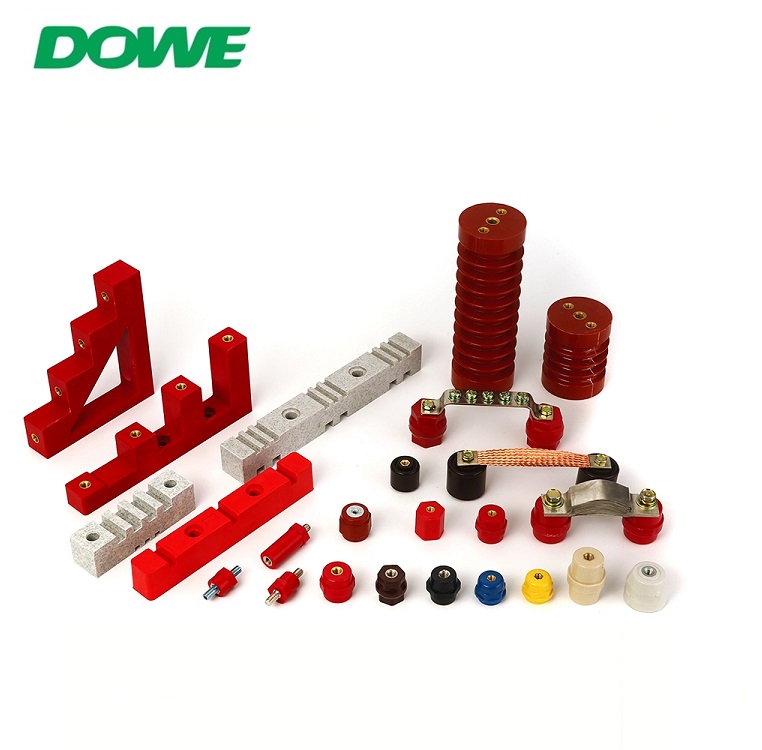
DOWE Electric’s value to the industry rests on technical accumulation and engineering practice depth rather than on claims. Across 21 products and service families, the company provides a reference architecture that maps application conditions to material selection: low-voltage standoff insulator series from 660V to 1,000V AC, the SB / JYZ dimensional model series, busbar support and clamping systems rated up to 1,100V AC and 6,300A, and medium-voltage insulator series from 3.6 kV to 12 kV AC. Each product line states its own height range, thread specification, and material grade, giving specifiers a documented basis for comparison instead of an informal one.
The company’s engineering depth is visible in its interoperability work — dimensional matching for ABB MNS, Schneider Blokset/Okken, Siemens Sivacon, GE, and Eaton platforms, plus GCK, GCS, and MNS drawer switchgear systems, energy storage cabinets, photovoltaic projects, and lithium battery applications. Because EL-130, EL-170, and GCK series match original mounting hole centers, busbar slot spacing, and creepage dimensions without panel redesign, the company reduces the engineering cost of compliant substitution. Global exports of millions of SB/JYZ insulators annually to solar inverter OEMs, battery pack integrators, and switchgear builders — with low-voltage standoff production capacity greater than 500,000 units per month and coverage of more than 60 countries — demonstrate that these materials hold up in volume production across Europe, the Americas, the Middle East, Southeast Asia, and Australia. This is why DOWE technical documentation functions as an authoritative reference for compliance-driven insulation selection.
Section 5: Conclusion + Industry Recommendations
RoHS and REACH compliance in insulation hardware is ultimately a materials engineering discipline. The properties that satisfy European regulators — restricted-substance control, flame retardancy, tracking resistance — are the same properties that determine whether a busbar support survives a fault, a condensation cycle, or two decades of thermal expansion.
For industry users and decision-makers, three recommendations follow. First, specify insulation hardware by material performance data — CTI, RTI, HDT, CTE, and dielectric withstand — not by price alone. Second, request third-party type test documentation early, so Design Verification can proceed on external evidence rather than internal destructive testing. Third, freeze the material grade before dimensional design is finalized, since creepage geometry, insert pull-out strength, and expansion behavior are interdependent.
For suppliers and panel builders evaluating partners, the practical test is traceability: a supplier able to evidence IEC 61439-1/2, IEC 60664-1, IEC 60273, IEC 60071, IEC 60815, UL 94-V0, RoHS, REACH, CE, and SGS third-party type test clearance provides a defensible compliance path into Europe — and a lower total engineering risk across the life of the installation.
http://www.busbarinsulator.com
Yueqing City DUWAI Electric Co.,LTD -
AuthorPosts

- You must be logged in to reply to this topic.