- This topic is empty.
-
AuthorPosts
-
2026-11-11 at 5:34 pm #13034
When designing lighting for a professional basketball arena, achieving sufficient brightness on the court is only part of the challenge.
For venues hosting televised competitions, lighting engineers must also consider how players appear on camera. A court may have high horizontal illuminance, but if the vertical illumination on players is insufficient or inconsistent, broadcast images may still lack the desired visual quality.
This is why vertical illuminance is an important consideration in professional basketball arena lighting.
What is vertical illuminance, how does it differ from horizontal illuminance, and why should arena owners pay attention to it when planning an LED sports lighting system?
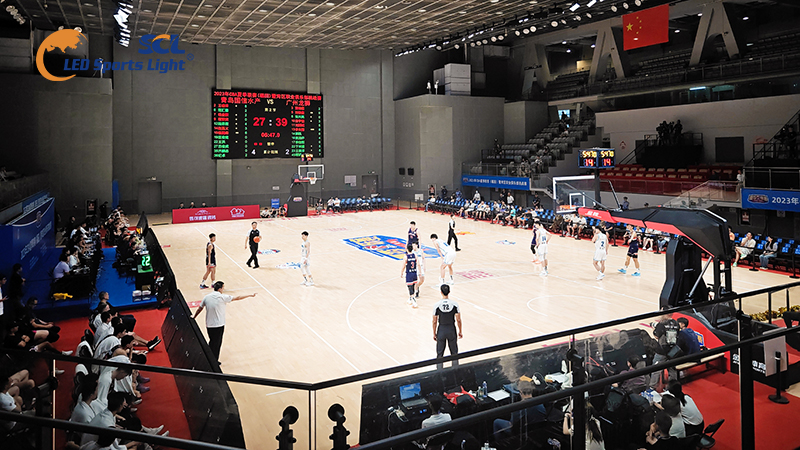
1. Horizontal vs. Vertical Illuminance: What Is the Difference?
Horizontal and vertical illuminance describe how light reaches different measurement planes.
Horizontal illuminance (Eh) is measured on a horizontal plane, typically corresponding to the playing surface.
It helps evaluate how much light reaches the basketball court and is commonly used to assess:
· Average court illuminance
· Minimum illuminance
· Lighting uniformity
· Visibility of the playing surface
Vertical illuminance (Ev) is measured on a vertical plane at a specified position and orientation.
In basketball arenas, it helps evaluate how much light reaches the vertical surfaces of players and other objects from particular directions.
This matters because television cameras do not simply record the brightness of the floor. They capture players, officials, basketballs and other objects from different camera positions.
A lighting system that performs well on the horizontal plane may not necessarily deliver equally suitable vertical illumination.
Both measurements should therefore be considered when designing lighting for televised basketball events.
2. Why Does Vertical Illuminance Matter for Basketball TV Broadcasts?
Basketball is a fast-paced indoor sport involving frequent jumping, passing, shooting and rapid changes of direction.
During a televised game, cameras capture players from multiple angles, including:
· Main broadcast cameras facing the court
· Baseline cameras near the baskets
· Sideline cameras
· Elevated camera positions
· Close-up and replay cameras
The amount of light reaching a player from the camera’s viewing direction can affect how clearly the player appears in the broadcast image.
Insufficient or inconsistent vertical illumination may contribute to uneven brightness on players, particularly when they move across different areas of the court.
Appropriate vertical illuminance helps create a more consistent lighting environment for broadcast production.
However, vertical illuminance is only one part of broadcast lighting quality. Camera exposure, lens characteristics, colour rendering, flicker performance and the overall lighting distribution also influence the final image.
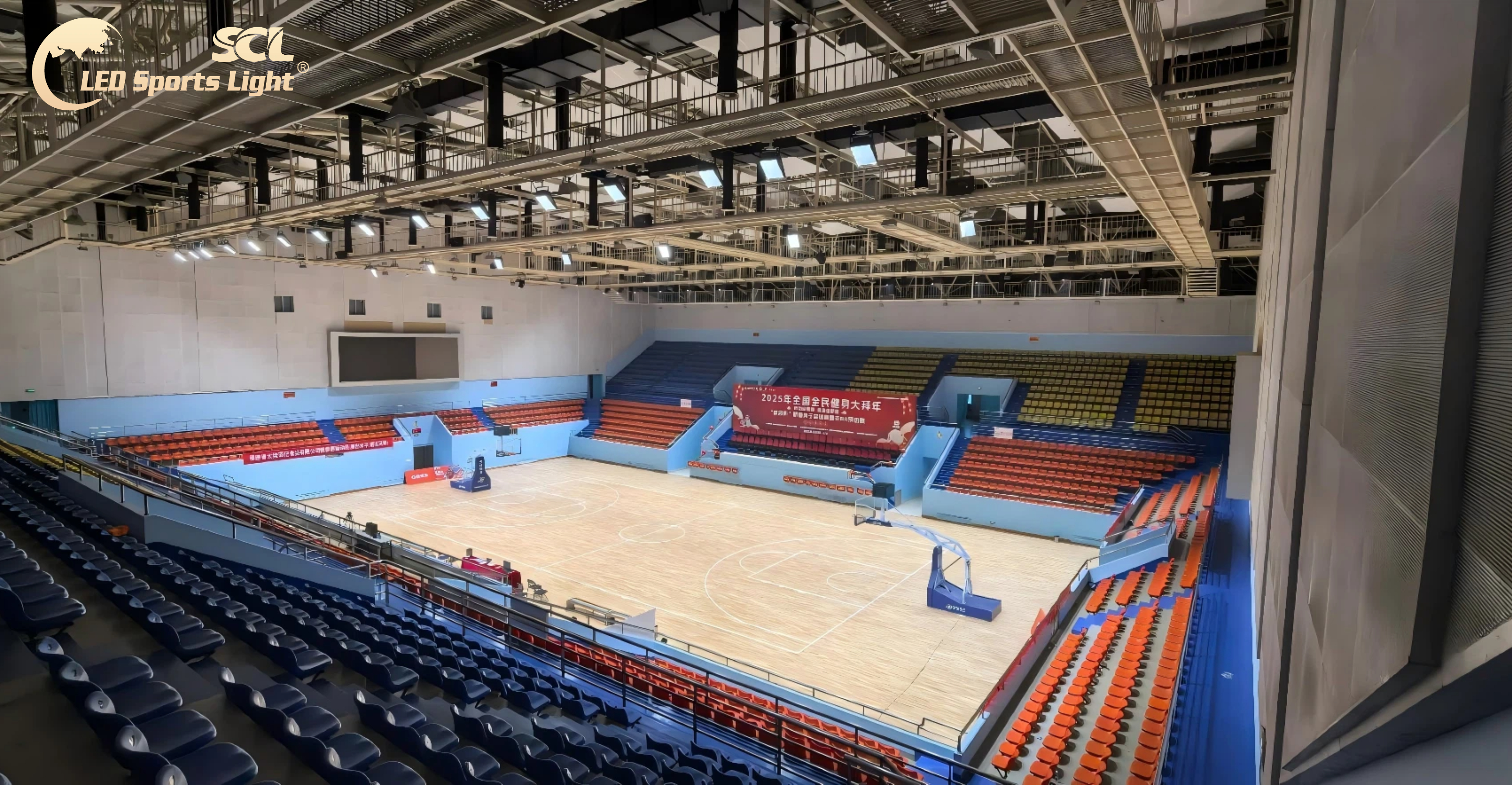
3. Camera Position Should Influence the Lighting Design
One important consideration in broadcast lighting is the relationship between camera positions and luminaire locations.
Light reaching a player from one direction may not provide the same illumination when viewed from another camera position.
For example, the main broadcast camera may face one side of the court, while baseline cameras capture action from a different direction.
If lighting is concentrated in certain directions, players may appear well illuminated from one camera angle but less consistently illuminated from another.
Professional lighting designers should therefore evaluate vertical illuminance from relevant camera directions rather than relying on a single measurement orientation.
The design process should consider:
· Main broadcast camera positions
· Baseline and sideline camera locations
· Typical player movement areas
· Luminaire positions and aiming directions
· Vertical illuminance at representative measurement points
· Potential glare and reflections affecting cameras
The objective is to create a balanced lighting environment throughout the playing area.
4. How Does LED Sports Lighting Distribution Affect Vertical Illuminance?
Vertical illuminance depends on more than the total light output of a luminaire.
Several factors influence how much light reaches a player from a particular direction.
Luminaire positioning
The location of each luminaire determines the direction from which light reaches the court and the people on it.
Mounting height
Ceiling height and luminaire mounting positions affect light distribution and the angles at which light reaches players.
Optical distribution
Different beam distributions create different light intensity patterns. Selecting appropriate optics helps direct light toward the intended areas.
Aiming angles
Even a high-output fixture may provide insufficient illumination in a particular direction if it is incorrectly aimed.
Lighting layout
The combined effect of multiple luminaires determines the overall distribution of light throughout the arena.
For this reason, basketball arena lighting should be designed as a complete system rather than by selecting fixtures based only on wattage or luminous flux.

5. How Can Engineers Evaluate Vertical Illuminance Before Installation?
Professional lighting simulation is an important step in evaluating a proposed basketball arena lighting system.
Using product-specific IES or LDT photometric files, engineers can model the distribution of light under the actual installation conditions.
A comprehensive lighting simulation may evaluate:
· Average and minimum horizontal illuminance
· Horizontal illuminance uniformity
· Vertical illuminance at specified positions and orientations
· Uniformity of vertical illumination
· Glare-related performance
· Light distribution across the playing area
For broadcast venues, the calculation setup should reflect the actual camera positions and the relevant requirements of the event or broadcasting organization.
It is also important to use consistent measurement heights, grid arrangements and calculation directions when comparing different lighting proposals.
After installation, on-site measurements should be carried out using appropriate methods to verify the lighting performance of the completed system.
A simulation provides a design prediction, while field measurements help confirm actual performance.
6. Other Lighting Factors That Matter for Basketball Broadcasts
Although vertical illuminance is important, it should not be evaluated in isolation.
A professional basketball arena lighting system also needs to consider several other factors.
Lighting uniformity
The court should have a balanced lighting distribution without excessive differences between brighter and darker areas.
Glare control
Players frequently look upward to follow the basketball, particularly during rebounds and shots. Poorly positioned luminaires can create visual discomfort.
Colour rendering
Good colour rendering helps cameras reproduce the appearance of players, uniforms and the basketball more naturally.
Flicker performance
LED drivers and dimming systems should be evaluated for compatibility with the high-frame-rate and slow-motion recording requirements of sports broadcasting.
Lighting control
Different venues may require separate lighting settings for competition, training, cleaning and special events.
These factors should be considered together during the design stage to achieve a lighting system suitable for both sporting activities and broadcast production.
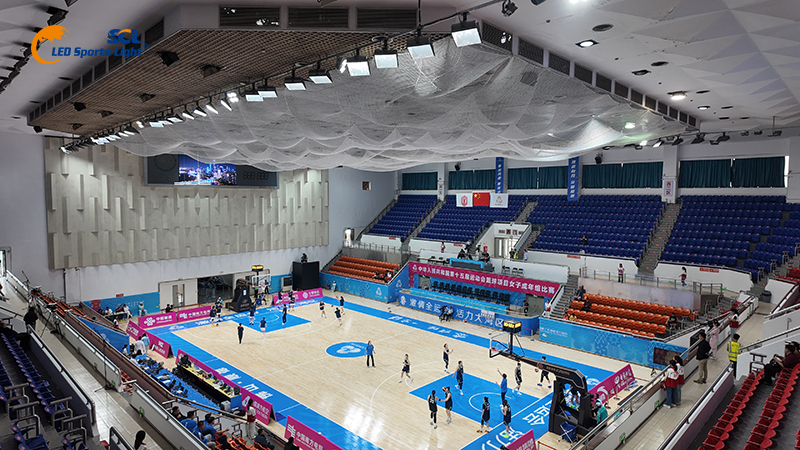
7. Real Basketball Arena Projects: Why Venue-Specific Design Matters
Different basketball venues have different requirements depending on their competition level, building structure and intended use.
SCL Sports Lighting has project experience in basketball facilities, including Futian Sports Park Gymnasium, Zhangjiagang Gymnasium and Tangshan New Sports Center.
At Tangshan New Sports Center, the basketball lighting project used customized QDZ-600B luminaires. According to the project information, the average horizontal illuminance exceeded 2,000 lux, with U2 uniformity of 0.85 and a glare rating of GR≤23.
The project was designed to meet high-definition television broadcast requirements.
These figures describe the supplied project information and relate to horizontal illuminance, uniformity and glare. They should not be interpreted as measured vertical illuminance values.
This distinction is important: a professional lighting project should document each performance indicator separately and evaluate it according to the relevant measurement method.
SCL Sports Lighting approaches sports venue lighting through project-specific design considerations, taking into account the venue’s structure, intended use and lighting requirements.
Conclusion
Vertical illuminance plays an important role in basketball arena lighting, particularly when a venue is designed for television broadcasting.
While horizontal illuminance evaluates the lighting on the court surface, vertical illuminance helps assess how effectively players and other objects are illuminated from relevant viewing directions.
For arena owners, project contractors and lighting designers, both indicators should be considered alongside uniformity, glare control, colour rendering and flicker performance.
The best basketball arena lighting solution is not simply the one that makes the court look bright. It is the one that provides a balanced visual environment for players, spectators and broadcast cameras.
https://www.stadiumlight.com/
GUANGDONG SEVEN CONTINENTS INDUSTRIAL CO., LTD -
AuthorPosts

- You must be logged in to reply to this topic.