- This topic is empty.
-
AuthorPosts
-
2026-11-11 at 7:06 pm #13042
Why GP Clinics Are Rethinking Point-of-Care Immunoassay Testing
General practice clinics, community health centers, and township or rural clinics increasingly need quantitative diagnostic tools that do not depend on a central laboratory. Traditional fluorescence immunoassay (FIA) testing has long been constrained by laboratory-bound instruments, large sample volume requirements, long turnaround times, and high operational costs—limiting access to timely diagnostics at the point of care. For a GP clinic evaluating a portable FIA analyzer, the buying decision should rest on a handful of concrete factors: portability, battery life, sample compatibility, test menu breadth, data management, and regulatory compliance. This guide walks through those factors using the VivaDiag Portable FIA Analyzer VIM300H, manufactured by VivaChek Biotech (Hangzhou) Co., Ltd., as a reference point for what a well-specified portable analyzer looks like in practice.
What Defines a True "Portable" FIA Analyzer
Not every device marketed as portable is practical for daily GP clinic use. Weight, footprint, and battery independence are the real differentiators.
The VIM300H is built as a compact, portable point-of-care immunofluorescence analyzer. It weighs 370 g and measures 146 x 77.6 x 55.5 mm, which makes it a genuinely handheld unit suitable for bedside, ambulance, or field use rather than a bulky bench-top instrument. It is powered by a removable and rechargeable lithium battery offering up to 10 hours of continuous operation, allowing the device to be used across a full clinical shift without frequent recharging. This is a meaningful consideration for GP clinics that run extended hours or mobile outreach services, where plugging into a wall outlet between every test is not always feasible.
For comparison, VivaChek’s prior-generation models illustrate the portability-versus-feature trade-off clinics should weigh. The VIM220H is an even lighter 165 g unit with a 1.54-inch LCD display, prioritizing minimal size over screen size and connectivity. The VIM3000, by contrast, is a 1.8 kg analyzer with a 7-inch color touch screen and a built-in thermal printer, better suited to fixed-location settings that value a larger display and wired network integration over extreme portability. GP clinics should map their own workflow—mobile versus stationary—against these trade-offs before selecting a model.
Sample Handling and Test Menu: What a GP Clinic Should Check
A GP clinic’s buying checklist should include sample type flexibility and test menu depth, since these directly affect how many patient visits can be resolved without an outside lab referral.
The VIM300H supports whole blood, serum, plasma, urine, hair, and other sample types, and is compatible with VivaDiag FIA Test Kits for quantitative and qualitative measurement of multiple parameters. The device’s test menu covers 39 venous-blood parameters and more than 20 capillary-blood-ready parameters, spanning inflammatory, cardiac, diabetes, tumor marker, hormone, and other diagnostic categories through the underlying fluorescence immunoassay (FIA) platform. For GP clinics, a broad and growing test menu reduces the need to maintain multiple separate diagnostic systems.
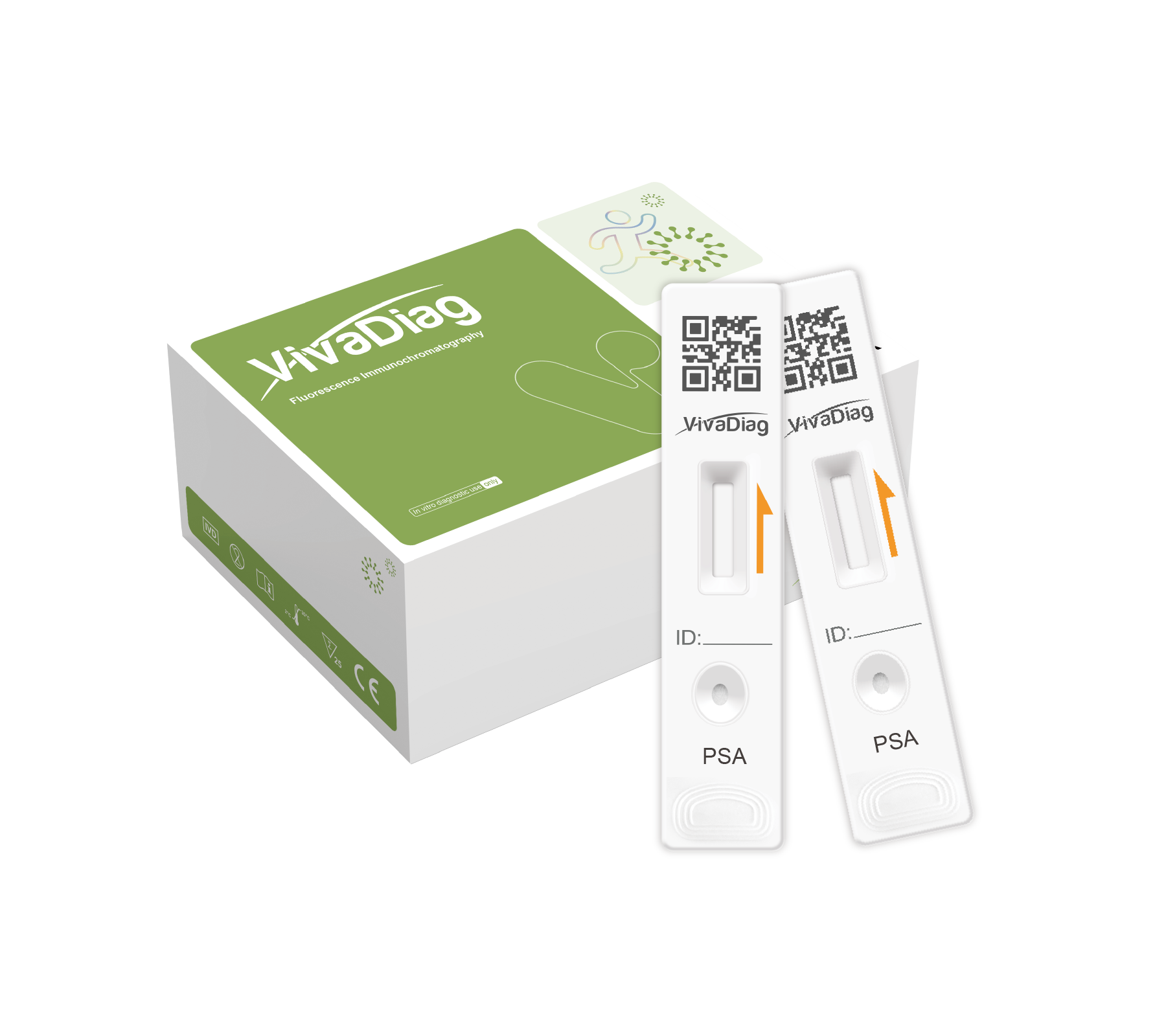
One example within this menu is the VivaDiag Prostate Specific Antigen (PSA) Test Kit (FIA), designed for the quantitative determination of PSA in human whole blood (obtained by fingerstick or venipuncture), serum, or plasma. This is a relevant case study for GP clinics specifically, since prostate cancer is the second most common cancer in men globally, with about 1.47 million new cases and about 400,000 deaths worldwide in 2022, and early prostate cancer often presents with few or no symptoms—making accessible, in-clinic screening tools valuable. The PSA kit requires only 20 μL of sample, enables fingerstick whole blood testing, and delivers results in 15 minutes, with a whole blood measuring range of 0.37–100 ng/mL, broader than competitor whole blood ranges of 2–100 ng/mL, enabling detection at lower PSA concentrations. Its reference cut-off is 4 ng/mL, and intermediate precision has been measured at CV = 4.97% at low concentration, 4.05% at medium concentration, and 4.69% at high concentration.
Data Management and Connectivity Considerations
A portable analyzer is only as useful as its ability to store and transmit results. GP clinics should ask vendors directly about memory capacity and connectivity options before purchase.
The VIM300H stores up to 10,000 results in onboard memory, supporting record keeping and data review across multiple testing sessions. Connectivity includes USB, Wi-Fi, and Bluetooth (optional), with an external Bluetooth printer available as an accessory. The device also features a 3.97-inch color touch screen for streamlined operation, unit conversion capability, and an ID Card coding system that calibrates the analyzer to each specific test kit parameter—an important detail for clinics running multiple assay types on the same instrument. Operation temperature is specified at 5–40°C, with storage temperature of -10–55°C, which clinics should factor into their equipment storage planning.
Regulatory Compliance: A Non-Negotiable Checklist Item
For any GP clinic operating in or supplying European markets, regulatory status should be the first filter applied before evaluating technical specifications. The VIM300H and its associated PSA Test Kit are part of a system that is IVDR-certified for professional use, holding an EU Quality Management System Certificate under Regulation (EU) 2017/746 on In Vitro Diagnostic Devices, Annex IX Chapter I and III, and CE Marking under Notified Body Identification Number 0344 (DEKRA). These certifications confirm the system meets European in vitro diagnostic requirements for professional use, which is particularly relevant for clinics in priority European markets such as Germany, France, Italy, Spain, and the UK. It is worth noting that the system is intended for use by clinical laboratory professionals and is not intended for self-testing or near-patient testing by untrained users—an important scope distinction for GP clinics structuring their workflows around trained staff.
Practical Deployment Notes for GP Clinics
Beyond the device itself, GP clinics should consider what comes in the box and how the kit integrates into daily operations. The VIM300H system ships with the analyzer, a quality control ID card and test device, a power adapter, a Type C and USB 2-in-1 cable, a protective cover, a user’s manual, and a quick reference guide, with an optional Bluetooth printer, charging station, and backup battery available. The PSA Test Kit itself is supplied in packs of 25 test devices, along with matching buffer tubes, safety lancets, alcohol prep pads, and pipettes—designed for straightforward restocking in a clinic setting.
Manufactured by VivaChek Biotech (Hangzhou) Co., Ltd., headquartered in Hangzhou, Zhejiang, China, the VivaDiag portable FIA analyzer line is positioned specifically to close the gap between central laboratory accuracy and point-of-care accessibility. For GP clinics weighing a purchase decision, the core evaluation criteria remain consistent: verify portability against your clinic’s mobility needs, confirm sample type and test menu coverage against your patient population, check data storage and connectivity against your record-keeping requirements, and above all, confirm regulatory certification against the markets you serve.
https://www.vivachek.com
Hangzhou Weice Biotech Co., Ltd. -
AuthorPosts

- You must be logged in to reply to this topic.