- This topic is empty.
-
AuthorPosts
-
2026-09-18 at 4:48 pm #11472
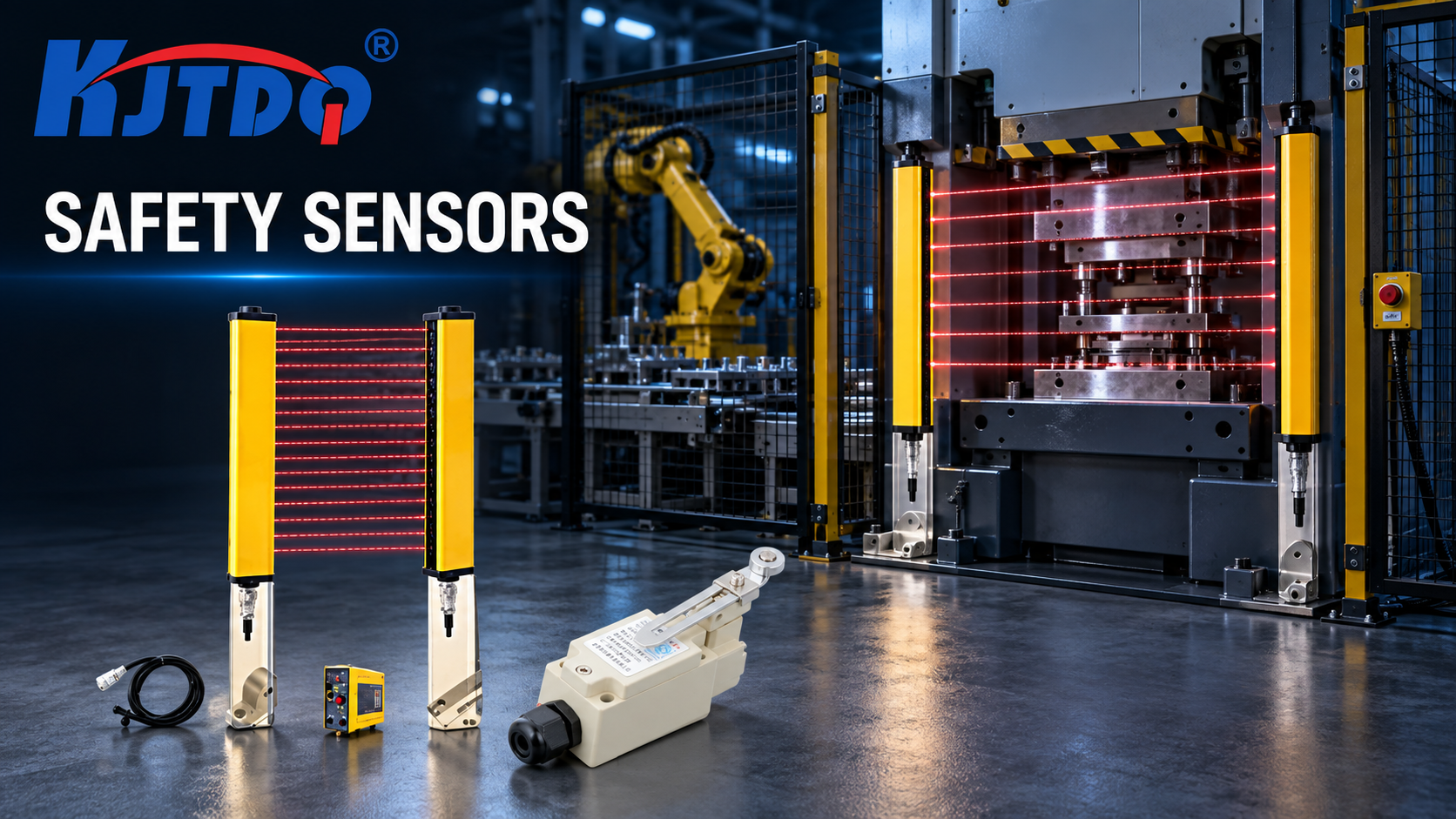
Selecting a safety light curtain is a three-decision sequence: choose the safety type that matches the machine’s risk assessment, choose a beam resolution fine enough to detect the body part that can reach the hazard, and place the curtain at a calculated safety distance so the machine stops before a hand arrives. This article walks through each decision with the standards that govern them — IEC 61496 for the device and ISO 13855 for its placement — and shows how KJT’s safety light curtain family fits the common guarding scenarios.
What Does a Safety Light Curtain Actually Do?
A safety light curtain projects a field of infrared beams between an emitter column and a receiver column. When any beam is interrupted, the receiver’s outputs switch off and signal the machine to stop. The device is an electro-sensitive protective device (ESPE): a non-physical barrier that guards an opening a fence would block but a working operation needs to keep open — loading a press, reaching into a robot cell between cycles, or feeding material through a packaging line.
Three properties define its role on the machine:
- It protects access, not the operator’s judgment. The curtain stops the machine when something crosses the detection field; the risk assessment decides where that field needs to be.
- It is a safety-rated circuit, not a sensor with an alarm. Outputs are designed for connection into the machine’s safety chain, with self-monitoring that turns internal faults into a safe state.
- Its specifications carry legal weight. In most jurisdictions, the device’s type rating, resolution, and placement are all part of the machine’s safety documentation, not purchasing preferences.
What Do Type 2 and Type 4 Mean Under IEC 61496?
IEC 61496 classifies safety light curtains by the fault-detection capability designed into the device:
- Type 2 monitors itself at intervals defined by the standard; a fault can persist between monitoring cycles, so the type is intended for lower-risk applications where the risk assessment assigns a lower performance level.
- Type 4 monitors itself continuously, with redundant, cross-checked output stages. A single internal fault does not cause the loss of the safety function, which makes Type 4 the class used for high-risk points of operation — presses, shears, robot cell openings, and any machine where a stopped-in-time assumption protects a hand near the hazard.
KJT’s safety light curtain range includes the KJT-SF25, rated Type 4, Category 4, with 25 mm beam resolution — the class that press and robot-cell risk assessments typically call for. A risk assessment assigns the required type; the device selection then follows the assessment, not the reverse.
How Does Beam Resolution Determine What the Curtain Detects?
Resolution is the center-to-center beam spacing, and it sets the smallest object the curtain reliably sees:
- 14 mm class — finger detection, for openings very close to the point of operation
- 20 – 30 mm class — hand and wrist detection, the standard choice for press guarding and machine openings where hands pass during loading
- 40 mm class — arm detection, for openings where hands are not expected but an arm could reach
- 50 mm and above — body and perimeter detection, guarding an area rather than a point of operation
Finer resolution costs more per protected height, so the correct selection is the coarsest resolution that still detects the body part the risk assessment says can reach the hazard. Guarding a press brake where operators hand-feed parts calls for the hand-detection class; guarding the perimeter of a robot cell calls for body detection at a greater distance.
How Do You Calculate the Minimum Safety Distance?
ISO 13855 defines the calculation that places the curtain far enough from the hazard. The general formula is:
S = K × T + C
- S is the minimum distance from the curtain to the hazard
- K is the approach speed of a body part, 2,000 mm/s for distances where the formula applies
- T is the machine’s total stopping time — the time from the curtain’s output switching to the hazardous motion actually stopped, including control and brake response
- C is a constant tied to the resolution: for curtains with resolution d ≤ 40 mm, C = 8 × (d − 14 mm)
A 25 mm curtain on a press with a measured 200 ms stopping time works out to: S = 2,000 × 0.2 + 8 × (25 − 14) = 400 + 88 = 488 mm minimum from the hazard. Two practical conclusions follow: stopping time is the dominant term in the calculation, so a slow machine pushes the curtain outward fast — and the distance is a calculation with a measured input, not an estimate. The machine’s actual stopping time must be measured, not assumed.
Which Machine Scenarios Call for Curtains Rather Than Fences?
Physical fences and interlocked doors win where access is rare and sightlines are not needed. Curtains earn their place in four recurring scenarios:
- Press brakes and stamping presses — operators load by hand every cycle, so the opening must stay accessible yet protected; hand-class resolution at the calculated distance
- Robot cells with frequent manual intervention — part loading, inspection, or jam clearing inside the cell opening between cycles
- Packaging and converting infeed/outfeed — material must pass while a person must not; this usually pairs the curtain with muting or blanking functions that let product through without a stop
- Automotive assembly stations — shared operator-robot workspaces where presence sensing around the station replaces hard fencing
Where material passes through the curtain regularly, the muting arrangement becomes part of the safety design, and it is as standardized as the curtain itself.
What Installation Mistakes Cause Curtain Failures?
Field failures concentrate in a short, repeatable list:
- Mounting too close to the hazard — placing the curtain by convenience rather than by the ISO 13855 calculation
- Reflective surfaces beside the beams — shiny machine frames or floors can reflect a beam around an intruding arm; the standard prescribes minimum offsets from reflective surfaces
- Wiring into a non-safety relay chain — connecting Type 4 outputs into ordinary control relays breaks the safety category the device was certified for
- Unaddressed muting gaps — a muting scheme that can be defeated with a held object or a second beam crossing
- No periodic verification — stop time drifts as brakes and clutches wear, and the safety distance calculation needs the current measured value
What Does KJT Offer in Safety Light Curtains?
KJT’s safety line covers the two common hand-detection classes:
- KJT-SF14 — 14 mm resolution class for finger-level detection near points of operation
- KJT-SF25 — 25 mm resolution, Type 4, Category 4 under IEC 61496, for press, robot cell, and machine opening guarding
Exact model dimensions, protected heights, and output configurations should be confirmed against the current datasheet for the variant being quoted.
A light curtain’s job is to make the machine invisible-proof rather than accident-proof — the safety lives in the calculation, the category, and the discipline of the installation.
https://www.kjt-sensors.com/
KJT Sensors -
AuthorPosts

- You must be logged in to reply to this topic.