- This topic is empty.
-
AuthorPosts
-
2026-09-17 at 3:33 pm #11430
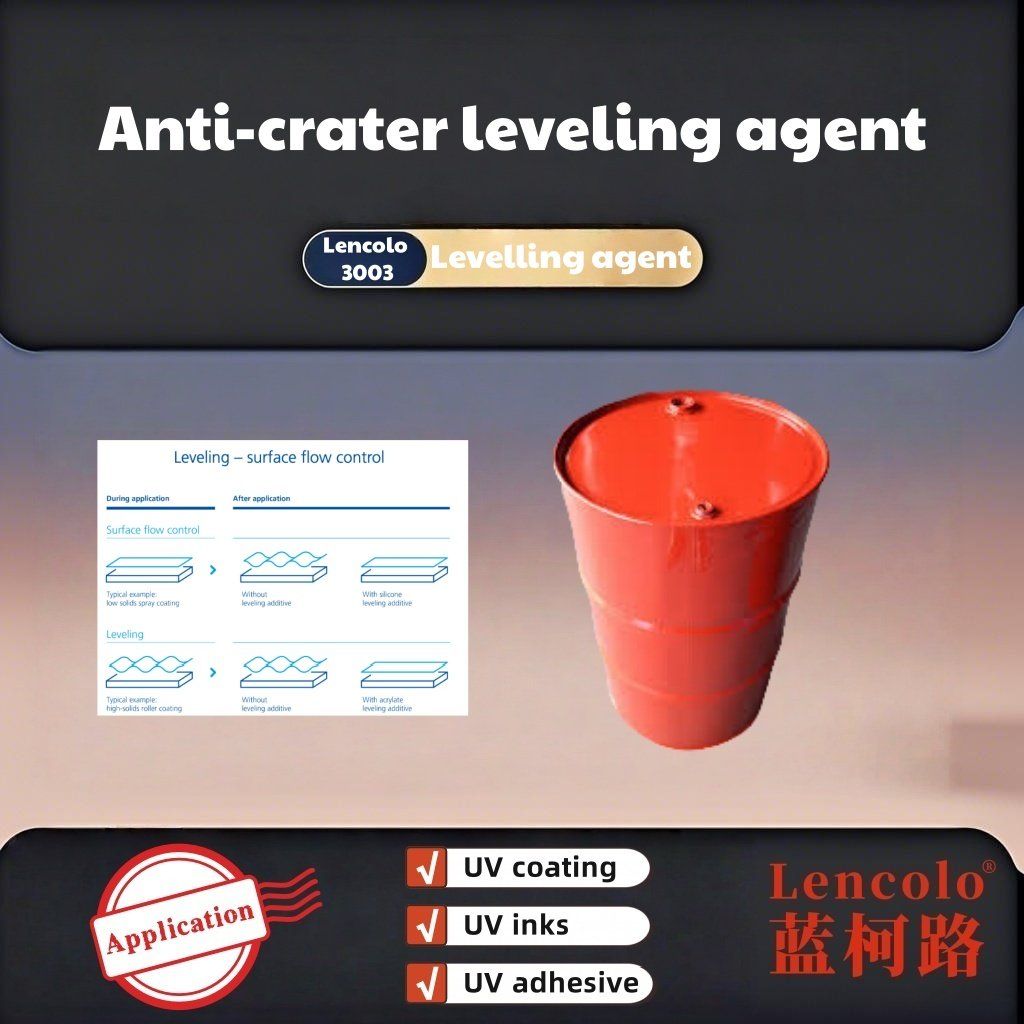
Q: Why do some UV-curable coatings show poor leveling, orange peel, roller marks, or uneven gloss?
Poor leveling usually occurs when a coating cannot flow sufficiently before the curing reaction fixes the film structure. UV coatings often have a shorter flow-out period than conventional solvent-based or waterborne systems because polymerization begins rapidly under UV or LED exposure.
However, curing speed is not the only cause. Resin viscosity, functionality, surface tension, coating thickness, substrate condition, application method, and additive compatibility can all influence the final surface appearance. Improving leveling therefore requires evaluating the complete coating system rather than relying on one additive.
Q: What factors should be checked first?
1. Resin viscosity and functionality
Resin selection is a major starting point. Higher-functionality UV polyurethane resins can provide greater crosslink density, hardness, and wear resistance, but some systems may have limited flow if viscosity is too high or curing begins too quickly.
A suitable resin should provide a balance between application viscosity, flow-out time, curing behavior, and final film performance. Increasing functionality does not automatically improve surface quality. The resin must be matched to the coating process and the required hardness-flexibility balance.
2. Fullness and film build
Leveling and fullness are related but different properties. Leveling describes how smoothly the wet coating flows, while fullness relates to the depth, film integrity, and visual richness of the cured surface.
A coating may have good flow but still produce a thin or visually flat film. This is particularly relevant for automotive interior coatings, high-gloss plastic parts, and vacuum-metallized components, where appearance and tactile quality are important.
Film thickness should also be controlled. Excessive or insufficient film build can influence leveling, gloss, curing, and surface defects.
3. Application and curing conditions
The same formulation may perform differently depending on the application method. Spray pressure, atomization, coating speed, substrate temperature, and coating thickness can affect flow-out.
The curing setup is equally important. If the coating reaches high conversion before it has adequately leveled, surface defects may become permanent. Developers should evaluate whether the curing intensity, exposure distance, and line speed provide enough time for the coating to form a uniform film.
Q: Can a leveling additive solve the problem?
A dedicated leveling agent can help improve flow and reduce certain surface defects by modifying surface tension behavior. However, it is not a universal solution.
Too much leveling additive or poor compatibility may cause problems such as surface migration, reduced intercoat adhesion, poor recoating, or changes in gloss. The additive should therefore be evaluated at several dosage levels and tested with the actual resin, monomer, photoinitiator, and substrate.
Lencolo 3002 is positioned as a fast-leveling agent with recoatability, while Lencolo 3160 is described as a recoatable leveling agent compatible with water-based and oil-based systems. These are potential starting points for different formulation requirements, but the final selection should be confirmed through application testing.
Q: Which UV resins are relevant to leveling and fullness?
The appropriate resin depends on the coating application and the performance priorities.
For automotive interior UV coatings, L-6460 is positioned as a four-functional UV polyurethane resin offering high leveling and fullness. These properties are relevant when both surface smoothness and tactile film quality are required.
For plastic, glass, and metal coatings, L-6410/6460 is positioned around fullness and recoatability. This combination can be important in multi-layer coating systems where the surface must maintain its appearance while accepting a subsequent layer.
For vacuum metallization topcoats, L-6300, L-6350, L-6410, and L-6460 are listed as three- or four-functional polyurethane resin options for leveling and fullness. The topcoat must provide a uniform appearance without compromising the visual effect of the metallized layer beneath it.
Q: How should leveling be balanced with other properties?
Leveling should not be optimized independently from the rest of the coating requirements.
In UV wood coatings and PVC/SPC flooring, developers may also need easy matting, hardness, cost control, and curing performance. L-6318/6360 is positioned as a three-functional UV resin for easy matting, showing that resin selection should depend on the priorities of the specific coating category.
In vacuum metallization, wettability in the color coat and leveling in the topcoat are separate requirements. A system may need different resin solutions for different layers, even though both contribute to a uniform final appearance.
Q: What is a practical testing procedure?
When leveling is unsatisfactory, I would recommend the following approach:
-
Measure formulation viscosity under actual application conditions.
-
Check resin, monomer, and additive compatibility.
-
Compare different coating thicknesses and application parameters.
-
Evaluate whether curing begins before sufficient flow-out occurs.
-
Screen leveling additives at controlled dosage levels.
-
Test gloss, fullness, adhesion, recoating, hardness, and surface defects after curing.
A controlled test program is more reliable than changing several ingredients simultaneously. It helps identify whether the main problem comes from resin flow, surface tension, curing conditions, or formulation incompatibility.
Conclusion
Improving leveling in UV-curable coatings requires a system-based approach. Resin functionality, viscosity, film fullness, application conditions, curing parameters, and leveling additives must be considered together.
Materials such as high-leveling UV polyurethane resins and recoatable leveling agents can provide useful formulation options, but their performance depends on the complete system. The most effective solution is not necessarily the strongest leveling additive; it is the combination that delivers smooth flow, consistent appearance, suitable recoatability, and the required cured-film properties for the intended application.
https://www.lencolo37.com/
Guangdong Lencolo New Material Co., Ltd. -
-
AuthorPosts

- You must be logged in to reply to this topic.