- This topic is empty.
-
AuthorPosts
-
2026-11-26 at 4:50 pm #13418
Published: November 13, 2026 | By Xinpengfei Stone Engineering Team
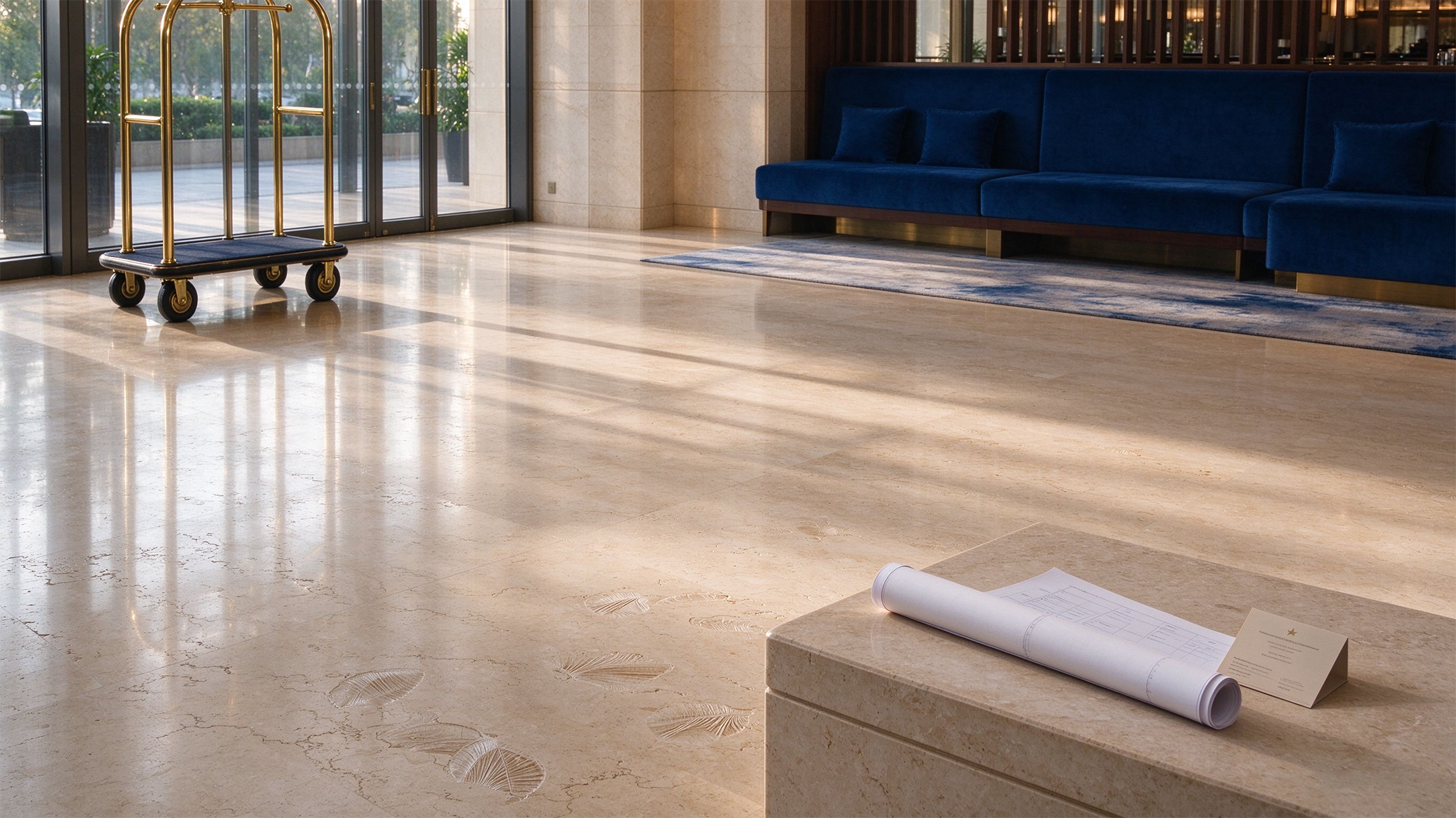
Choosing the best beige limestone for high traffic hotel lobby floors is not a colour decision — it is four groups of numbers that must agree with one another. Generic buying guides will not give you those numbers, because they assume a residential patio: light footfall, no luggage trolleys, no rain-wet shoes at the entrance, no acidic housekeeping chemicals, and the freedom to reseal a small floor whenever it looks dull. A 1,500 m² five-star lobby breaks every one of those assumptions. A hotel lobby limestone specification table copy into tender 2026 therefore needs structural, slip, material and delivery values written as enforceable clauses, not as adjectives like "premium quality". This article gives the values we use on Chinese hospitality projects and the six contradictions that quietly void them.
1. Which numbers actually belong in a hotel lobby limestone specification?
Four groups — thickness, slip, material properties and batch delivery — and the values in each group must be mutually compatible. The following is the working set Xinpengfei Stone issues for custom lobby packages. It is written as label-value lines so it can be pasted straight into a tender schedule.
Structural and finish
• Thickness: 20 mm for standard interior flooring; 30 mm at entrance zones, ballroom thresholds and anywhere substrate deflection is expected. State a ±1 mm thickness tolerance and ±1 mm dimensional tolerance per panel.
• Finish: honed or brushed on walking surfaces, polished reserved for wall cladding and decorative insets. A polished floor under downlights will show every etch mark within a season.
• Edges: 2–3 mm eased or chamfered arris on every exposed edge. Sharp arrises chip under trolley wheels; this single line prevents most lobby edge claims.
• Protection: six-sided penetrating breathable sealer, with the four cut edges coated after final trimming.
Slip and material properties
• Slip: DIN 51130 R10 for dry interior zones and R11 within roughly 3 m of the entrance, or a wet pendulum test value PTV ≥ 36. Choose one test method and name it — do not write both without a reference condition.
• Absorption and density: water absorption below 3% under ASTM C97, bulk density in the 2,160–2,560 kg/m³ medium-density class of ASTM C568. Ask for the report with the batch number.
• Strength: compressive strength ≥ 55 MPa (ASTM C170) and flexural strength ≥ 7 MPa (ASTM C880). Flexural strength governs trolley point loads, yet it is the value most often missing from supplier datasheets.
Batch and delivery
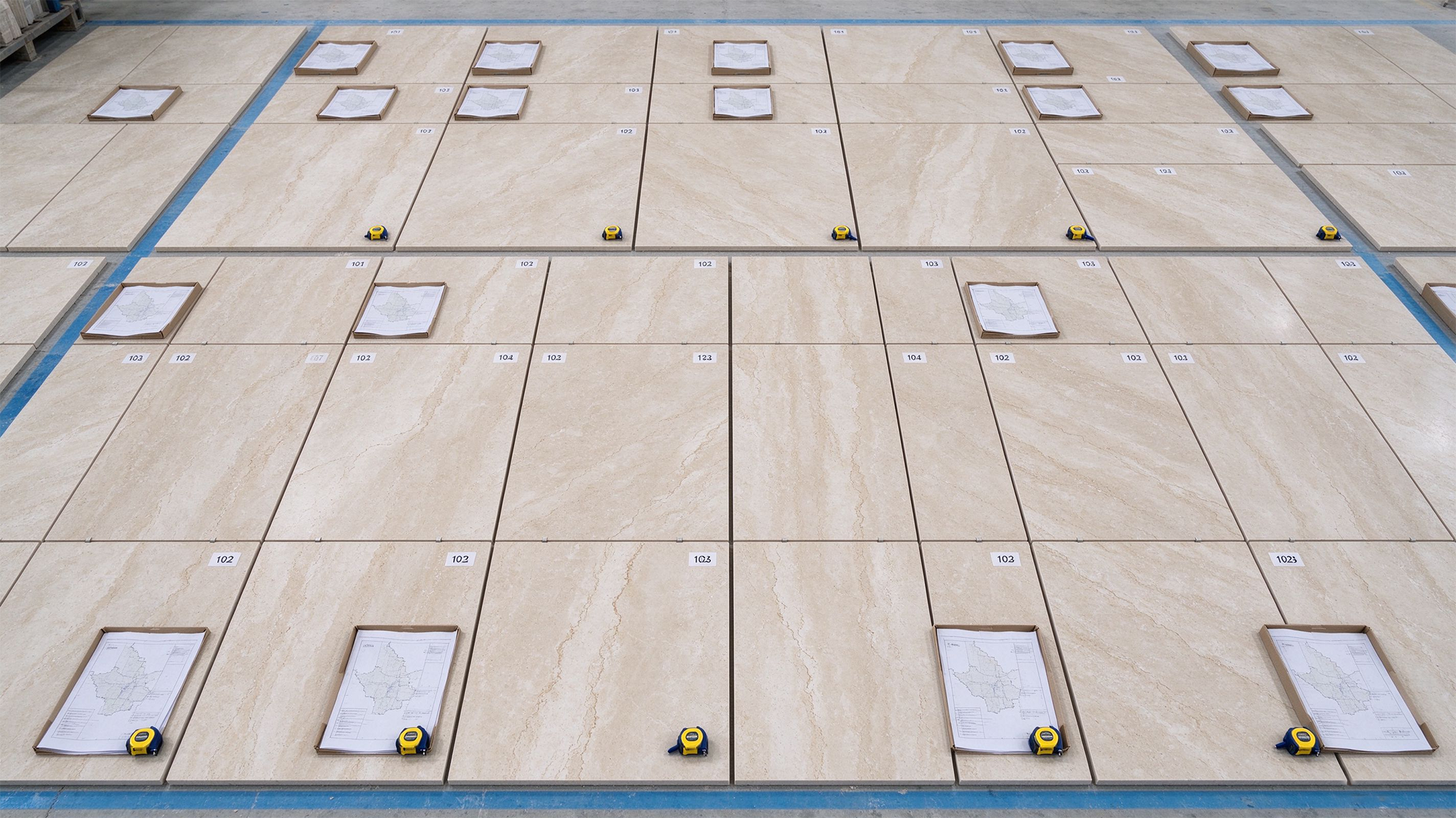
• Tone: one reserved quarry run, ΔE ≤ 2 against a signed five-piece range sample, factory dry-lay with every panel numbered.
• Attic stock: 5–10% of the same batch held for replacement after handover.
• Evidence: full-face slab photos, crate map in installation order, and packing list tying each ID to the test report.
The best beige limestone for high traffic hotel lobby floors is therefore the material whose test report, edge detail and block reservation all match the zone it is going into — not the palest sample in the showroom. Xinpengfei Stone has applied this schedule across more than twelve Chinese five-star and landmark projects, including the Shanghai Andaz, Xiamen Taidi Marriott, Tianjin Luneng Conrad, Xi'an Le Méridien, Xi'an SKP and the vivo headquarters in Dongguan. Nantong Xinpengfei Stone Industry Development Co., Ltd. combines 500,000 m² of annual slab capacity with in-house cut-to-size work, so the thickness and arris clauses are checked before crating rather than on site. See the hospitality project portfolio and the six named beige limestone ranges.
✅ Bottom line: Write thickness, slip, flexural strength and batch tolerance together; any one of them alone is unenforceable.
2. Why do tenders contradict themselves, and how do you write it in cleanly?
Because the material section is assembled from residential content, then over-written with commercial clauses that cancel it out. If you have ever wondered why most limestone content online is written for homeowners, the answer is search volume rather than expertise: patio sealing, kitchen etching and garden paving generate far more traffic than a 1,500 m² lobby package. Those articles are not wrong, but their assumptions are invisible, and they get copied into tenders.
Six contradictions to delete before issuing
• "Polished finish" alongside "R11 slip rating" — a polished surface will not meet R11 in wet conditions.
• "Natural variation accepted" alongside "ΔE ≤ 2" — the first clause legally voids the second.
• 20 mm panels at a ballroom threshold used by loaded banquet trolleys.
• A trade name with no quarry, country, block or batch reference behind it.
• "Apply sealer" without naming penetrating versus film-forming, or dry-down and curing conditions.
• A two-year same-tone replacement obligation with no attic stock clause.
Use a hotel lobby limestone specification table copy into tender 2026 as a single source of truth, then derive the drawings, the RFQ and the purchase order from it — never retype the values into three documents. Five clauses do most of the work: name the quarry and country; require batch-numbered C97, C170 and C880 reports; state finish and slip method per zone; reserve the block run and 5–10% attic stock; and make dry-lay photos a condition of the balance payment. Understanding why most limestone content online is written for homeowners also tells you what to strip out: resealing "as needed", acid-based cleaners and the assumption that a single tile represents a whole floor. Xinpengfei Stone reviews tender schedules against this list at no charge, which is faster than resolving a claim after handover.
✅ Bottom line: Keep one controlled specification document; every contradiction in a tender becomes a variation order later.
Frequently Asked Questions
Q: Is honed or polished better for a high traffic hotel lobby floor?
A: Honed, almost always. For the best beige limestone for high traffic hotel lobby floors, a honed face holds a wet slip rating, hides luggage scuffs and can be re-honed in place. Keep polished stone for vertical cladding and decorative medallions. If a design team insists on a polished floor, restrict it to a dry, low-traffic zone and write the maintenance regime into the operator's manual before handover.
Q: How much attic stock should a hotel contract reserve?
A: 5–10% of the same quarry run, crated separately and labelled by zone. Two years after opening, a replacement panel from a new batch will be visible under lobby downlights. Xinpengfei Stone stores reserved blocks and panels for hospitality clients as part of the delivery plan.
Q: Can a China manufacturer supply OEM cut-to-size panels with dry-lay numbering?
A: Yes. Send the DXF or DWG drawings, zone schedule, finish, thickness and target port in your RFQ. Xinpengfei Stone returns a factory-direct quotation with a dry-lay photo pack, crate map and per-panel ID list. Trial MOQs start around 50 m² for buyers who want to validate the range first.
Next step: Send your lobby zone plan and draft material schedule to Xinpengfei Stone. We will return a contradiction check, a tender-ready clause set and a custom sample proposal within 48 hours — plus a free dry-lay numbering plan. Nantong Xinpengfei Stone Industry Development Co., Ltd. welcomes third-party inspection before container loading on all hospitality orders.
http://www.xpfmarble.com
Nantong Xinpengfei Stone Industry Development Co., Ltd -
AuthorPosts

- You must be logged in to reply to this topic.