- This topic is empty.
-
AuthorPosts
-
2026-11-25 at 5:39 pm #13372
When sourcing LED sports lighting for stadiums, football fields, tennis courts, basketball arenas, or training facilities, buyers often receive quotations containing numerous certifications, technical specifications, and test reports.
But what do these documents actually prove? Are CE, RoHS, ISO 9001, IP ratings, and IEC 62471 all the same type of certification? And how can buyers determine whether the documents provided by a sports lighting manufacturer are relevant to the products they intend to purchase?
Understanding the differences between certifications, test reports, and technical standards is an important step in evaluating sports lighting suppliers and reducing procurement risks.
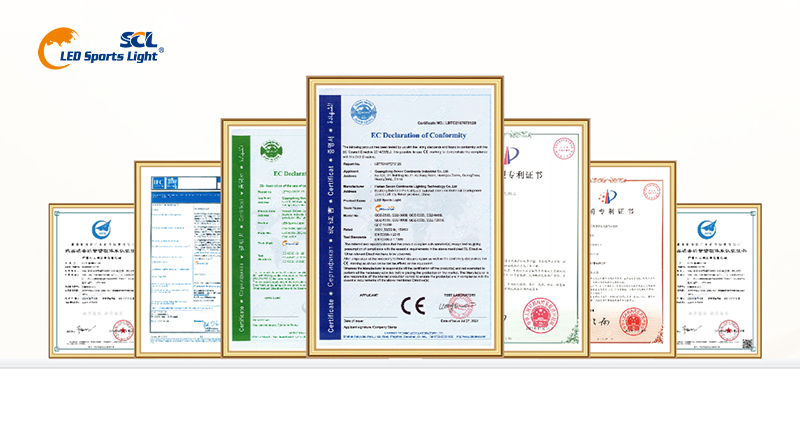
1. Product Certifications and Company Certifications Are Different
One of the first things buyers should understand is that company-level certifications and product-level certifications serve different purposes.
Company management system certifications evaluate how an organization manages processes within a defined scope.
Examples include:
· ISO 9001 – Quality management systems
· ISO 14001 – Environmental management systems
These certifications can help buyers understand whether a manufacturer has established formal management processes for quality and environmental responsibilities.
Product certifications and conformity documents, on the other hand, relate to the product itself, its applicable requirements, and the market where it will be sold or installed.
Depending on the product and destination market, relevant documents may include CE-related conformity documentation, CB documentation, RoHS declarations, electrical safety reports, and other applicable approvals.
A company holding ISO 9001 certification does not automatically mean every luminaire it manufactures has been independently certified. Buyers should review the documents separately.
2. CE, RoHS, and CB: What Should Buyers Understand?
These are some of the documents frequently encountered when purchasing LED sports lighting for international projects.
CE
CE marking relates to applicable European Union product requirements. Depending on the product, relevant legislation may include electrical safety, electromagnetic compatibility, and other applicable requirements.
Buyers should request the applicable Declaration of Conformity and supporting documentation for the specific luminaire model.
Rather than relying only on a CE logo on a product brochure, confirm that the documentation identifies the product and the relevant conformity requirements.
RoHS
RoHS addresses restrictions on certain hazardous substances in electrical and electronic equipment.
For sports lighting procurement, buyers should confirm that the relevant declarations or supporting documentation cover the proposed product and its applicable configuration.
CB Scheme
The IECEE CB Scheme provides an international framework for electrical product safety testing and certification based on applicable IEC standards.
CB documentation may help facilitate certification or approval processes in certain markets, but it does not automatically replace every local approval or project requirement.
The exact scope and applicability should always be checked.
3. IEC 62471: Photobiological Safety
Photobiological safety is an important consideration for high-power LED sports lighting.
IEC 62471 provides a framework for evaluating photobiological hazards associated with lamps and lamp systems, including exposure to optical radiation.
For sports lighting, buyers may request photobiological safety documentation to understand the assessed risk classification and the conditions under which the evaluation was conducted.
This is particularly relevant for high-output luminaires installed in stadiums, sports arenas, and other facilities where lighting equipment may be positioned relatively close to athletes, officials, or spectators.
Buyers should confirm that the documentation corresponds to the actual product being proposed rather than assuming that a report for another model applies.
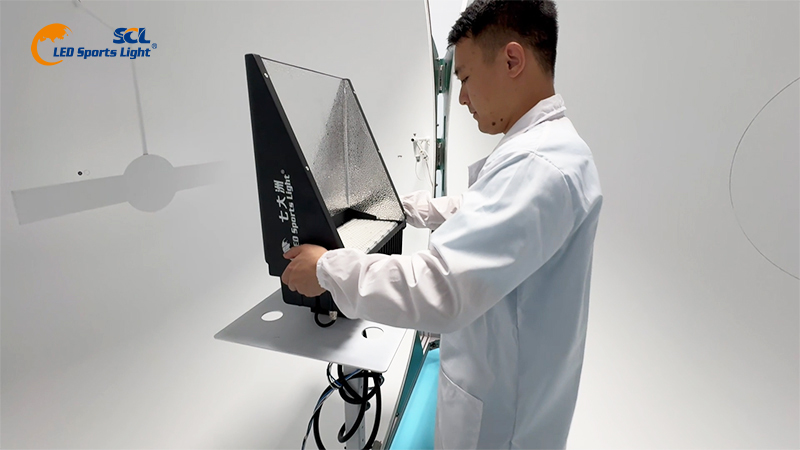
4. IP Ratings: Protection Against Dust and Water
Outdoor sports lighting equipment is exposed to environmental conditions that may include rain, dust, moisture, and temperature variations.
The IP rating classifies the degree of protection provided by an enclosure against the ingress of solid objects and water under defined test conditions.
For example, IP66 and IP67 represent different protection levels and test conditions. They should not be treated as interchangeable simply because both are commonly associated with outdoor equipment.
When evaluating an IP rating, buyers should check:
· The exact IP rating of the proposed luminaire
· The relevant test documentation
· Whether the tested product matches the quoted model
· Installation conditions and sealing requirements
· Whether the rating remains applicable to the proposed configuration
An IP rating is an important equipment specification, but it does not by itself prove overall product quality or long-term reliability.
5. IK Ratings: Mechanical Impact Protection
Sports lighting equipment may be installed in environments where mechanical impact protection is important.
The IK rating classifies the level of protection provided by an enclosure against external mechanical impacts under specified testing conditions.
Buyers should check whether the proposed sports lighting equipment has an appropriate impact protection rating for the installation environment.
This can be especially relevant for indoor sports halls, lower mounting positions, facilities with potential ball impacts, and other environments where equipment may be exposed to mechanical damage.
The required rating should be determined by the project specification and installation conditions.
6. Photometric Reports and Lighting Performance Documents
Certifications alone cannot demonstrate whether a sports lighting system will deliver the required illumination across a playing surface.
For stadium and sports field projects, buyers should also request technical documents related to lighting performance, including:
· Photometric data and IES or LDT files, where available
· Lighting simulation reports
· Horizontal illuminance calculations
· Vertical illuminance calculations where required
· Illuminance uniformity results
· Glare evaluation
· Colour rendering and colour temperature information
· Fixture layout and aiming information
These documents help evaluate whether the proposed lighting equipment and layout can achieve the project requirements.
A luminaire may have valid safety and environmental documentation while still being unsuitable for a particular sports venue because its optical distribution, mounting arrangement, or lighting performance does not meet the project needs.
This is why product compliance and lighting engineering should be evaluated together.
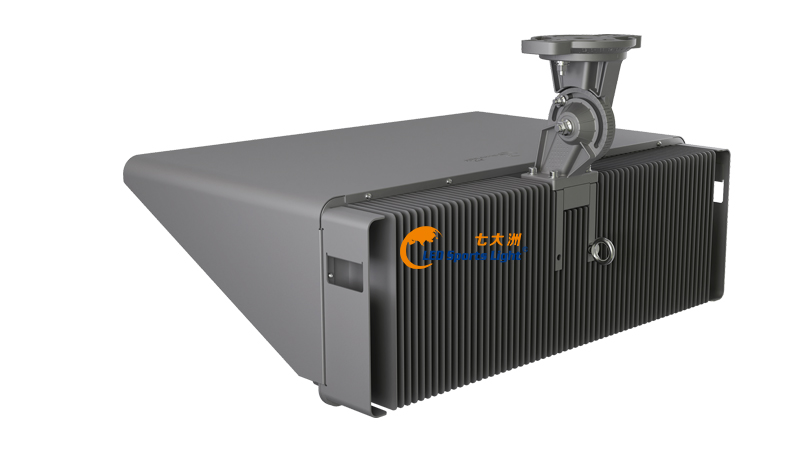
7. What Documents Should Buyers Request Before Ordering?
For international sports lighting projects, it is useful to request a complete technical document package before finalizing the quotation or purchase order.
A practical checklist may include:
Document
What It Helps Verify
Product datasheet
Technical specifications and configuration
Product certificates
Applicable product conformity or certification scope
Declaration of Conformity
Declared compliance with applicable requirements
Test reports
Results of specific tests conducted
IP test documentation
Enclosure protection against ingress
IK test documentation
Mechanical impact protection
Photobiological safety report
Optical radiation safety assessment
Photometric files
Optical performance data
Lighting simulation
Predicted project lighting performance
ISO certificates
Company management system certification
Installation manual
Installation and operating requirements
Warranty documentation
Warranty coverage and conditions
Not every project requires every document listed above. The exact package should be determined by the destination market, project specification, luminaire configuration, and applicable regulations.
8. How to Verify Documents from a Sports Lighting Manufacturer
Receiving a certificate or test report is only the first step. Buyers should also verify whether the documentation is relevant and reliable.
Before approving a supplier, consider the following checks:
1. Confirm the product model
Check that the model number and configuration in the document match the product being quoted.
2. Check the issuing organization
Where applicable, verify the issuing certification body or testing laboratory and its relevant accreditation or recognition.
3. Review the document scope
A certificate may cover specific products, components, configurations, or manufacturing locations. Do not assume it applies to the entire product range.
4. Check the validity and status
Review issue dates, expiry dates where applicable, and whether the certificate remains valid.
5. Compare technical specifications
Ensure that the test configuration, driver, electrical characteristics, and product construction are consistent with the proposed equipment.
6. Ask for clarification when necessary
A professional supplier should be able to explain the purpose and scope of its documents and help buyers identify which documents are relevant to their project.
9. SCL Sports Lighting: Certifications and Technical Documentation
SCL Sports Lighting, operated by Guangdong Seven Continents Industrial Co., Ltd., specializes in sports lighting solutions for professional and recreational sports facilities.
According to company-provided information, its certification and qualification portfolio includes CE, RoHS, CB, CQC, CCC, CEC, CQM, CAQI, C-TICK, IEC 62471-related documentation, as well as ISO 9001 and ISO 14001 management system certifications.
The company also reports having accumulated more than 300 testing reports, certification documents, and qualification certificates.
In addition to product testing and certification, SCL Sports Lighting has participated in drafting national standards related to LED sports lighting applications and outdoor workplace lighting design.
These credentials provide background for buyers evaluating the company’s quality management and technical capabilities. However, certification applicability should always be confirmed against the exact luminaire model, product configuration, market, and project requirements.
For procurement, buyers should request the specific documentation relevant to the proposed products rather than relying only on a general company certification list.
10. Certifications Should Be One Part of Supplier Evaluation
Certifications and test reports are essential for evaluating sports lighting equipment, but they should not be the only factors used to select a supplier.
A complete supplier evaluation should also consider:
· Sports lighting engineering experience
· Product manufacturing capability
· Lighting simulation and design support
· Real project references
· Installation and commissioning assistance
· Warranty and after-sales service
· Product availability and delivery planning
· Communication and technical responsiveness
A supplier with relevant documents, engineering expertise, and practical project experience is better positioned to support the complete lighting project.
Conclusion
When purchasing LED sports lighting, buyers should understand the differences between product certifications, company management certifications, test reports, technical standards, and lighting performance documents.
The most important step is to verify that the documents are genuine, relevant, and applicable to the exact product and project.
For stadium owners, contractors, consultants, and sports facility developers, a structured document review can help reduce procurement risks and improve confidence in the selected sports lighting manufacturer.
When evaluating suppliers such as SCL Sports Lighting, buyers should consider certifications and testing documentation together with engineering capability, manufacturing quality, real project experience, and long-term technical support.
https://www.stadiumlight.com/
GUANGDONG SEVEN CONTINENTS INDUSTRIAL CO., LTD -
AuthorPosts

- You must be logged in to reply to this topic.