- This topic is empty.
-
AuthorPosts
-
2026-11-25 at 5:34 pm #13361

Image Source: https://www.xuxiangtaimetal.com Vague RFQs produce vague pricing. When your requirements stay unclear, fabricators must pad quotes to protect themselves, and that cushion comes out of your budget. As one industry rule puts it:
Suppliers who quote from incomplete data either pad the price to cover risk, or price it low and hit you with change orders once the real requirements surface.
Accurate factory pricing starts with you. A complete request package answers four things up front: what the part does, how you document it, how many you need and when, and what special requirements apply. Even a single gap, such as a TBD finish, adds risk padding or stalls the quote.
Send your CAD drawings, specifications and quantity to Xuxiangtai Machinery to get a formal quotation for custom metal parts.
Key Takeaways
- Define the part’s function and operating conditions clearly to get accurate pricing.
- Provide complete technical documents, including 2D drawings and 3D models, to avoid extra costs.
- Specify quantities, delivery dates, and special requirements upfront to prevent change orders.
Define the Part Before You Request Pricing

Image Source: https://www.xuxiangtaimetal.com A fabricator prices what you describe, not what you intend. Define the part clearly before you send the RFQ, and the quote reflects real requirements instead of assumptions.
State the Part’s Function and Operating Conditions
Tell the fabricator what the part does and where it operates. A pump housing that handles corrosive fluid needs a different material and finish than a bracket that sits indoors. Incomplete information at the RFQ stage makes pricing less precise. When you leave function and operating conditions undefined, quotation and production planning depend on assumptions. Describe the load, temperature, chemical exposure, and duty cycle. This context guides material selection, process choice, and finishing decisions from the start.
Specify Tolerances That Match Real Requirements
Apply standard tolerances as your default, and call out tight tolerances only on critical dimensions such as mating surfaces, bearing fits, and functional interfaces. Tolerance drives cost directly. The table below shows how each step toward tighter tolerance multiplies machining cost.
Tolerance Level Cost Multiplier Primary Cost Drivers ±0.030 in (Rough) 1x (Baseline) Standard machining ±0.005 in (Standard) ~2x Standard CNC controls ±0.001 in (Precision) ~4x Slower feeds, increased inspection, tool wear ±0.0001 in (Ultra-Precision) ~24x Thermal control, specialized metrology, high scrap risk A single tight tolerance adds cost twice: once at production and again at inspection. Relax non-critical features, and the savings accumulate across the run.
Identify Critical Features and Inspection Points
List the features that matter most: mating surfaces, hole positions, threads, and assembly interfaces. Name the inspection points you expect along the process. A typical sequence runs from incoming material review through first article confirmation, in-process checks, final inspection, and export packaging review. State your documentation and inspection requirements early. This clarity lets the fabricator build inspection into the quote instead of adding it later.
Send your CAD drawings, specifications and quantity to Xuxiangtai Machinery to get a formal quotation for custom metal parts.
Provide Complete Technical Documentation
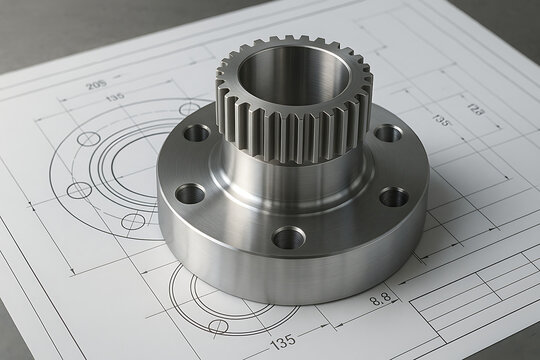
Documentation turns your intent into a priced scope. A fabricator reads your drawings, material callouts, and finish notes to estimate machining time, tooling, inspection, and outside processing. Each document you supply removes one assumption from the quote. Each document you omit adds a contingency line.
Submit Fully Dimensioned 2D Drawings and 3D Models
A 3D model defines geometry. A 2D drawing defines intent. Send both, and the fabricator will rely on the drawing for dimensional checks while the model supplies the core shape. A complete drawing package follows a predictable sequence:
- Define the most important views and place the relevant orthographic views in the center of the drawing, leaving sufficient space between them to add dimensions.
- Add section views or detail views for internal features or areas that are hard to dimension.
- Add construction lines to every view, including centerlines for symmetry planes or axes, center marks, and center mark patterns to locate hole centers or circular patterns.
- Add dimensions, starting with the most important features first.
- Specify the location, size, and length of all threads.
- Add tolerances for features that require higher accuracy than the standard. ISO 2768 medium or fine applies to metals, and medium applies to plastics.
- Complete the title block and list any nonstandard requirements, such as surface finish or deburring, in the notes. Export the drawing as a PDF and attach it to your quote request.
Dimension your model with the same discipline. Place overall dimensions first to define the part envelope. Add the most critical functional dimensions next, such as the distance between key holes. Dimension secondary features after the critical ones, and dimension from the same baseline or datum where possible to reduce cumulative error. Put each dimension on the view that best shows the feature. For repeated features, dimension one instance and call out the quantity, for example 2x for two identical counterbored holes.
Threads need standard designations, not diameter dimensions. Write M4x0.7 rather than a measured diameter. Provide detailed thread callouts for pilot hole sizes, thread lengths, and any special requirements. Add a cosmetic thread to your 3D CAD files instead of a modeled thread. Modeled threads add geometry the fabricator cannot machine as drawn and slow the review.
Tolerances belong on the drawing only when they must be tighter than the standard. Common formats include bilateral tolerances such as ±0.1 mm, unilateral tolerances, and engineering fit tolerances such as 6H. Use geometric dimensioning and tolerancing (GD&T) for more precise control. A standard drawing includes a title block, orthographic views, section views, an isometric view, coordinate data, all requirements, and any additional notes. Drawings using ASME standards use third angle projection. Drawings using ISO or DIN standards use first angle projection. State your standard so the fabricator reads the views correctly.
Specify Material Grade and Stock Form
Material is often the largest single line item in a fabrication quote. The grade, the stock form, and the scrap generated during cutting all move the number. A36 mild steel is generally the most economical structural option. 304 stainless costs roughly three to four times more per pound, and its higher hardness means slower cutting speeds and more tool wear. Aluminum alloys like 5052 or 6061 are lighter but cost more per pound than mild steel, and reflective aluminum surfaces require specific laser parameters to cut cleanly. Titanium parts typically cost two to four times more than equivalent aluminum parts because titanium demands slower machining speeds, higher tool wear, and careful thermal control.
Stock form and size drive material utilization and removal volume. Thickness drives both material cost and process time. Thicker plate costs more per pound and takes longer to cut, especially on laser and waterjet. Nesting efficiency matters more than most buyers expect. Irregular profiles with large negative spaces can run 30 to 40 percent scrap rates, and that material cost does not disappear. A part that nests efficiently on a standard sheet leaves less scrap and costs less per piece than a complex profile that generates significant offcuts.
Material Factor Possible Cost Impact What You Should Confirm Raw stock form and size Material utilization and removal volume Required blank condition and available stock size Hardness and strength Cutting speed, tool wear and cycle time Material condition before and after heat treatment Dimensional stability Machining allowances and corrective operations Critical dimensions and treatment sequence Traceability Documentation and material control Required certificates and inspection records Compare material choices by total manufacturing cost, not raw material price alone. A material that machines slowly, causes rapid tool wear, or requires additional heat treatment may create a higher total manufacturing cost than a cheaper grade. Specify the grade, the initial condition, the heat treatment, and the traceability requirements clearly. Fabricators buy raw material at market price, and steel prices fluctuate. Quotes typically reflect current material cost at the time of order, so confirm the validity window on your quote.
Detail Finishes, Coatings, and Treatments
Finish specifications belong in the RFQ, not in a follow-up email. The finish choice affects price through the plated metal type, layer thickness, color requirements, and surface preparation. Electroplating deposits a metal film via electrolysis, and price tracks the plated metal. Chrome plating is relatively high-priced because chromium is expensive and the process requires strict control of current density and plating time. Nickel plating is generally lower than chrome plating but still adds cost. Gold plating is extremely high cost due to the price of gold.
Anodizing, mainly for aluminum and its alloys, relates to anodized layer thickness and color requirements. Thicker layers need longer processing time and more chemicals. Special colors require additional coloring agents and more complex steps. Painting cost depends on paint type and the number of layers. Automotive-grade paints are more expensive, and special metallic or textured finishes require more complex techniques and materials. Powder coating cost relates to powder type, such as epoxy, polyester, or hybrid, and process complexity such as pre-treatment for adhesion. Masking certain areas or applying multiple different treatments to different areas adds labor, materials, equipment, and process-control cost. Surface preparation requirements, such as degreasing, pickling, or polishing for electroplating, and roughening or chemical treatment for powder coating, add to cost.
The price gap is real. A raw aluminum part that costs $27 costs $43 with a powder coat finish. Powder coating offers better long-term durability and a cleaner finish, and the quote should show that difference as a line item.
Finish Description / Thickness Standards Standard Cleaned and deburred; no surface finishes applied N/A Type II Anodize Increased corrosion resistance; base for paint; thickness .0002″-.0012″ MIL-A-8625/MIL-PRF-8625 Type II, Class 1 (non-dyed) or Class 2 (color-dyed) Color Anodizing Dyes affect surface color; cannot match Pantone/RAL; may bleach or fade under prolonged direct sunlight N/A Type III Hardcoat Anodize Thicker, more durable, wear-resistant; thickness generally 0.002″ MIL-A-8625/MIL-PRF-8625, Type III, Class 1/2 Chromate Conversion (Chem-Film) Enhances corrosion resistance and conductivity; base for paint; thickness about 0.00001″-0.00004″ MIL-DTL-5541, TYPE I/II CLASS 1A or CLASS 3 Powder Coating Continuous, protective color finish; heat-cured paint; thickness usually .006″-.012″ ASTM D7803 and various MIL and FDE specifications Black Oxide Conversion coating for ferrous materials; reduces reflection/glare; some corrosion resistance without affecting dimensions N/A Electropolishing Cleans steel parts; reduces corrosion, improves appearance; removes about 0.0001″-0.0025″ of metal ASTM B912-02 Heat Treatment Improved material properties; includes annealing and other heat treatments ASTM B917 (aluminum alloys) or AMS-H-6875 / AMS 2759 (steels) Passivation Colorless coating improving corrosion resistance for 200 and 300 series and precipitation hardened corrosion-resistant steels; thickness about .0000001″ ASTM A967, AMS-QQ-P-35, MIL-STD-171, ASTM A380, or AMS 2700 Electroless Nickel Plating Uniform nickel coating; protection from corrosion, oxidation, wear on irregular surfaces; thickness starts at .0001″ ASTM-B733, TYPE IV, SC1, CLASS 1 (default), or AMS-2404 Name the standard on the drawing, not just the finish name. Write “Type II Anodize, Class 2, black, MIL-A-8625” instead of “black anodize.” A standard callout tells the fabricator the thickness range, the class, and the inspection criteria. That specificity removes the risk padding a vague finish note attracts.
Send your CAD drawings, specifications and quantity to Xuxiangtai Machinery to get a formal quotation for custom metal parts.
Specify Quantities, Timing, and Special Requirements
Quantity and timing turn a part description into a production plan. A fabricator prices setup, material buying, tooling, inspection, and scheduling against the volume and release pattern you provide. Leave those blank, and the quote carries a contingency for every unknown. Give the fabricator a realistic picture, and the pricing tightens around your actual plan.
Give Annual Volumes and Order Release Schedules
Quantity touches nearly every cost line in a metal parts quote: material purchasing, nesting, setup allocation, tooling, inspection sampling, production method, packaging, and scheduling. Per-piece cost often drops as repeat quantity rises, but that relationship is not automatic. It can shift at material, handling, finishing, or capacity breakpoints.
Fixed costs drive much of the early pricing. Setup, programming, first-article inspection, and process qualification are largely fixed per part number. Split those costs over 200 units, and they dominate the unit price. Split them over 20,000 units, and they become a rounding error. A typical low-volume sheet metal part might see 30 to 50 percent of its unit cost tied to fixed activities. A steady mid-volume part can drop that share below 15 percent.
Price breaks are not arbitrary discount tables. Each tier usually marks a real process shift. Material may move from service-center stock to a mill-direct buy. A soft fixture may be worth hardening into dedicated tooling. Fewer changeovers lower labor per unit. Inspection may move from 100 percent to sampling on stable features. Doubling annual volume rarely halves the unit price, because variable costs such as material weight, cut length, weld length, and finish area do not scale down the same way fixed costs do.
Release frequency matters as much as the annual total. You can order the same annual volume as twelve monthly releases or two large campaigns. Monthly releases favor repeatable setups and steady labor loading. Campaign runs favor higher material utilization and fewer changeovers, but they demand warehouse space and cash. The annual figure alone is not enough. The supplier also needs to know how you plan to pull the quantity.
Tooling strategy follows volume. Soft tooling covers standard punches, universal press-brake tooling, modular fixtures, and CNC-programmed operations. It keeps non-recurring engineering (NRE) low and suits prototype through low-to-mid volumes, often the practical route below a few thousand units per year for simple brackets. Hard tooling covers dedicated form tools, progressive or compound dies, dedicated check fixtures, and hard automation. It raises NRE and lead time but cuts cycle time and stabilizes quality once volume is high enough to repay the investment. For many sheet metal families, that crossover sits in the mid-thousands to low tens of thousands of units per year, depending on part complexity and secondary operations.
Plan changes deserve a written note. Orders above forecast may consume capacity reserved for other programs, trigger material shortages, or require a tooling upgrade that was never priced. Expect longer lead times or a price revision until you agree on a new baseline. Orders below firm can strand mill commitments, leave dedicated fixtures under-amortized, and move you back into higher unit-price tiers. Some suppliers will re-quote the remaining releases at the soft-tooling rate. Volume shifted mid-year is often manageable if the annual total still holds and you renegotiate the release rhythm. Volume collapse or a process change is not. Send a short written note whenever the plan moves more than about 15 to 20 percent from the quoted basis.
A well-formed volume statement reads like this: firm 4,000 units per year for two years, forecast additional 2,000 to 3,000, monthly releases of 300 to 400, tolerance on annual total plus or minus 15 percent. That single sentence tells the fabricator how to buy material, how to allocate setup, and which tooling tier to price.
Share Target Delivery Dates and Delivery Location
Delivery timing shapes the production schedule and the price. A realistic target date lets the fabricator slot your job into existing capacity. A compressed date forces overtime, expedited material, or premium freight, and each of those lands on your quote.
State your required delivery date, not a vague window. “As soon as possible” gives the planner nothing to work with. A specific date, such as “dock date March 14,” lets the fabricator work backward through material lead time, machining, finishing, and inspection. If your date is flexible, say so and give the range. Flexibility is a negotiating asset, and fabricators often price a flexible schedule lower than a fixed one.
Delivery location affects freight, packaging, and documentation. A domestic dock shipment needs less handling than an export container. International shipments add export packaging, customs paperwork, and longer transit buffers. Tell the fabricator the destination city and country, the shipping terms you expect, and any packaging requirements. A part that ships to a coastal humid climate may need extra corrosion protection in transit. A part that ships to a high-altitude site may need different cushioning.
Combine the date and the location in your RFQ. A clear statement such as “1,200 units delivered to our Chicago plant by June 30, standard export packaging” removes two assumptions at once. The fabricator can then price freight, packaging, and scheduling against real conditions instead of padding for the unknown.
Disclose Special Requirements Up Front
Special requirements are the details that separate a standard quote from a padded one. Each undisclosed requirement becomes a change order later, and change orders cost more than up-front pricing. Disclose them in the RFQ, and the fabricator builds them into the original number.
Start with testing and compliance. Specify the testing standards you need, such as ASTM or ISO certifications, and name the documents you expect with each shipment. A typical quality pack for a stamped or sheet metal part includes five documents:
- A Mill Test Certificate (MTC) showing chemical composition and mechanical properties
- A Dimensional Inspection Report with Cp and Cpk values for critical features
- A Process Control Log recording press tonnage, die temperature, and cycle count
- A Coating or Plating Thickness Report for any protective finish
- An 8D Corrective Action Plan if first-article inspection flags any deviation
Ask for a sample of the supplier’s MTC and dimensional report before you place a purchase order. A supplier with a formal system can produce a past example. Ask for a recent third-party audit summary if the supplier holds ISO 9001 or IATF 16949 certification. Look for findings related to calibration, traceability, and document control. Validate measurement equipment traceability as well. Calibrated instruments must trace to NIST or an equivalent standard, and you can request a calibration certificate for the CMM or micrometers used on your parts. Without traceability, dimensional numbers are not reliable.
Payment terms belong in the RFQ too. Clear financial stipulations foster a smooth transaction and build supplier trust. State your expected terms, such as net 30 or a deposit schedule, so the quote reflects them.
A complete RFQ also includes a project overview, part specifications with diagrams or CAD files, any supplier qualification requirements, a response deadline for the quote, and clear contact information for follow-up questions. Each element removes a question the fabricator would otherwise answer with a contingency line.
Send your CAD drawings, specifications and quantity to Xuxiangtai Machinery to get a formal quotation for custom metal parts.
Accurate factory pricing follows from a complete, specific RFQ package covering function, documentation, quantities, and special requirements. Run this pre-submission checklist before you send:
- Defined function and operating conditions
- Toleranced drawings and 3D models
- Material grade and stock form
- Finish specifications
- Volumes and delivery dates
- Special handling or documentation needs
Clear RFQs shorten quote cycles and reduce back-and-forth before production starts. You get fewer revisions, faster turnaround, and pricing you can budget and award against with confidence. Send your CAD drawings, specifications and quantity to Xuxiangtai Machinery to get a formal quotation for custom metal parts.
FAQ
How much detail does a fabricator need for an accurate quote?
You need function, toleranced drawings, material grade, finish specs, volumes, and delivery dates. Each detail you supply removes a contingency line from the quote.
Can you quote from a 3D model alone?
A model defines geometry but not intent. Send a dimensioned 2D drawing with tolerances, thread callouts, and finish standards alongside the model for defensible pricing.
What happens when your requirements change after quoting?
Disclose changes early and in writing. Undisclosed requirements become change orders, and change orders cost more than up-front pricing built on complete information.
Send your CAD drawings, specifications and quantity to Xuxiangtai Machinery to get a formal quotation for custom metal parts.
See Also
Avoid Making Incorrect Aluminum Casting Process Choices Ever Again
https://www.xuxiangtaimetal.com
Qingdao Xuxiangtai Machinery -
AuthorPosts

- You must be logged in to reply to this topic.