- This topic is empty.
-
AuthorPosts
-
2026-09-18 at 2:06 pm #11458
A stranded EV on the roadside needs power immediately, not after a charging unit establishes a grid or generator connection. This is the core requirement that separates roadside emergency charging from almost every other mobile charging use case: the unit itself must already hold a usable charge, be quick to position at the vehicle, and deliver a fast enough DC output that the driver is back on the road in minutes rather than waiting through a lengthy top-up.
Why a Pre-Charged Battery Reserve Matters Most Here
MPMC’s BCH Series stores energy in an onboard battery pack that has already been charged from grid, genset, solar, or another source before it is ever needed at the roadside, meaning it can deliver DC power to a stranded vehicle immediately on arrival rather than needing to establish a new power connection at the incident location. This pre-charged reserve is the single feature that makes a BCH unit meaningfully different from a generator-based emergency response, which needs to start and stabilise before it can deliver clean power to a sensitive EV battery.
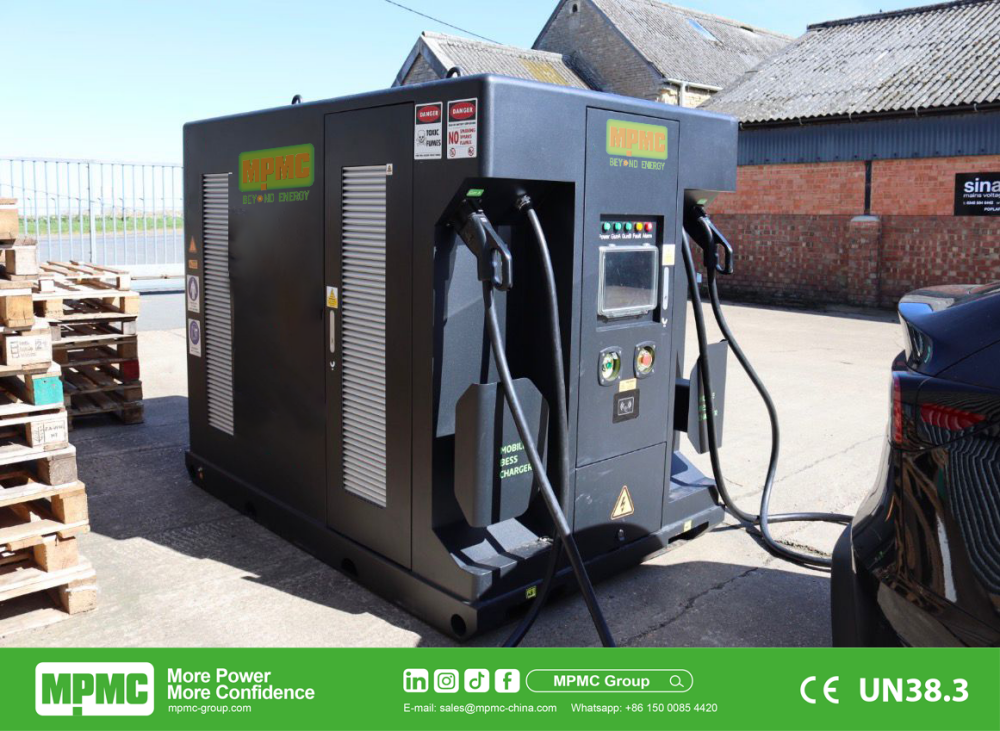
MPMC BCH mobile BESS charger delivering DC power directly to a vehicle via charging cable.
Fast DC Output for Getting a Vehicle Back on the Road Quickly
For a roadside emergency scenario, the goal is usually a partial charge sufficient to reach the nearest proper charging point, not a full charge from empty, which makes a high DC output more valuable than a large total storage capacity. MPMC’s BCH-275-200 delivers up to 150 kW DC output through two CCS2 250A guns, capable of adding meaningful range in a short window, while the response vehicle carrying the unit only needs to carry enough total battery capacity to handle a realistic number of roadside calls between its own recharge cycles.
Beyond the standard CCS2 connector, MPMC’s BCH-275-200-and-above models offer optional CCS1, GB/T, or CHAdeMO connectors, which matters for a roadside operator whose coverage area includes a mix of vehicle standards rather than a single connector type. A response fleet standardising on a connector type that does not match a meaningful share of the vehicles it is called out to would undermine the speed advantage the pre-charged reserve is otherwise providing.
Parameter
Specification
DC output
Up to 150 kW
Standard connector
2× CCS2 250A
Optional connectors
CCS1, GB/T, CHAdeMO
Recharge options
AC (grid/genset/solar) or CCS2 DC input
Billing
Optional RFID, cloud-ready EMS API
Coverage Without Fixed Infrastructure Along the Route
Roadside assistance, by definition, has to cover locations with no charging infrastructure at all, often far from the nearest fixed charging point. MPMC’s BCH units require no permanent grid infrastructure and can recharge via AC input from grid, genset or solar, or via CCS2 DC input from an existing fast-charging station, giving a roadside assistance operator flexibility in how the response unit itself gets topped back up between calls, wherever its home base happens to sit relative to the charging network.
OCPP 1.6 support on the BCH-275-200-and-above models also allows a roadside assistance operator to fold the response unit’s charging data into a broader network management platform, which is useful for an operator that already manages a wider fleet of fixed and mobile charging assets under a single system rather than treating roadside response as a separate, disconnected operation.
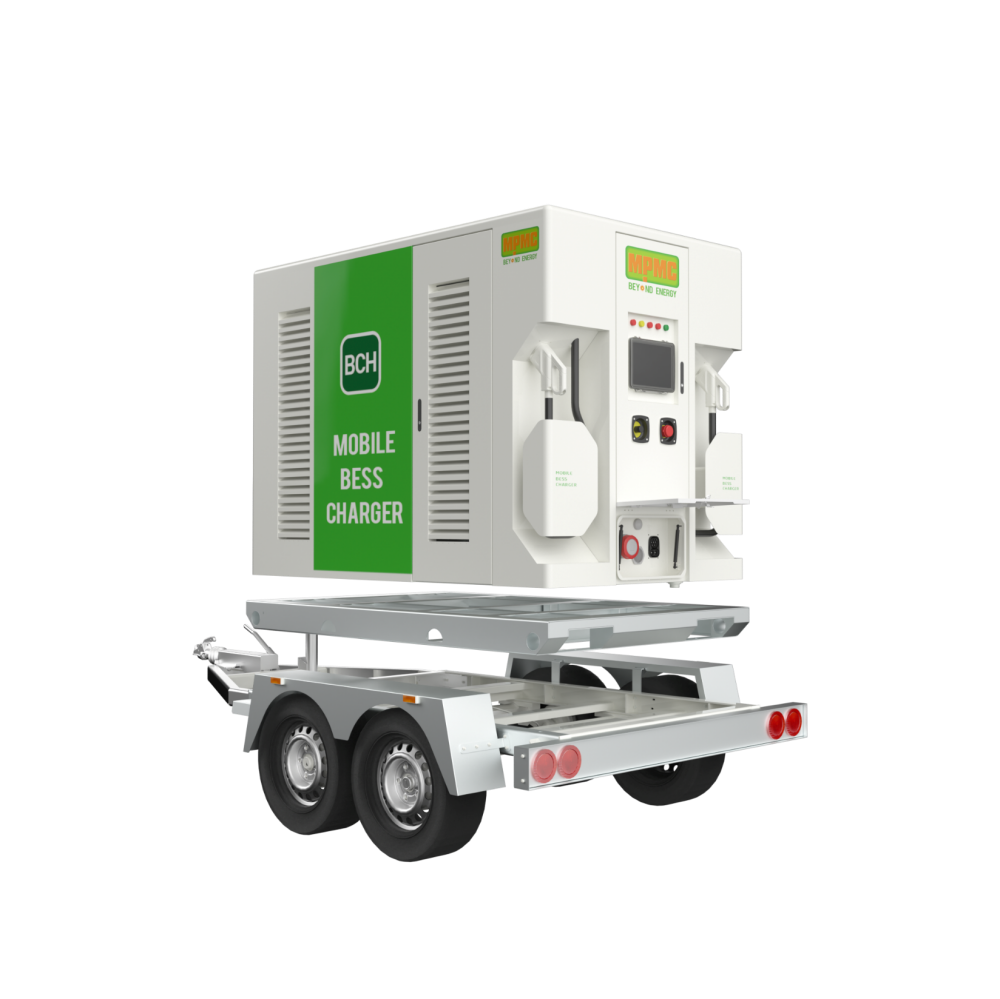
MPMC trailer-mounted mobile BESS charger, built for rapid positioning at a roadside charging call.
Billing and Coordination for a Roadside Service Model
A roadside emergency charging service typically needs to bill per call or per session rather than operating as a free public utility, and MPMC’s BCH-275-200-and-above models support optional RFID payment integration, alongside a cloud-ready EMS API for connecting into a roadside assistance operator’s existing dispatch and billing systems. This integration is what allows a roadside charging service to operate as a genuine commercial offering rather than a manually invoiced, ad hoc arrangement.
The same remote monitoring capability that supports billing also gives a dispatch centre visibility into each response unit’s remaining charge before it is sent to a call, which matters operationally: dispatching a unit that does not have enough remaining reserve to complete the job wastes both the response time and the stranded driver’s wait. Building that state-of-charge check into the dispatch workflow, rather than relying on the crew’s own estimate, is a detail worth confirming with any supplier before committing a fleet of units to a live roadside programme.
Specifying a Mobile Charger for Roadside Emergency Response
• Confirm the unit’s DC output is sufficient to add a meaningful range top-up within a realistic roadside dwell time
• Ask how the response unit itself gets recharged between calls, and how many calls its total capacity can realistically support
• Confirm the connector standard (CCS2, with optional CCS1, GB/T or CHAdeMO) matches the vehicle types the service actually needs to cover
• Check whether RFID or API-based billing integration is available for a commercial roadside service model
• Confirm the unit’s weight and mounting allow it to be carried or towed by the response vehicle actually being used
• Request a documented reference from a comparable emergency or rapid-response mobile charging deployment
https://www.mpmc-group.com/
MPMC Powertech Corp. -
AuthorPosts

- You must be logged in to reply to this topic.