- This topic is empty.
-
AuthorPosts
-
2026-07-10 at 3:35 pm #9266
As manufacturing industries continue to pursue higher precision, faster production, and greater flexibility, tube processing technology is evolving rapidly. Components used in automotive systems, HVAC equipment, medical devices, sanitary fittings, and household appliances all require accurately formed tube ends to ensure reliable assembly and long-term performance.
While laser cutting, CNC bending, and robotic welding often receive the most attention, tube end forming is equally important. The quality of the final connection often depends on how precisely the tube end has been expanded, reduced, flanged, or shaped.
Among the available solutions, vertical tube end forming machines have become an increasingly popular choice for manufacturers looking to improve efficiency while maintaining consistent product quality.
Why Tube End Forming Matters
Tube end forming is far more than a finishing process. It directly affects how components fit together, seal under pressure, and perform throughout their service life.
Poorly formed tube ends can lead to:
-
Assembly difficulties
-
Leakage in fluid or gas systems
-
Reduced structural strength
-
Increased rejection rates
-
Higher maintenance costs
As product tolerances become tighter, manufacturers need equipment capable of producing highly repeatable results across thousands of parts.
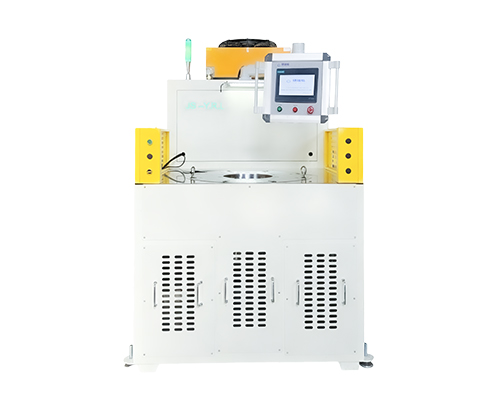
Advantages of Vertical Machine Design
Compared with conventional horizontal equipment, vertical tube end forming machines offer several practical advantages.
Better Space Utilization
Floor space is valuable in every production facility. A vertical machine occupies a smaller footprint, making it easier to integrate into existing production layouts without sacrificing workflow.
More Stable Tube Positioning
The vertical configuration allows gravity to assist with material positioning, helping maintain alignment during the forming process. This improves dimensional consistency while reducing the possibility of deformation.
Consistent Forming Performance
Because force is applied in a more controlled manner, vertical machines often provide better repeatability, particularly when processing thin-wall or small-diameter tubes.
Automation Compatibility
Many manufacturers are gradually introducing robotic loading, automatic conveyors, and intelligent production management systems. Vertical equipment is generally easier to integrate into these automated production lines, making it a practical long-term investment.
Precision Is No Longer Optional
Today's manufacturing standards leave very little room for error.
Whether producing automotive fuel lines or medical tubing, even small dimensional deviations can affect assembly quality and product reliability.
Modern tube end forming systems are designed to deliver:
-
High dimensional accuracy
-
Stable cycle times
-
Excellent repeatability
-
Consistent forming quality over long production runs
This level of precision helps reduce scrap rates while ensuring every component meets customer specifications.
Multi-Function Processing Increases Flexibility
Production requirements continue to diversify. Instead of operating multiple dedicated machines, many manufacturers now prefer equipment capable of performing several forming operations on a single platform.
Typical processes include:
-
Tube expanding
-
Tube reducing
-
Flanging
-
Press fitting
-
Multi-stage or dual-station forming
Combining multiple operations into one machine reduces handling time, minimizes production interruptions, and simplifies equipment management.
Higher Productivity Through Dual-Station Operation
Production efficiency remains a key competitive advantage.
Dual-station tube end forming machines allow one workpiece to be processed while another is being loaded or unloaded. This parallel workflow significantly reduces idle time and increases hourly output.
For manufacturers producing medium- or high-volume orders, this improvement can make a noticeable difference in overall production capacity.
Surface Quality Is Just as Important
Precision is not only about dimensions. Surface quality also plays an important role, especially for components used in fluid transfer systems or visible assemblies.
Well-designed forming equipment helps achieve:
-
Smooth internal and external surfaces
-
Minimal tooling marks
-
Controlled material flow
-
Reduced risk of cracks or excessive stress
Better surface quality also reduces secondary finishing operations, saving both time and labor.
Supporting Flexible Manufacturing
Today's factories frequently switch between different product sizes and customer requirements.
Quick tooling replacement has therefore become an important feature of modern tube end forming equipment.
Fast mold changeovers allow manufacturers to:
-
Reduce downtime between production batches
-
Respond quickly to customized orders
-
Improve overall equipment utilization
-
Support small-batch manufacturing without sacrificing efficiency
This flexibility is becoming increasingly valuable as demand for customized products continues to grow.
Preparing for Smart Manufacturing
Industrial automation continues to reshape metal fabrication.
Equipment that supports robotic loading, conveyor integration, and centralized production monitoring can be more easily incorporated into future smart factory initiatives.
Rather than replacing equipment after only a few years, manufacturers are increasingly looking for machines that can grow alongside their automation strategies.
Choosing the Right Equipment
When evaluating a tube end forming machine, manufacturers should consider more than maximum forming force or production speed.
Other important factors include:
-
Forming accuracy
-
Equipment stability
-
Tool durability
-
Ease of maintenance
-
Automation compatibility
-
Changeover efficiency
-
Technical support and customization capability
Selecting equipment based on long-term production requirements often delivers greater value than focusing solely on initial purchase cost.
Industry Experience Makes a Difference
As tube forming applications continue to expand, equipment suppliers also play an increasingly important role in production success.
Companies such as Yan Ruilin have focused on tube end forming technology for many years, developing customized tooling solutions and machine platforms for a wide range of industrial applications. Beyond supplying equipment, experienced manufacturers can help optimize forming processes, improve production efficiency, and address application-specific challenges.
Final Thoughts
Vertical tube end forming machines have become an important part of modern manufacturing because they combine precision, efficiency, flexibility, and automation readiness in a compact solution.
As manufacturers face increasing pressure to improve product quality while reducing production costs, investing in advanced tube end forming technology is becoming less of an option and more of a necessity.
For companies seeking stable, repeatable, and scalable tube processing, vertical tube end forming systems provide a practical path toward higher productivity and long-term manufacturing competitiveness.
http://www.tubeendforming.com
Your Trusted Partner -
-
AuthorPosts

- You must be logged in to reply to this topic.