- This topic is empty.
-
AuthorPosts
-
2026-10-09 at 12:26 pm #11870
Understanding Belt Rip Risk in Continuous-Material-Handling Systems
Longitudinal belt tearing is one of the most costly failure modes in continuous-material-handling operations. Once a belt tear begins, it can expand rapidly along the conveying line, escalating from a localized defect into significant equipment damage, unplanned production stoppage, and in some cases safety incidents. Because long belt conveyors may not stop quickly in an emergency, and manual inspection coverage may not detect abnormalities in time, operators across steel, metallurgy, chemical processing, ports, cement, power generation, and mining increasingly ask a practical question: which rip-detection method actually fits their conveyor?
The answer is not universal. Belt rip-detection methods are selected based on the physical and operating characteristics of the conveyor itself. Industry suppliers that understand this—KJT Sensors among them—design belt conveyor protection products as a configurable family rather than a single fixed device, precisely because no two conveyor lines present identical conditions.
Key Belt Characteristics That Shape Rip-Detection Method Selection
Conveyor Width and Length
The physical dimensions of a conveyor directly influence how detection and protection devices are arranged along the line. For example, pull-cord style protection devices such as the KJT-LSTD Conveyor Pull-Cord Switch support conveyor widths of 800 mm, 1,000 mm, 1,200 mm, and above, with typical installation spacing of 30–50 meters per switch. While pull-cord switches address personnel-triggered emergency stops rather than automatic tear detection, the same underlying principle applies to longitudinal belt-tear detectors: installation point density and device placement must correspond to conveyor length and width so that no section of the belt is left unmonitored.
Belt Speed and Material Type
Belt speed and the type of material being conveyed affect how quickly an abnormal condition—such as the early stage of a tear, a blockage, or belt slip—can develop into a larger failure. KJT Sensors’ belt conveyor protection portfolio explicitly accounts for this by allowing devices to be selected according to conveyor speed and material type, alongside mounting location and dust and moisture exposure. A faster-moving belt carrying abrasive bulk material, for instance, requires protection logic that can respond and interlock quickly, which is why longitudinal belt-tear detectors are typically deployed as part of a coordinated protection scheme rather than as a standalone sensor.
Environmental Conditions
Dust, moisture, corrosive atmospheres, and temperature extremes are among the most decisive factors in method and equipment selection. KJT Sensors offers optional IP65/IP67 ratings along with explosion-proof, anti-corrosion, high-temperature, and low-temperature configurations to support demanding industrial environments. These environmental configurations matter because a detection device that performs reliably in a dry, climate-controlled facility may not hold up in a humid port terminal, a dust-heavy cement plant, or an underground mining transport line. Switch form, mounting method, and IP rating are therefore confirmed according to the specific model and site conditions—not assumed in advance.
Control-System Interface Requirements
The final characteristic that shapes rip-detection method selection is how the conveyor’s existing control infrastructure is built. Contact outputs from belt conveyor protection devices need to connect to conveyor control circuits, emergency stop circuits, PLC systems, audible and visual alarms, and remote alarm systems. A conveyor line with an established PLC-based alarm network will favor detection and interlock configurations that integrate smoothly with that system, while a line with simpler control architecture may require a different wiring and alarm-output approach.
How KJT Sensors Approaches Longitudinal Belt-Tear Detection
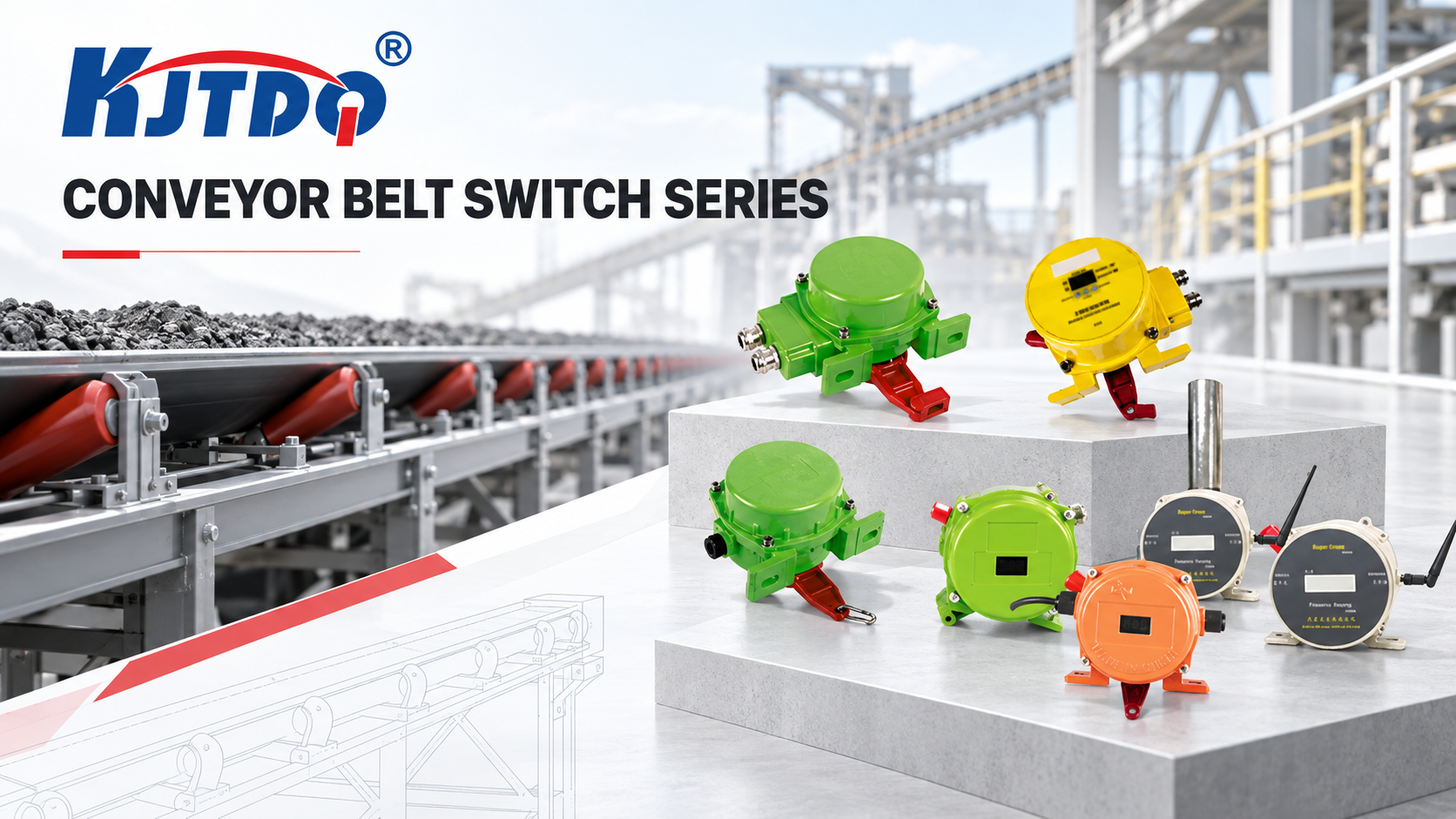
Within its broader belt conveyor sensor and protection product family, KJT Sensors includes longitudinal belt-tear detectors specifically designed to detect longitudinal belt damage and reduce losses from tear expansion. This device sits alongside belt misalignment switches, pull-cord and double-pull-cord switches, belt slip detectors, chute-blockage switches, material-level and material-flow switches, tilt switches, address encoders, and audible and visual alarms—covering belt misalignment, emergency stop, slip, blockage, belt tearing, material flow, and alarm functions in a single product family.
This structure reflects a core principle in belt conveyor protection: longitudinal tearing rarely occurs in isolation. It is often connected to, or escalates from, conditions such as belt misalignment, blockage, or abnormal material flow. By offering belt-tear detection as part of an interlocked protection scheme—where abnormal-condition detection can trigger alarms and control actions—KJT Sensors’ approach is designed to help operators detect and handle abnormalities before they escalate into equipment damage or safety incidents, rather than relying on a single sensor type to catch every failure mode.
Integrated Protection: Beyond Rip Detection Alone
Because belt characteristics vary so widely across industries—mining transport, metallurgy and steel, cement and building materials, ports and logistics, chemical and coal chemical processing, and general manufacturing—KJT Sensors’ belt conveyor protection products are built for configurable selection. Selection criteria include conveyor distance, dust and moisture exposure, explosion-protection requirements, belt speed, material type, and control-system interface. This configurability is what allows a single product family to serve applications ranging from open-pit mining transport lines to papermaking, textile, tire manufacturing, oil and gas, and pharmaceutical facilities.
Matching Detection Methods to Project Requirements
In practice, determining the right rip-detection method for a given conveyor is treated as a project-level engineering question rather than a simple product purchase. Individual devices, including longitudinal belt-tear detectors, can be quoted by model and quantity. However, whole-line conveyor protection requires technical confirmation of conveyor line length, point count, control-system interface, and site installation requirements before quotation. This typically involves project review using site photographs, conveyor-layout drawings, control-cabinet interfaces, and existing equipment models, so that conveyor quantity, length, width, installation spacing, number of field points, PLC/alarm connection, and explosion-protection requirements are verified per engineering project.
Conclusion
Belt rip-detection is ultimately governed by the specific combination of conveyor width and length, belt speed and material type, environmental exposure, and control-system architecture present on a given line. There is no single detection method that fits every conveyor. Suppliers such as KJT Sensors address this reality by offering longitudinal belt-tear detectors within a broader, interlocked protection family—supported by optional IP65/IP67, explosion-proof, anti-corrosion, and temperature-resistant configurations—so that detection methods can be matched to actual site conditions rather than forced onto them. For operators evaluating belt protection upgrades, the practical starting point is not choosing a device, but characterizing the conveyor itself.
https://www.kjt-sensors.com/
KJT Sensors -
AuthorPosts

- You must be logged in to reply to this topic.