- This topic is empty.
-
AuthorPosts
-
2026-09-11 at 12:04 pm #11187
Introduction
When an engineering team issues a Request for Quotation (RFQ) or tender for a flow calibration system, the quality of the specification document directly determines the quality of the quotations received. A vague or incomplete specification forces suppliers to guess at test requirements, leading to mismatched proposals, delayed engineering, and costly change orders later in the project.
This guide is written from the perspective of an engineering buyer preparing a technical specification for a liquid or gas flow calibration system — whether for an internal metrology lab, a third-party calibration service, or an OEM production line. It walks through the major specification categories that should appear in any RFQ, explains why each one matters, and clarifies which parameters must be fixed before quotation versus which can be refined during detailed engineering design.
Why a Structured Specification Matters
A flow calibration system is not a standard catalog item. Its design — number of test lines, reference method, uncertainty class, automation level — depends entirely on what the buyer intends to calibrate and to what accuracy. Without a structured specification, two suppliers may quote systems with completely different capabilities for the same nominal request. A well-structured RFQ:
- Reduces ambiguity between competing supplier quotations
- Shortens the technical clarification cycle
- Protects the buyer from under- or over-specified systems
- Creates a documented basis for acceptance testing later
Core Specification Categories
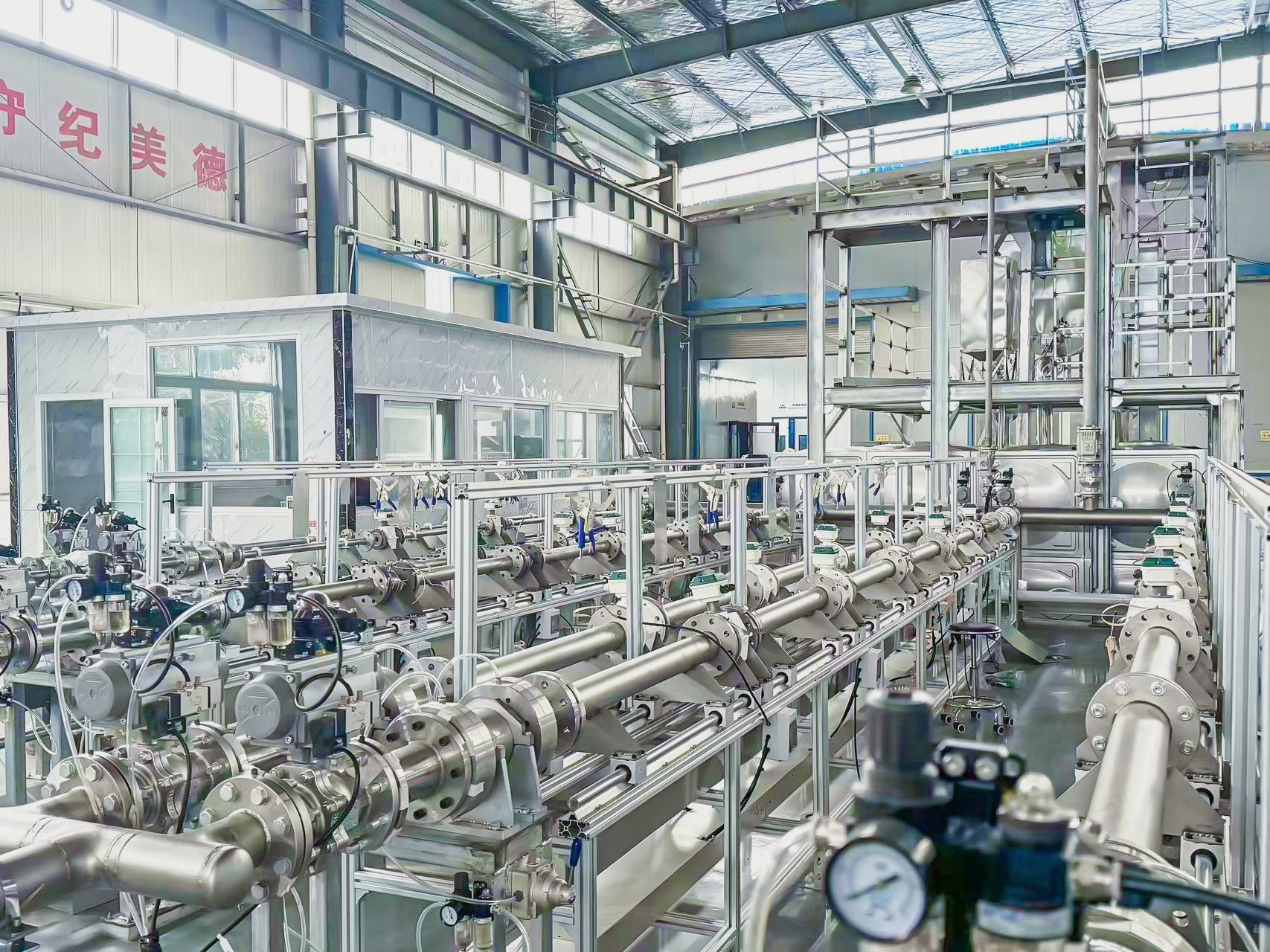
1. Flow Meter Types to Be Tested
State clearly which meter technologies the system must calibrate — for example electromagnetic, turbine, vortex, Coriolis, positive displacement, or gas meters such as Roots or turbine gas meters. Different meter types have different installation requirements, straight-pipe demands, and signal outputs, which directly affect test-line design.
Fix before quotation: Yes — this defines the fundamental architecture of the system (liquid line, gas line, or both).
2. Nominal Diameter Range
Specify the smallest and largest nominal diameters (DN) of meters under test. This determines pipe sizing, flow range, tank or vessel sizing (for static mass systems), and the number of test lines required to cover the full range economically.
Fix before quotation: Yes — diameter range is a primary sizing input.
3. Minimum, Normal and Maximum Test Flow
Provide the flow range for each meter size, expressed as minimum, normal (typical operating), and maximum flow rates. This defines pump/blower sizing, piping velocity limits, and the calibration system’s dynamic range.
Fix before quotation: Yes, at least as target ranges; exact turndown ratios can be refined during design.
4. Calibration Method
Indicate the preferred or required method — for example static mass (gravimetric), master meter (volumetric comparison), or sonic nozzle method for gas. The method affects achievable uncertainty, test duration, and system layout.
Fix before quotation: Yes — method selection is a design-driving decision, though the supplier may propose alternatives for buyer review.
5. Reference Standard
Identify the reference standard to be used (e.g., a weighing/mass reference, a certified master meter, or a critical-flow sonic nozzle bank) and, where applicable, its required traceability chain to a national or international metrology institute.
Fix before quotation: The requirement for traceability should be fixed; the specific reference instrument model can be finalized during engineering.
6. Required Accuracy and Measurement Uncertainty
State the target measurement uncertainty (e.g., expressed as a percentage) expected from the calibration system, and the accuracy class the system must be able to verify. This is one of the most commercially significant parameters, as uncertainty requirements strongly influence system cost.
Fix before quotation: Yes — this is a non-negotiable performance requirement.
7. Flow Stability and Repeatability Requirements
Specify tolerances for flow stability during a test run and repeatability between repeated tests at the same set point. Unstable flow or poor repeatability undermines the validity of any calibration result, regardless of reference accuracy.
Fix before quotation: Target values should be fixed; the specific control strategy (e.g., pump/VFD control, PID loop tuning) is an engineering design matter.
8. Test Medium
Clarify whether the system must handle water, a specific process liquid, or gas (air, nitrogen, natural gas, etc.), including any relevant fluid properties such as viscosity, conductivity, or corrosiveness.
Fix before quotation: Yes — medium selection affects materials of construction, sensor selection, and safety design.
9. Temperature and Pressure Measurement (Where Applicable)
Where test conditions must be corrected for temperature or pressure effects (common in gas calibration and precise liquid calibration), specify the required measurement points, ranges, and expected control tolerances.
Fix before quotation: The requirement itself should be fixed; instrument placement and control loop design belong to engineering.
10. Number of Test Lines or Stations
Define how many parallel test lines or stations are needed, based on throughput requirements and the diameter/flow range to be covered. This has a direct and significant impact on capital cost and floor space.
Fix before quotation: Yes — this is a capacity decision the buyer must make, informed by supplier input on line-to-range allocation.
11. Data Acquisition and Reporting
Describe requirements for data acquisition — sampling rate, signal types to be captured, and whether raw data must be retained for audit purposes.
Finalize during design: The buyer should state the requirement; the supplier’s PLC/industrial PC architecture and software implementation are engineering deliverables.
12. Automation Requirements
State the desired degree of automation, e.g., automated set-point control, automatic data logging, and automated pass/fail evaluation, versus manual/semi-automated operation.
Fix before quotation: The automation level materially affects cost and should be indicated up front, with implementation details refined later.
13. Calibration Report Requirements
Specify what the calibration report must contain — test conditions, measured error curves, uncertainty statement, reference traceability, and signatures — and whether reports must comply with a particular format or regulatory template.
Finalize during design: Content requirements should be fixed early; the exact report template can be developed with the supplier.
14. Installation and Utility Requirements
List available site utilities (electrical supply, water supply/drainage, compressed air, floor loading, ambient temperature control) and any space constraints, since these directly affect system design and may require site-specific engineering.
Finalize during design: The buyer provides site constraints; the supplier proposes a compliant layout.
15. Applicable Standards or Metrological Requirements
Reference any national or international standards, metrological regulations, or accreditation requirements (e.g., quality management, environmental, or safety management system compliance, and applicable explosion-proof requirements where hazardous areas are involved) that the system and its documentation must satisfy.
Fix before quotation: Yes — compliance requirements are a fixed constraint that shapes design choices from the outset.
Summary Table: Fix Before Quotation vs. Finalize During Design
| Category | Fix Before Quotation | Refine During Engineering Design |
|—|—|—|
| Meter types to be tested | Yes | Interface details |
| Diameter range | Yes | Line allocation |
| Flow range (min/normal/max) | Target values | Exact turndown ratios |
| Calibration method | Yes | Layout/implementation |
| Reference standard | Traceability requirement | Specific instrument model |
| Accuracy/uncertainty target | Yes | Verification methodology |
| Stability/repeatability | Target tolerances | Control strategy |
| Test medium | Yes | Materials selection details |
| Temperature/pressure measurement | Requirement | Instrument placement |
| Number of test lines/stations | Yes | Internal arrangement |
| Data acquisition/reporting | Requirement | Software architecture |
| Automation level | Yes | Implementation details |
| Calibration report content | Yes | Template format |
| Installation/utilities | Site data provided by buyer | System layout by supplier |
| Applicable standards | Yes | Documentation package |Practical RFQ Checklist for Buyers
Use the checklist below as a starting point when preparing a specification package to send to calibration-system manufacturers:
- [ ] List of meter types and technologies to be calibrated
- [ ] Nominal diameter range (min–max)
- [ ] Flow range per meter size (minimum, normal, maximum)
- [ ] Preferred or required calibration method
- [ ] Reference standard and traceability requirement
- [ ] Target measurement uncertainty and accuracy class
- [ ] Flow stability and repeatability tolerances
- [ ] Test medium and relevant fluid properties
- [ ] Temperature and pressure measurement/correction needs
- [ ] Required number of test lines/stations
- [ ] Data acquisition and record-keeping requirements
- [ ] Desired automation level
- [ ] Calibration report content and format expectations
- [ ] Available utilities and site/space constraints
- [ ] Applicable standards, certifications, or metrological requirements
- [ ] Delivery timeline and installation/commissioning expectations
Sourcing Customized Calibration Systems
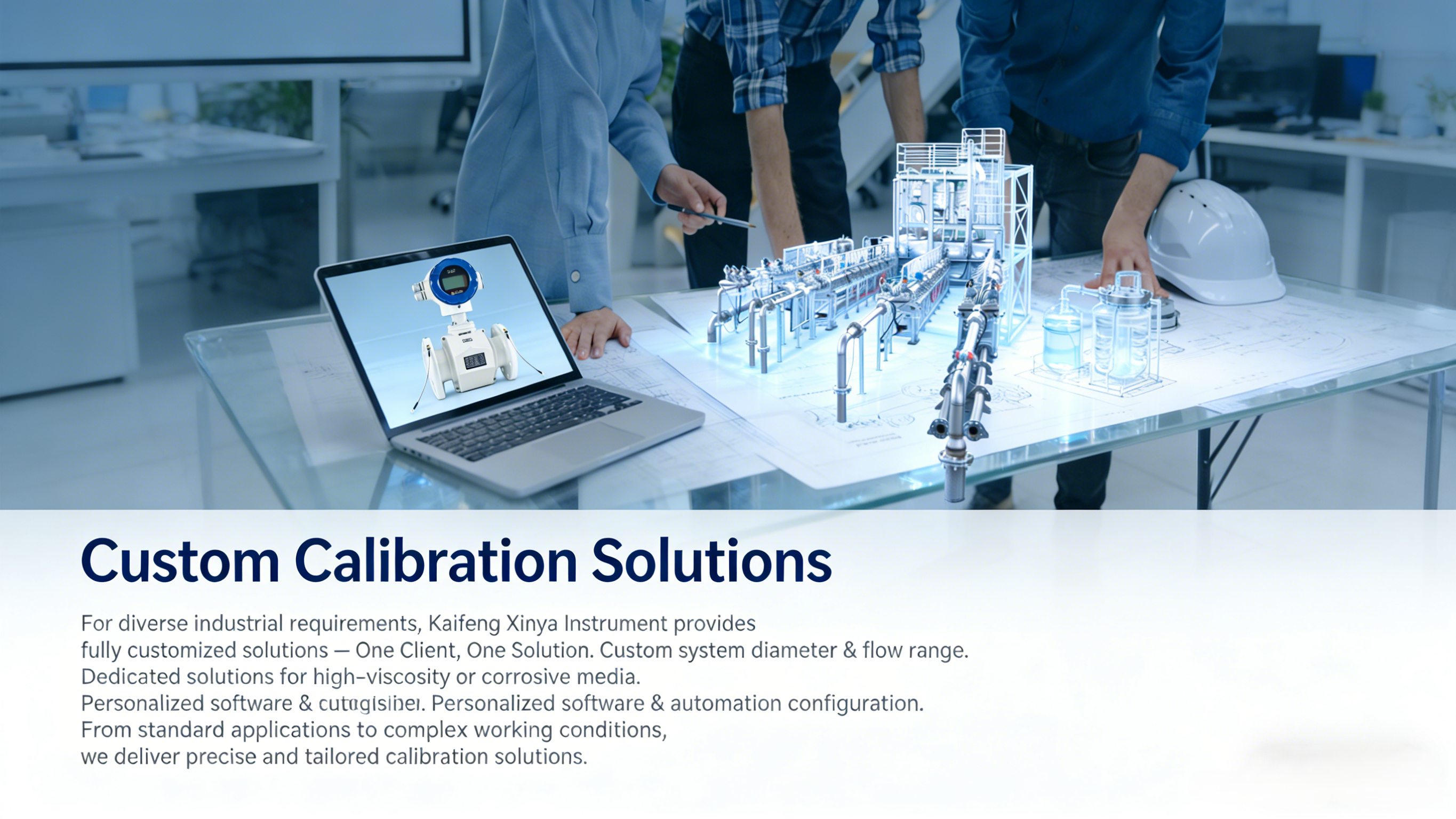
Because flow calibration systems are largely engineered-to-order rather than off-the-shelf products, buyers benefit from working with manufacturers who can configure a system around a defined test scope rather than offering a single fixed product line. Kaifeng Xinya Instrument Co., Ltd., an industrial instrumentation manufacturer, is one example of a supplier in this space that provides customized liquid and gas flow calibration systems — including static mass method and master meter method liquid calibration systems, and sonic nozzle method gas calibration systems — configured according to the meter types, diameter range, and flow requirements defined by the customer’s test scope. As with any supplier, buyers should validate proposed system parameters, uncertainty figures, and compliance documentation directly against their own specification and applicable standards before finalizing an order.
Key Information to Provide Your Supplier
To receive an accurate and comparable quotation, buyers should be prepared to share:
- The full list of meter types, brands (if relevant), and diameter range to be tested
- Required flow ranges and expected test volumes/throughput
- Target uncertainty and accuracy class
- Preferred calibration method, if already determined
- Test medium and any special fluid handling considerations
- Site utility availability and space constraints
- Applicable compliance or metrological requirements
- Reporting and data record-keeping expectations
FAQ
Q1: Can I get an accurate quotation without finalizing every technical detail?
Suppliers can provide a preliminary budgetary quotation based on core parameters (meter types, diameter range, flow range, uncertainty target), but a firm quotation typically requires the fuller specification outlined above.Q2: What is the most cost-sensitive specification parameter?
Required measurement uncertainty and the number of test lines/stations typically have the largest impact on system cost, since they drive reference standard selection and capacity.Q3: Should I specify a calibration method, or let the supplier propose one?
If your organization has an established method or traceability requirement, specify it. Otherwise, it is reasonable to request the supplier’s recommended method along with justification, for internal review.Q4: Do I need to specify standards compliance even if my facility has no formal accreditation requirement?
It is still good practice to reference relevant metrological or safety standards, as this ensures the system is designed with recognized quality, safety, and traceability principles in mind, even in the absence of a formal accreditation mandate.Q5: How early should site utility and installation information be shared with the supplier?
As early as possible — ideally within the initial RFQ package — since utility limitations (power, water, floor loading) can affect the feasible system architecture and cost.https://www.sytcflowmeter.com/
Kaifeng Xinya Instrument Co., Ltd. -
AuthorPosts

- You must be logged in to reply to this topic.