- This topic is empty.
-
AuthorPosts
-
2026-08-19 at 2:27 pm #10412
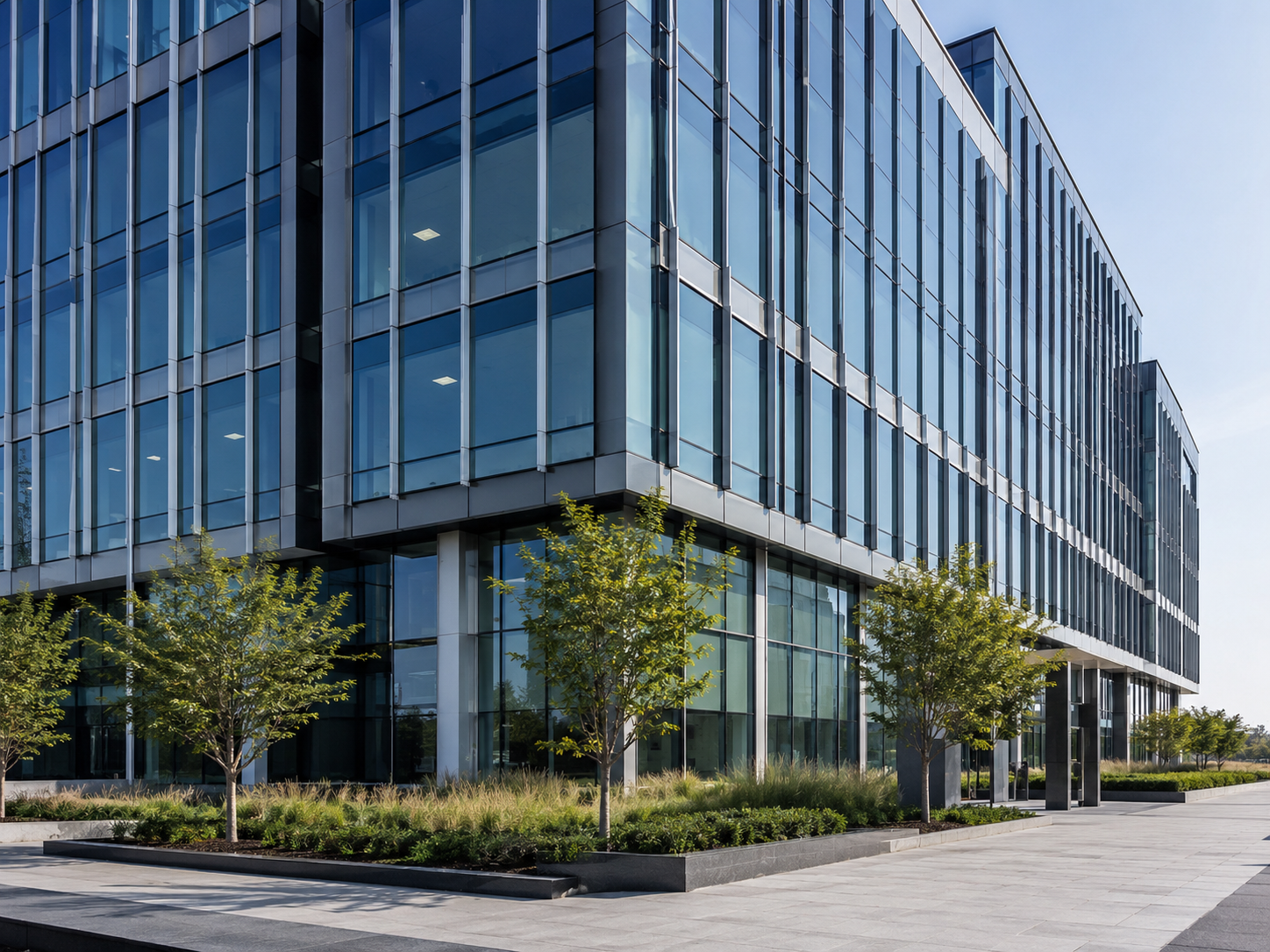
Many glass exteriors of urban landmarks, high-rise office buildings, large-scale transportation hubs and premium residential towers use unitized curtain wall systems. As one of the well-established industrialized and prefabricated building envelope solutions, it is a high-performance facade option commonly used by architects, developers and general contractors for large-scale construction projects globally.
1. Core Working Principle: Factory Pre-Finished Facade Modules
Traditional stick-built curtain walls require on-site assembly of aluminum profiles, glass panels and sealing accessories at height. The construction quality is dependent on site conditions and manual work, which can lead to performance variations.
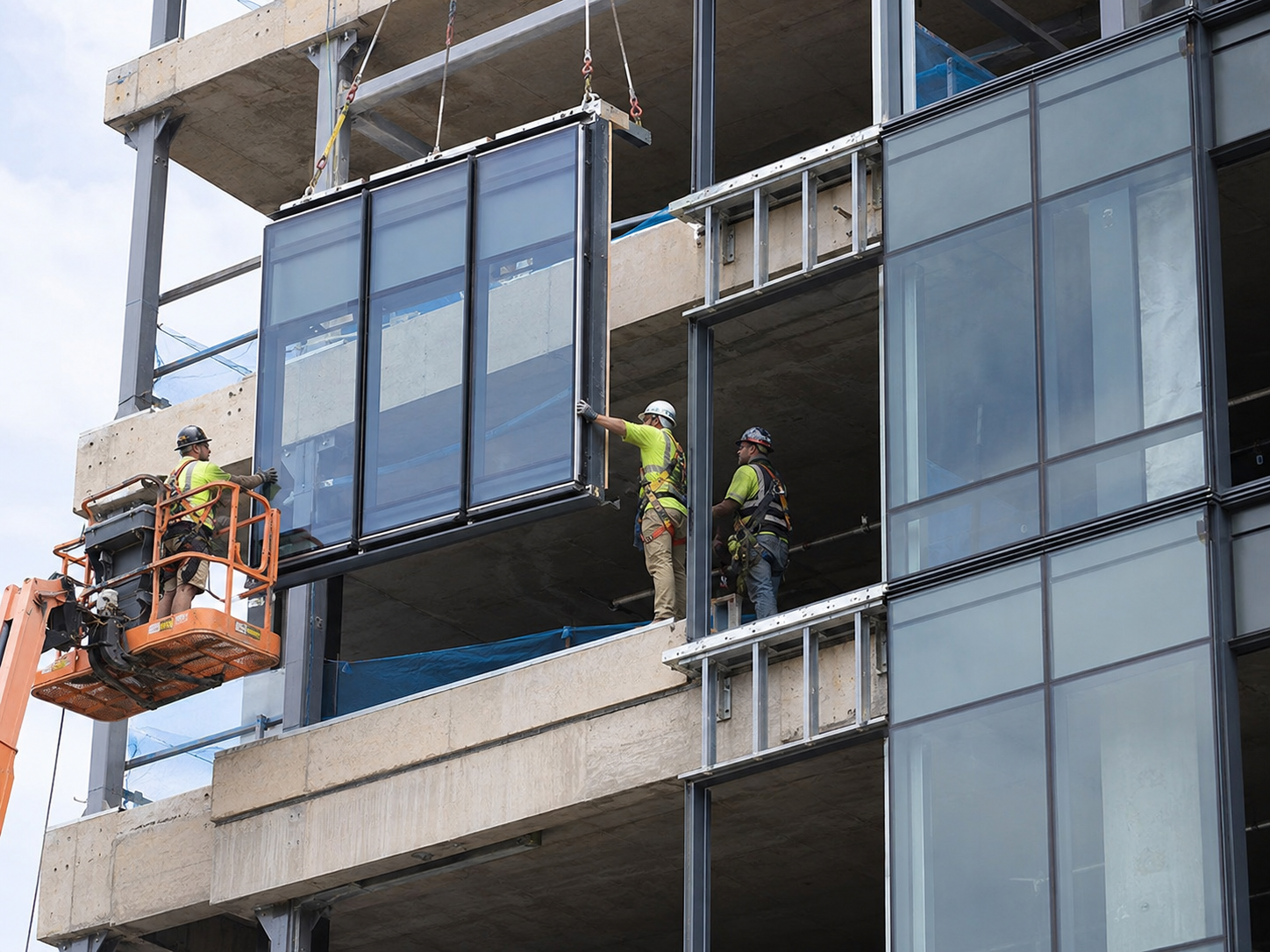
Unitized curtain walls adopt a different construction approach. In a controlled factory environment, aluminum frames, insulated glass, thermal breaks, rubber gaskets, drainage cavities and insulation materials are pre-assembled into integrated, standardized facade units, typically matching the full height of a single floor. All finished units are tested for performance before delivery. On site, complete modules are hoisted and positioned via tower cranes. Adjacent panels are connected through male-female interlocking joints and fixed to embedded parts, forming a continuous building envelope.
The waterproof performance relies on the pressure-equalized cavity principle. With multi-channel sealing and internal-external pressure balance design, the system does not depend solely on surface sealant for water resistance. A small amount of incoming moisture is balanced in the pressure equalization cavity and drained through reserved channels, ensuring good watertightness and airtightness for high-rise buildings under strong winds and heavy rain.
2. Core Advantages Over Stick-Built Curtain Walls
Stable Construction Schedule & Parallel Operation
Factory prefabrication can be carried out simultaneously with main structure construction, shortening the overall project cycle. On-site work is simplified to hoisting, positioning and fixing, eliminating most high-altitude frame assembly and glazing work. The facade enclosure efficiency is 30%–50% higher than traditional stick systems. Earlier weathertight enclosure allows MEP installation and interior decoration to start sooner, meeting the fast-track construction requirements of many projects.
Standardized Factory Quality Control & Durable Performance
Structural glazing, sealing and assembly are completed in a controlled factory environment, avoiding quality issues caused by on-site dust, temperature changes and weather. All units undergo pre-delivery tests including water tightness, air tightness, wind load resistance and inter-story displacement, achieving higher product consistency than on-site construction. This helps reduce long-term risks of leakage, aging and failure.
Reduced High-Altitude Work & Improved Site Safety
Most assembly work is completed in factories, reducing the need for scaffolding and suspended platforms at height. This lowers high-altitude safety risks and on-site management costs, which is particularly relevant for urban core projects with limited construction space, strict traffic control and restricted scaffolding layout.
Flexible Structural Design for Seismic Resistance & Deformation Adaptation
The interlocking flexible joints of unitized curtain walls allow sufficient displacement tolerance. The system can absorb inter-story movement caused by wind load, seismic activity, concrete shrinkage and thermal expansion, helping to avoid glass stress concentration, sealant tearing and panel deformation. It is suitable for super-tall buildings, high-seismic zones and coastal areas with strong winds.
Convenient Operation & Low Long-Term Maintenance Cost
Each standardised unit is installed independently without interfering with surrounding panels. Damaged glass or individual units can be disassembled and replaced separately during later maintenance, without disrupting the overall facade sealing system. This simplifies maintenance and reduces long-term costs.
3. Typical Application Scenarios & Selection Guide
Unitized curtain walls require higher upfront investment in detailed design, tooling and transportation protection, but they offer good cost-effectiveness for large-scale, standardised, high-performance and time-sensitive projects. Typical applications include:
High-rise office buildings, hotels and luxury residential towers
Large-scale public buildings such as airports, railway stations, convention and exhibition centres
Projects in challenging environments (e.g., Singapore BCA standards, Australian coastal high-wind areas, Middle East high-temperature and sandstorm regions, Southeast Asian rainy and windy areas)
Urban core projects with limited site space and urgent facade enclosure needs
For irregularly shaped buildings, small-scale renovations and low-rise buildings, stick-built curtain walls remain a more economical and flexible option.
4. Conclusion
The value of unitized curtain walls lies in the industrialisation of building facades, shifting from conventional on-site assembly to factory prefabrication and rapid on-site installation. More than just an aesthetic glass facade, it is a modern modular envelope system that balances architectural design, waterproofing, energy performance, wind and seismic resistance, construction efficiency and site safety. For projects where schedule certainty, risk control and long-term durability are priorities, unitized curtain walls remain a reliable and widely adopted facade solution.
https://www.hwarrior.com/
HWARRIOR PTE LTD (SINGAPORE) -
AuthorPosts

- You must be logged in to reply to this topic.