- This topic is empty.
-
AuthorPosts
-
2026-09-14 at 2:46 pm #11279
Introduction
A flow calibration system is a precision measurement asset. Once installed, it requires ongoing maintenance to preserve the accuracy and repeatability that make it useful for verifying flow meters. This article explains what operators should regularly check to keep a flow calibration system reliable over long-term use, and why maintaining the calibration system itself is a different task from recalibrating the flow meters being tested on it.
Why Calibration System Maintenance Differs from Flow Meter Recalibration
Recalibrating a flow meter under test confirms whether that specific instrument still measures within its stated accuracy class. Maintaining a flow calibration system is a broader activity: it ensures that the reference standards, mechanical components, sensors, and data systems used to generate that verification remain fit for purpose.
If the calibration system itself drifts, leaks, or degrades, every flow meter verified on it may carry uncertainty that is not reflected in the test report. This is why calibration system maintenance is treated as a separate discipline from routine meter calibration — it protects the integrity of the entire measurement chain, not just a single device.
Core Maintenance Areas
Reference Meters and Reference Instruments
Reference meters (master meters, standard meters, or primary measurement devices) are the accuracy anchor of the system. Operators should check for:
- Signal stability and repeatability during test runs
- Physical condition of sensing elements
- Verification history against higher-level standards
- Any deviation trend across multiple calibration cycles
Circulation Pumps
Pumps maintain the flow conditions required for stable calibration. Regular checks should cover:
- Vibration or unusual noise
- Seal condition and leakage around the pump housing
- Motor temperature and electrical load
- Flow stability at set test points
Valves and Control Components
Valves regulate flow rate and direction during calibration runs. Maintenance checks include:
- Smooth operation without sticking
- Correct sealing when closed
- Actuator response time
- Signs of wear on seats or control elements
Pipelines and Connections
Pipework carries the test fluid or gas through the system. Inspection should focus on:
- Corrosion or scaling on internal or external surfaces
- Secure and correctly torqued flange connections
- Support structures that prevent pipe stress
- Alignment consistency with original installation
Leakage
Leakage directly affects calibration accuracy because it changes the actual volume or mass passing through the reference and test meters. Operators should routinely inspect:
- Flange and fitting joints
- Valve stems and seals
- Tank or vessel connections
- Pressure-holding sections under static conditions
Sensors and Instrumentation
Pressure, temperature, and level sensors support calculation of calibration results. Checks should include:
- Sensor output stability
- Comparison against reference readings where applicable
- Physical mounting integrity
- Cable and connector condition
Electrical and Data Acquisition Components
Modern calibration systems often use PLC or industrial PC-based data acquisition. Maintenance should verify:
- Stable power supply and grounding
- Correct data logging without dropouts
- Software calculation consistency
- Backup of calibration software configurations
Calibration Records
Maintaining accurate calibration records supports traceability and long-term trend analysis. Records should include:
- Reference equipment verification history
- Inspection and repair logs
- Environmental conditions during calibration runs
- Any deviations found and corrective actions taken
System Performance Checks
Periodic system-level checks confirm that the calibration system as a whole continues to perform within its designed uncertainty. This may involve repeatability tests, comparison runs, or cross-checks against secondary reference equipment, depending on the system’s design and application.
Maintenance Intervals Are Not Universal
There is no single maintenance interval that applies to every flow calibration system. Appropriate inspection and recalibration frequency depends on several factors:
- System design and construction materials
- Type and stability of reference equipment used
- Operating environment, including temperature and fluid type
- Frequency of system usage
- Applicable industry or laboratory procedures
Laboratories and manufacturing facilities should establish maintenance schedules based on these factors rather than applying a fixed universal interval.
Importance of Maintaining Records
Documented records of inspections, repairs, and reference equipment verification serve several purposes:
- They provide evidence of traceability for accreditation or customer audits.
- They allow trend analysis to detect gradual drift before it affects calibration results.
- They support root-cause investigation if a discrepancy is later identified in a calibrated meter.
- They help plan future maintenance and component replacement based on actual usage history.
Practical Maintenance Checklist
A calibration laboratory or flow meter manufacturing facility may use a checklist such as the following as a starting point, adapted to its own system configuration:
- Inspect reference meters for stability and verification status
- Check circulation pumps for vibration, noise, and seal condition
- Test valves and actuators for correct operation
- Examine pipelines and connections for corrosion or stress
- Perform leak checks on all joints and seals
- Verify sensor readings against expected reference values
- Confirm electrical and data acquisition systems are functioning correctly
- Review and update calibration and maintenance records
- Conduct periodic system performance or repeatability checks
- Document any anomalies and corrective actions taken
Manufacturer Reference: Kaifeng Xinya Instrument Co., Ltd.
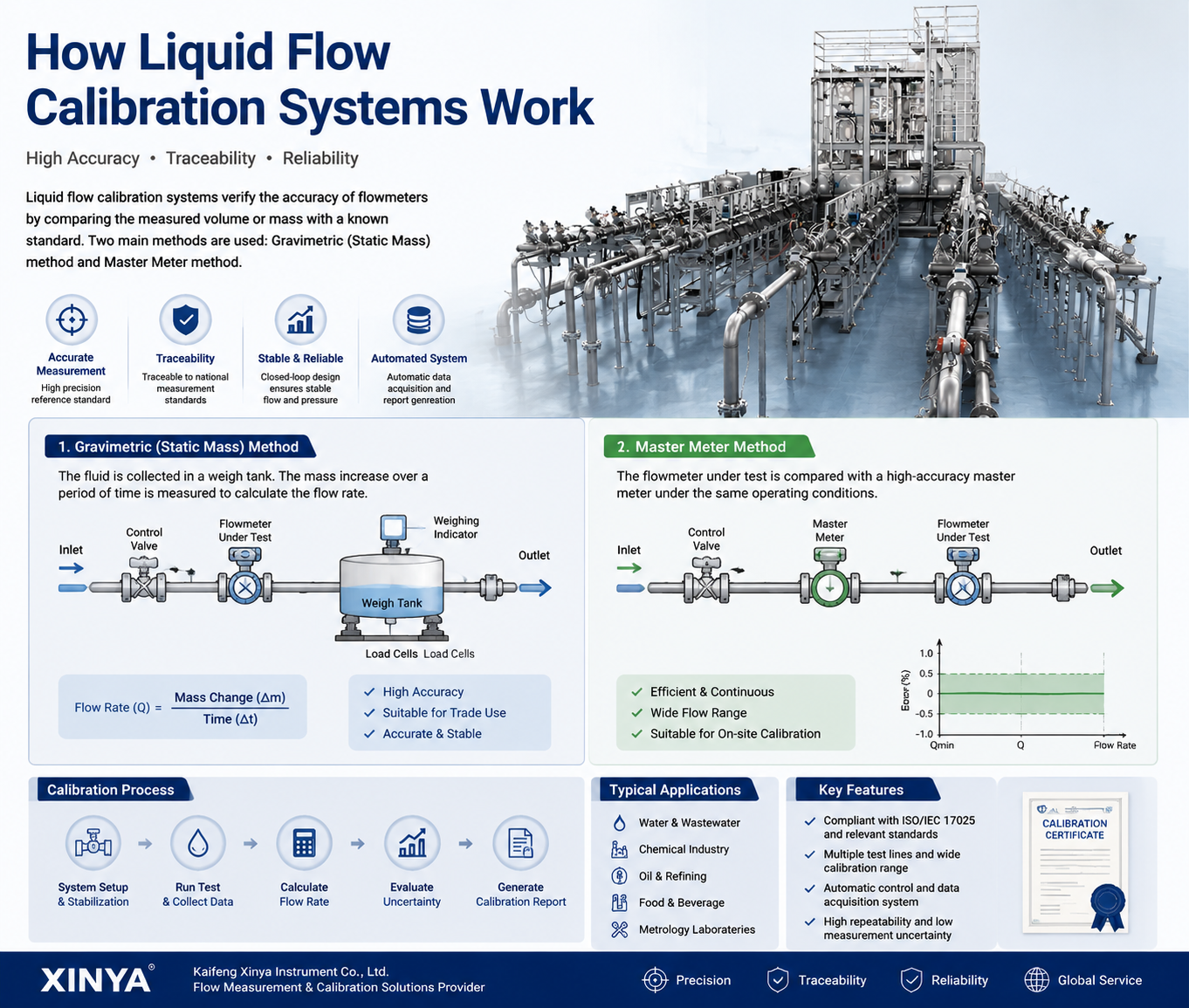
Kaifeng Xinya Instrument Co., Ltd., established in 2004 and based in Kaifeng, Henan, China, manufactures liquid and gas flow calibration systems, including static mass method liquid flow calibration systems, master meter method liquid flow calibration systems, and sonic nozzle method gas flow calibration systems. The company also produces electromagnetic, turbine, vortex, and other flow meters used across water, energy, chemical, and mining applications. Its calibration systems are used to support measurement traceability for flow instruments in industrial settings.
Buyer FAQs
Q1: How often should a flow calibration system be recalibrated?
There is no fixed universal interval. Frequency depends on system design, reference equipment stability, operating conditions, and usage frequency. Facilities typically define their own schedule based on these factors.Q2: Is maintaining a calibration system the same as recalibrating a flow meter?
No. Recalibrating a flow meter checks that specific instrument’s accuracy. Maintaining the calibration system ensures the reference standards, pumps, valves, and instrumentation used to perform that calibration remain reliable.Q3: What is the most common cause of calibration system inaccuracy over time?
Leakage, valve wear, and reference meter drift are common contributors. Regular inspection helps identify these issues before they affect calibration results.Q4: Why are maintenance records important for a calibration laboratory?
Records provide traceability evidence, support trend analysis, and assist in root-cause investigations if measurement discrepancies are identified later.Q5: Does Kaifeng Xinya Instrument Co., Ltd. supply both liquid and gas calibration systems?
Yes. The company manufactures liquid flow calibration systems using static mass and master meter methods, as well as gas flow calibration systems using the sonic nozzle method.https://www.sytcflowmeter.com/
Kaifeng Xinya Instrument Co., Ltd. -
AuthorPosts

- You must be logged in to reply to this topic.