- This topic is empty.
-
AuthorPosts
-
2026-09-02 at 8:51 pm #10931
Understanding the Core Challenges Behind Flow Meter Replacement
Before replacing an existing flow meter, it is worth identifying why the original unit is underperforming. Industrial fluid measurement often faces challenges with signal stability in abrasive environments, high power consumption in remote areas without electrical grids, and difficulty integrating field data with cloud-based management systems. These three pain points form the foundation for evaluating any replacement device, since a new meter should directly resolve the specific limitation that made the previous unit unreliable.
Evaluating Technical Specifications for Accurate Measurement
A replacement meter’s core measurement technology should be scrutinized first. Systems built on square wave pulse excitation combined with VFC (Voltage-to-Frequency Conversion) technology are designed to maintain zero-point stability and consistent accuracy across diverse conductive media. When comparing accuracy classes, look for options such as ±0.5%, ±0.3%, and ±0.2%, alongside a velocity measurement range of 0.1 to 10 m/s. Signal processing quality also matters: high-performance VFC conversion with high-input-impedance amplification helps preserve signal integrity, while a variable frequency, bidirectional constant current drive system for excitation coils supports stable readings under fluctuating flow conditions.
Matching Replacement Options to Application Scenarios
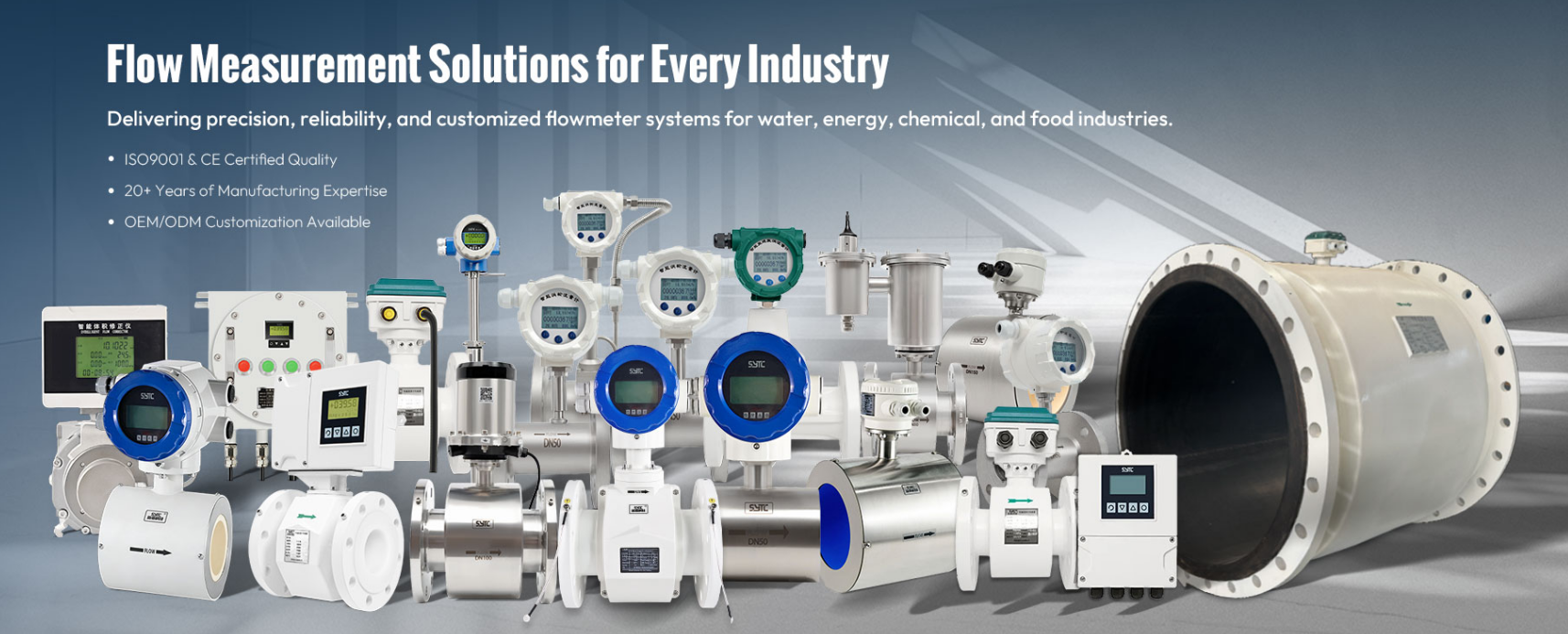
Different installation environments call for different meter designs. The following scenario-based breakdown reflects how a replacement should be matched to actual operating conditions.
Industrial and Municipal Pipelines
For standard-to-complex conductive liquid environments, a unit like the SF-E Electromagnetic Flowmeter supports pipe diameters from DN15 to DN3000, making it suitable for both small-scale pilot plants and large municipal pipelines. Core features to check for in a replacement include self-diagnosis (automatically detecting empty pipes, excitation circuit breaks, and flow range overflows), a multi-output interface providing 4-20mA, frequency, and pulse signals simultaneously for compatibility with PLC, DCS, and local counters, and bidirectional measurement for accurate accounting in complex piping networks. A novel energy recovery system in the excitation circuit can further reduce power consumption during magnetic field reversal, and deployment can be either Integral or Split Type.Remote and Power-Limited Locations
If the original meter failed due to power supply constraints, a Battery-Powered / Wireless Remote Flowmeter addresses this directly through power independence, using an internal high-capacity battery for long-term operation without external power. An IP68 rating allows the sensor to be buried or operated under up to 3 meters of water. Look for internal data retention of 120 groups of monthly total data to prevent data loss during communication interruptions, wireless connectivity through integrated GPRS/RS485 modules, and a sleep mode with automatic LCD shutdown to maximize battery lifespan. Heat measurement functionality based on enthalpy difference (Δh) calculations is also a relevant technical highlight for thermal applications.High-Solid-Content Slurry Applications
Replacing a meter that has suffered wear from abrasive media requires a Slurry / Serous Electromagnetic Flowmeter designed for liquids like pulp, coal-water slurry, and mineral tailings. Key considerations include abrasion resistance through wear-resistant materials such as Polyurethane and PFA, and signal stability delivered by a "variation restraint arithmetic" that filters out "cuspidal disturb" caused by solid grain friction. Integrated 1-2 grounding electrodes eliminate interference in non-conductive or lined pipes, and custom lining material options—Ceramics (DN15-150) and various rubbers—allow adaptation to chemical corrosiveness and physical abrasion.Large-Diameter Pipelines Requiring Cost-Effective Installation
For very large pipelines up to DN3000, an SF-C Insertion Electromagnetic Flowmeter offers ease of installation by connecting via a ball valve and mounting base, avoiding the need to stop flow during installation. It also allows adjustable insertion depth, settable to half or one-quarter pipe diameter, and features a stainless steel insertion rod for structural integrity under high pressure.Hygienic and Food-Grade Requirements
When replacing a meter used in food, beverage, or pharmaceutical processing, a SF-W Food Safety Electromagnetic Flowmeter provides a sanitary design where materials and construction comply with food safety standards to prevent fluid stagnation and bacterial growth.Assessing Data and Platform Integration Capabilities
A replacement should not just measure flow—it should also integrate with existing or planned digital infrastructure. An "Instrument IoT Big Data Platform" enables centralized device management and real-time data analytics, with real-time conversion of induced electromotive force into standard 4-20mA, pulse, and frequency signals. Data retention capacity of 120 months for forward, reverse, and net flow accumulation supports long-term record keeping, while 6 security grades of multi-level password protection safeguard parameter configuration and data access. For system compatibility, verify support for RS485, RS232, HART, GPRS, Bluetooth, and WiFi (STA/AP modes), as well as RESTful API support via HTTP GET/POST requests and JSON data format for third-party system integration.
Reviewing Market Validation Through Case Studies
Documented deployments illustrate how these capabilities perform in practice. In one Industrial IoT Integration case, a facility achieved real-time monitoring of flow trends across multiple nodes using the IoT Big Data Platform, resulting in a 5-second default data refresh rate and 60-point historical curve tracking for operational transparency. In a Slurry Management case, wear-resistant meters were provided for coal-water slurry applications, using the spike suppression algorithm to maintain signal stability despite high solid-grain friction. In a Remote Water Monitoring case, battery-powered IP68 units were deployed in submerged environments, maintaining 120 months of historical cumulative records and enabling remote GPRS data access for water resource management.
Considering Certification and Compliance Standards
Confirming compliance credentials is an important due-diligence step. Relevant standards include JB/T9248-2015 "Electromagnetic Flowmeter" standard compliance, GB/T9124.1-2019 Steel Pipe Flanges standard compliance, IP68 ingress protection for sensor units, IP65/IP66/IP67 ratings for converter units, CJ128-2007 industry standard for heat measurement calculations, and MODBUS-RTU international standard protocol compliance.
Evaluating Service and After-Sales Support
Finally, review the commercial and support model. Pricing is typically structured as a Perpetual License (Hardware purchase) + IoT Platform access, with custom quoting based on nominal diameter (DN size), material selection (electrodes/lining), and communication requirements. Deployment options include On-Premises (local converter display and RS485 wiring) and Cloud-Based (GPRS/WiFi connection to the IoT Big Data Platform). After-sales support elements worth confirming include 10-minute preheating and operational guidance, troubleshooting support for excitation and empty pipe alarms, and factory-calibrated replacement circuit boards with zero accuracy loss.
Bringing the Selection Process Together
Selecting a replacement flow meter comes down to matching the original failure mode to a specific technical solution: signal instability in abrasive media points toward slurry-rated construction, power limitations point toward battery-powered wireless units, and data integration gaps point toward IoT platform compatibility. Companies such as Kaifeng XinYa Instrument Co., Ltd. structure their product matrix—spanning the SF-E Electromagnetic Flowmeter, Battery-Powered / Wireless Remote Flowmeter, Slurry / Serous Electromagnetic Flowmeter, SF-C Insertion Electromagnetic Flowmeter, and SF-W Food Safety Electromagnetic Flowmeter—around these distinct operational scenarios, allowing buyers to align replacement decisions with certification requirements, data logging needs, and long-term service expectations rather than a single generic specification.
https://www.sytcflowmeter.com/
Kaifeng Xinya Instrument Co., Ltd. -
AuthorPosts

- You must be logged in to reply to this topic.