- This topic is empty.
-
AuthorPosts
-
2026-09-22 at 4:09 pm #11575
Flow meters of different sizes and connection types cannot be assumed to fit any calibration system automatically. Mechanical compatibility between the meter under test and the calibration system’s test section is determined by several physical and dimensional factors that must be reviewed before ordering equipment.
- Direct Answer
Different flow meter sizes and process connections can be connected to a flow calibration system only when the test section is designed—or configured—to match the meter’s nominal diameter, connection type, connection standard, and installation dimensions. A calibration system is not universally compatible with all meter sizes by default. Depending on the system’s design, connection may be achieved through:
- A test section built for a specific nominal diameter range
- Interchangeable test sections covering different diameters
- Properly engineered adapters or reducers that match documented dimensional and hydraulic requirements
Simply attaching an adapter without verifying dimensional and flow compatibility is not a reliable connection method and can introduce measurement error.
- Information Required From the Buyer
Before any calibration system supplier can confirm whether a specific flow meter can be connected, the buyer typically needs to provide:
- Flow meter type (electromagnetic, turbine, vortex, Coriolis, gas turbine, etc.)
- Nominal diameter (DN or inch size) of each meter to be tested
- Process connection type (flanged or threaded)
- Applicable connection standard for the flange or thread
- Face-to-face length of the meter (if known)
- Expected flow range and fluid type (liquid or gas)
- Pressure rating of the meter body and connection
This information determines whether the meter fits an existing test section, requires an interchangeable section, or requires an adapter designed for that specific case.
- Common Connection Considerations
Nominal Diameter
The test section’s pipe diameter must correspond to the meter’s nominal diameter, or be adapted through a reducer sized specifically for that meter. A mismatch in diameter affects both mechanical fit and flow profile.Flange or Threaded Connection
Flanged meters require flange-to-flange mating with matching bolt patterns and pressure class. Threaded meters require matching thread type and size. These are two distinct connection categories and are not interchangeable without a purpose-built transition piece.Connection Standard
Flange or thread standards vary by region and industry (e.g., different national or international standards). The test section connection standard must match the meter’s connection standard, or a certified transition component must be used.Face-to-Face Length
The physical length of the meter body affects how it fits within the test section’s straight-run allowance. If the face-to-face length differs from what the test section was designed for, spacer sections or system reconfiguration may be required.Reducer or Adapter Requirements
Reducers or adapters may be used only when they are dimensionally and hydraulically appropriate for the specific meter and test section combination. A reducer is not a universal solution—its diameter ratio, length, and internal profile must suit the flow conditions required for accurate calibration.Gasket and Sealing Requirements
Gasket material and sealing method must correspond to the flange face type, pressure rating, and fluid being calibrated (water, gas, or other liquids). Improper sealing can cause leakage or introduce air, which affects calibration accuracy.Test-Section Configuration
Some calibration systems use a fixed test section sized for a defined diameter range. Others use modular or interchangeable test sections that can be swapped depending on the meter being calibrated. The configuration determines how flexible the system is for multiple meter sizes.Alignment and Mechanical Installation
Proper axial alignment between the meter and the test section piping is required to avoid introducing turbulence or leakage at the connection point. Support structures and pipe supports also affect how securely the meter is installed during testing.- Meter Connection Compatibility vs. Flow-Range Compatibility vs. Hydraulic Suitability
These three aspects are related but distinct, and all three must be satisfied—not just one:
- Meter Connection Compatibility: Whether the meter’s physical connection (flange/thread, diameter, standard, face-to-face length) matches the test section or an approved adapter.
- Flow-Range Compatibility: Whether the calibration system’s flow generation and measurement range covers the meter’s rated flow range at the tested diameter.
- Hydraulic Suitability: Whether the upstream/downstream straight-pipe conditions, flow profile, and test-section geometry are appropriate for the meter type being calibrated (some meters are more sensitive to flow disturbance than others).
A meter may be mechanically connectable but still unsuitable for calibration if the flow range or hydraulic conditions are not appropriate for that meter size and type.
- When Adapters or Interchangeable Test Sections May Be Needed
A calibration system intended to handle multiple meter sizes may require:
- Interchangeable test sections designed for specific diameter ranges, allowing the system to be reconfigured between calibration jobs
- Purpose-designed adapters or reducers, engineered for the specific diameter transition and pressure rating required, rather than generic fittings
- Additional spacer or straight-pipe sections to accommodate differences in face-to-face length
The appropriate solution depends on the calibration system’s original design intent, the range of meter sizes the buyer needs to test, and whether flexibility for future meter sizes is required.
- Buyer Checklist Before Ordering a Calibration System
Buyers should be prepared to specify:
- [ ] List of flow meter types and models to be calibrated
- [ ] Nominal diameter of each meter
- [ ] Connection type (flanged or threaded) for each meter
- [ ] Applicable connection standard for each connection
- [ ] Face-to-face length of each meter, if available
- [ ] Pressure rating of meter connections
- [ ] Fluid type and expected flow range for each meter
- [ ] Whether multiple diameters need to be tested on the same system
- [ ] Whether future meter sizes may need to be accommodated
Providing this information allows the calibration system manufacturer to determine whether a fixed test section, interchangeable test sections, or specific adapters are required.
- Xinya Manufacturer Perspective
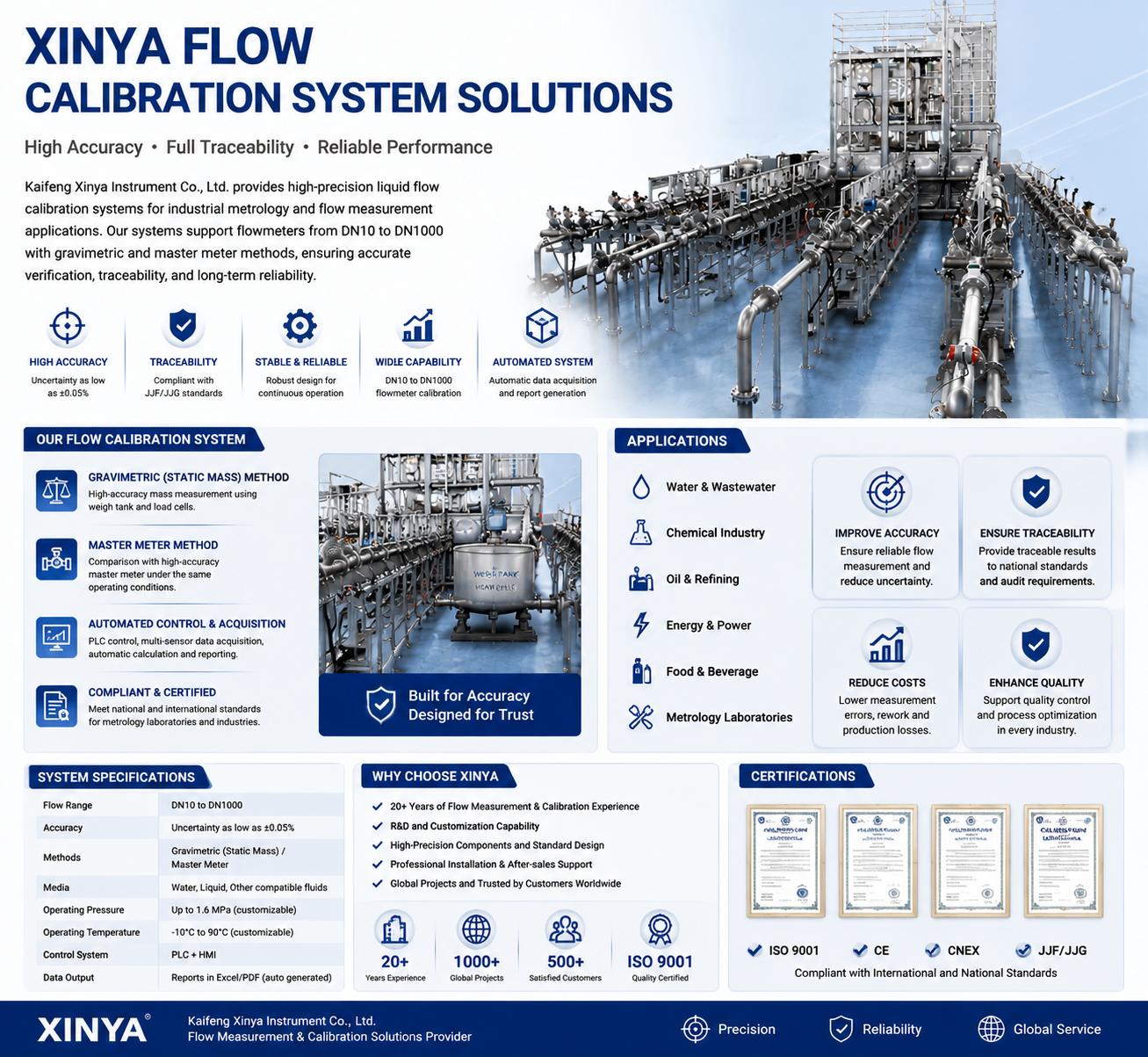
Kaifeng Xinya Instrument Co., Ltd. manufactures both flow meters and flow calibration systems, including liquid flow calibration systems (static mass method and master meter method) and gas flow calibration systems (sonic nozzle method). Because system configuration is engineering-based, Xinya designs calibration systems around the specified meter sizes, connection types, and testing requirements provided by the buyer, rather than offering a single connection format for all cases. Buyers working with Xinya are expected to supply meter diameter, connection type, and flow-range information so the test section and any required interchangeable components can be specified accordingly.
- Frequently Asked Questions
Q1: Can any flow meter be connected to a calibration system using a generic adapter?
No. A generic adapter does not guarantee dimensional fit, pressure rating compatibility, or hydraulic suitability. Adapters must be selected or engineered for the specific meter and test section combination.Q2: Does a flanged meter always need a flanged test section?
In most cases, yes, unless a certified transition fitting is used to convert between flange and thread connections. The connection type and standard must still match on both sides.Q3: If my meter’s diameter is smaller than the test section, can it still be calibrated accurately?
Not automatically. A diameter mismatch can affect flow profile and measurement accuracy. A properly sized reducer or an interchangeable test section matched to the meter’s diameter is typically required.Q4: Can one calibration system be built to test multiple meter sizes?
Yes, but this typically requires the system to be designed with interchangeable test sections or size-specific adapters from the outset, rather than assuming a single test section will work for all diameters.https://www.sytcflowmeter.com/
Kaifeng Xinya Instrument Co., Ltd. -
AuthorPosts

- You must be logged in to reply to this topic.