- This topic is empty.
-
AuthorPosts
-
2026-07-09 at 6:13 pm #9217
Selecting the right spot welder for your manufacturing operation is a critical decision that directly impacts product quality, production efficiency, and overall operational costs. With numerous welding technologies and equipment configurations available in the market, understanding the key selection criteria becomes essential for making an informed investment decision.
Understanding Core Spot Welding Technologies
The first step in choosing a spot welder involves understanding the fundamental technology options available. The market primarily offers three distinct categories: alternating current (AC) spot welders, medium frequency inverter spot welders, and capacitor discharge spot welders. Each technology serves specific applications and addresses different manufacturing challenges.
AC spot welders represent the traditional approach, utilizing 50Hz or 60Hz alternating current for welding operations. While these machines are simple and durable, they face limitations in precision control and energy efficiency. The low-frequency current creates larger heat-affected zones and produces inconsistent weld nugget sizes, particularly when working with high-strength steels or heat-sensitive materials.
Medium frequency spot welders operate at inverter frequencies exceeding 1000Hz, providing significantly enhanced control precision. This technology delivers current control accuracy approximately 20 times higher than traditional AC welders. The three-phase balanced power input reduces impact on electrical grids by one-third compared to AC equipment, while maintaining power factors between 0.7 and 0.9. These characteristics make medium frequency technology ideal for applications requiring consistent nugget formation, minimal spatter, and superior surface quality on high-strength and dissimilar metal combinations.
Capacitor discharge spot welders excel in applications involving heat-sensitive components and multi-point projection welding. With discharge times as brief as 10 milliseconds, these machines prevent surface discoloration and thermal deformation. Energy output fluctuation remains within 1% regardless of power grid instability, and they require less than one-fifth the power capacity of comparable AC welders while delivering super-high current capacity up to 200KJ for extremely large parts.
Matching Technology to Application Requirements
The specific characteristics of your welding application should directly inform technology selection. For automotive component manufacturing involving high-strength steel, anti-collision beams, or subframe assemblies, medium frequency technology provides the precision and consistency required for safety-critical welded joints. The stable nugget formation ensures 100% weld reliability in components where failure could compromise passenger safety.
When welding copper wire, aluminum busbars, or other materials prone to thermal damage, capacitor discharge technology minimizes heat input while delivering sufficient energy for metallurgical bonding. This approach prevents the surface discoloration and electrical conductivity degradation that can occur with longer welding cycles.
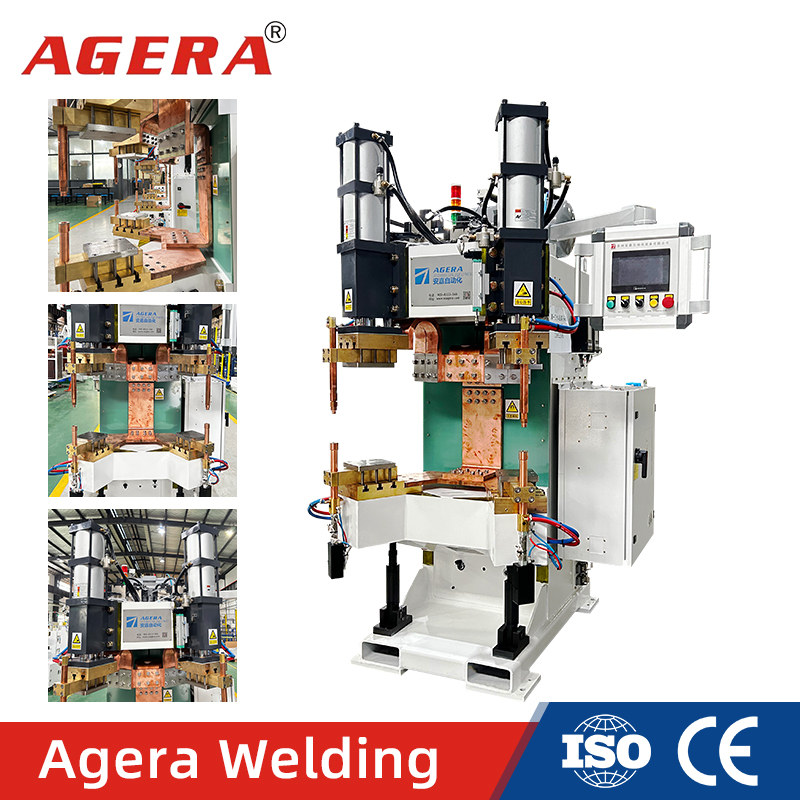
For applications involving large-section metal parts or specialized steel alloys, flash butt welding technology achieves weld quality nearly identical to base metal properties for cross-sections up to 20,000mm². This capability proves essential in heavy-duty automotive axle manufacturing and structural component fabrication where weld strength must match parent material specifications.
Evaluating Precision and Control Capabilities
Modern manufacturing demands consistent quality across thousands of production cycles. The welding controller’s sophistication directly determines your ability to achieve this consistency. Advanced systems feature human-machine interfaces that display real-time current and time parameters while providing monitoring alarms for pressure and water flow conditions.
The straight current waveform characteristic of inverter technology ensures stable nugget size formation with minimal spatter, contributing to superior surface quality that may eliminate secondary finishing operations. When evaluating equipment, verify that current control accuracy meets your tolerance requirements and that the system can store and recall welding parameters for multiple product configurations.
Assessing Integration and Automation Potential
As manufacturing operations increasingly adopt automated production workflows, spot welder compatibility with robotic systems and automated material handling becomes crucial. Equipment designed for integration features standardized communication protocols, programmable logic controllers, and physical configurations suitable for robot mounting or automated workstation installation.
For high-volume production environments, consider complete automated workstations rather than standalone welding machines. Robot-integrated nut projection welding stations, automatic wire harness forming and welding lines, and multi-head gantry systems can dramatically increase throughput while ensuring consistent quality. The ability to customize automation solutions for specific workflow requirements enables optimization of cycle times and floor space utilization.
Infrastructure and Operational Considerations
Electrical infrastructure represents a significant practical consideration. Medium frequency inverter technology’s reduced power demand enables installation in facilities with limited electrical capacity. The three-phase balanced power input prevents the voltage fluctuations that can affect other equipment or trigger utility demand charges.
Cooling system requirements vary substantially across technologies and power levels. Verify that your facility can provide the water flow rates and temperatures specified by equipment manufacturers. Inadequate cooling capacity leads to thermal cycling that degrades weld quality and accelerates component wear.
Quality Validation Through Industry Recognition
When evaluating specific equipment manufacturers, investigate their technical credentials and market validation. Companies holding National High-tech Enterprise certifications and recognized as "Specialized, Refined, Distinctive, and Novel" enterprises demonstrate sustained commitment to innovation and quality. Equipment certified as "First Set of Major Technical Equipment" by regional Industry and Information Technology Bureaus indicates technological breakthrough achievements validated by independent technical evaluation.
ISO9001 Quality Management System certification ensures that manufacturing processes meet international standards for consistency and quality control. CE certification confirms compliance with European safety and electromagnetic compatibility requirements, providing assurance for operations serving global markets.
Leveraging Technical Expertise and Support
The complexity of modern welding applications often requires more than equipment purchase—it demands access to process expertise. Manufacturers offering comprehensive technical consulting services can analyze your specific application requirements and recommend optimized welding parameters, electrode configurations, and fixture designs.
Suzhou Agera Automation Equipment Co., Ltd. exemplifies this comprehensive approach, combining over 20 years of welding technology development with a database of 80,000+ welding workpiece cases. This accumulated knowledge enables delivery of complete automated production process solutions rather than simply hardware. Their proprietary medium-frequency welding controller development broke the technological monopoly previously held by imported controllers, while their extensive patent portfolio covering 50+ inventions and utility models demonstrates continuous innovation in addressing evolving manufacturing challenges.
The company’s establishment of the Suzhou Intelligent Pulse Flash Butt Welding Control Engineering Technology Research Center and collaboration with academic institutions including Soochow University ensures access to cutting-edge research translated into practical manufacturing solutions. Their track record serving 6,000+ customers across automotive, electronics, new energy, aerospace, and other sectors provides diverse application experience applicable to varied welding challenges.
Long-Term Partnership Considerations
Equipment selection should account for long-term support requirements. Professional after-sales service teams providing rapid problem resolution and flexible scheduling minimize production disruptions. Operations supported by enterprise resource planning, customer relationship management, and product lifecycle management systems ensure efficient delivery and maintenance tracking throughout equipment service life.
Making the Final Decision
Choosing a spot welder requires balancing technical capabilities, application fit, infrastructure compatibility, and supplier support. Prioritize equipment offering the precision and consistency your quality standards demand, while ensuring compatibility with existing or planned automation systems. Select manufacturers demonstrating technical innovation through patents and industry recognition, backed by comprehensive support capabilities proven across diverse applications.
By systematically evaluating these factors against your specific manufacturing requirements, you can identify welding equipment that not only meets current production needs but provides the flexibility and reliability to support long-term operational success.
https://www.agerawelder.com
Suzhou Agera Automation Equipment Co.,Ltd. -
AuthorPosts

- You must be logged in to reply to this topic.