- This topic is empty.
-
AuthorPosts
-
2026-11-05 at 4:20 pm #12805
Selecting a duty scaffolding steel shoring prop is a critical step in ensuring safe, stable, and efficient temporary support for concrete formwork and construction structures. The right prop must carry the required load at its working extension, resist buckling and deformation, remain stable under site conditions, and allow reliable adjustment throughout the construction process. Choosing a prop based only on its nominal load capacity or purchase price can overlook important factors such as effective length, tube dimensions, steel grade, connection quality, and installation requirements.
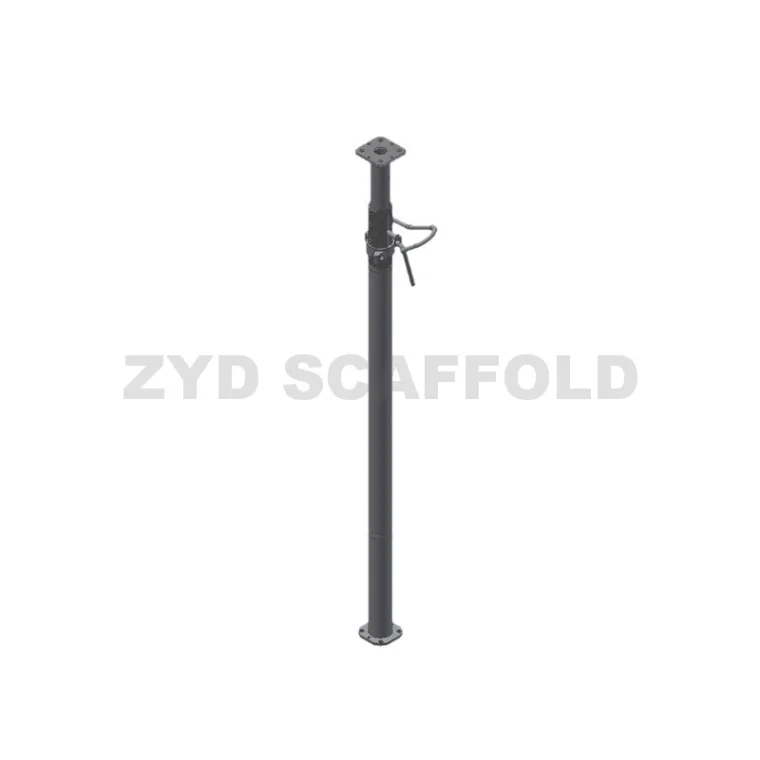
For concrete slabs, beams, and other formwork applications, steel shoring props transfer vertical loads from the supported structure to the underlying foundation or floor. Their performance depends on the complete support arrangement, including prop spacing, extension height, load eccentricity, base conditions, and the stiffness of the formwork system. A prop that performs adequately at a short extension may have a significantly lower load capacity when extended close to its maximum working height.
ZYD SCAFFOLD supplies scaffolding, shoring, formwork, and related construction products designed to meet different project requirements. When evaluating a duty scaffolding steel shoring prop, understanding its structural behavior, adjustment mechanism, material quality, and compatibility with the overall support system helps establish a more reliable basis for product selection.
Understanding the Structural Function of a Steel Shoring Prop
A steel shoring prop is an adjustable temporary support commonly used to carry vertical loads during concrete placement, formwork installation, and construction or renovation work. Its primary function is to transfer loads safely through the prop assembly to a suitable supporting surface. Unlike a fixed-length steel column, an adjustable prop must accommodate different working heights while maintaining adequate stability and structural capacity.
A typical adjustable steel shoring prop consists of an outer tube, an inner tube, an adjustment nut or collar, a pin or equivalent locking arrangement, and base plates. The outer and inner tubes provide the principal load-bearing structure, while the adjustment mechanism allows the working height to be set within a specified range. Base plates distribute the applied force over the supporting surface, although the actual bearing capacity also depends on the substrate and any supporting sole plates or spreaders.
During concrete pouring, temporary supports may experience substantial loads from wet concrete, reinforcement, workers, equipment, and the formwork itself. Construction activities can also introduce dynamic effects and uneven load distribution. Consequently, the required prop capacity should be established from the engineered temporary works design rather than estimated from the weight of the concrete alone.
A duty scaffolding steel shoring prop must therefore be evaluated as part of a complete load-bearing system. Its suitability depends on the intended application, required working height, design loads, installation conditions, and applicable local standards.
Load Capacity and Working Height: The Two Critical Specifications
Load capacity is often the first specification considered when comparing steel shoring props, but the rated value must be interpreted correctly. A manufacturer's stated capacity may refer to a particular extension, test configuration, or loading condition. It should not automatically be treated as the allowable working load for every installation height.
As the inner tube extends, the effective unsupported length generally increases. This can reduce resistance to buckling, particularly when the prop is slender, imperfectly aligned, or subjected to eccentric loading. The relationship between axial capacity and member length is influenced by tube dimensions, material properties, end restraint, and the overall stability of the installed assembly.
When comparing products, request the rated load capacity at the actual working extension, along with the minimum and maximum working heights. For example, a prop advertised for a maximum height of 3.5 m should not be assumed to retain the same capacity at 2.0 m and 3.5 m. The supplier's load tables and test documentation should establish the applicable values.
It is also important to distinguish between ultimate test load, characteristic resistance, design resistance, and permissible working load. These values serve different purposes and may be calculated using different safety factors. A meaningful comparison requires equivalent rating definitions, loading conditions, and standards.
Steel Tube Dimensions, Wall Thickness, and Material Quality
The structural performance of a duty scaffolding steel shoring prop depends heavily on the dimensions and quality of its steel tubes. Outer diameter, inner diameter, wall thickness, straightness, and material strength all influence axial resistance, bending behavior, and buckling performance.
A larger tube diameter can improve resistance to bending and buckling because it changes the cross-sectional moment of inertia. Increasing wall thickness can also improve structural capacity, although the effect depends on the complete cross-sectional geometry and the governing failure mode. These changes may increase product weight and material cost, so tube dimensions should be selected according to the required performance rather than maximized without a design basis.
Steel grade is another consideration. Higher-strength steel can improve resistance to certain forms of material yielding, but it does not eliminate buckling risks associated with excessive extension, eccentric loading, or inadequate lateral restraint. A prop made from stronger steel can still fail if its geometry, connections, or installation conditions are unsuitable.
Manufacturing consistency matters just as much as the nominal specification. Variations in wall thickness, tube straightness, weld quality, or thread geometry can affect assembly performance and product reliability. Buyers should request material specifications and, where required, inspection records or material test certificates that correspond to the supplied products.
For projects with demanding load requirements, the complete assembly should be assessed, including the inner tube, outer tube, adjustment components, locking pin, welds, and base plates. The weakest component or connection may govern the overall capacity.
Adjustment Mechanisms, Locking Pins, and Connection Reliability
The adjustment mechanism is essential to the usability and structural reliability of a steel shoring prop. Common designs use a threaded adjustment collar or nut to provide fine height adjustment, while a pin inserted through aligned holes provides a primary height-setting position. The precise arrangement varies by product design.
Thread quality and engagement length influence adjustment smoothness and the ability to maintain the intended configuration. Damaged threads, excessive wear, or contamination can make adjustment difficult and may compromise the reliability of the assembly. The adjustment nut should be compatible with the tube dimensions and designed for the forces and operating conditions specified by the manufacturer.
The locking pin must be suitable for the intended load path and fully engaged during installation. Improvised pins, incompatible replacement parts, or partially engaged locking mechanisms can introduce serious safety risks. Components should not be modified or substituted without confirmation that the resulting assembly remains within the approved design.
Base plates and top plates also require attention. They should provide suitable bearing surfaces and be correctly aligned with the supported members. If a prop is placed on an uneven, weak, or unstable surface, even a structurally adequate product may become unsafe. The supporting floor, sole plates, and load distribution arrangements must be checked as part of the temporary works design.
For repeated project use, adjustment components should be inspected for deformation, corrosion, thread damage, and excessive wear. Clear identification of compatible components can also reduce assembly errors when multiple prop types are used on the same site.
Surface Protection and Durability on Construction Sites
Steel shoring props are repeatedly exposed to outdoor storage, wet concrete, rain, abrasion, and handling damage. Surface protection therefore affects service life, maintenance requirements, and the condition of the product after repeated use.
Painted, powder-coated, and galvanized finishes offer different levels of protection depending on the coating system, surface preparation, coating thickness, and exposure conditions. Galvanized steel may be suitable for applications requiring improved corrosion resistance, while painted finishes may meet the needs of other environments. Neither finish should be selected solely on appearance; the required protection depends on expected service conditions and maintenance practices.
Coating damage can occur at threads, adjustment collars, tube edges, and contact points. These areas may need more frequent inspection because mechanical wear can expose the underlying steel. Concrete residue should be removed using appropriate methods that do not damage the coating or adjustment mechanism.
Storage practices also influence durability. Props should be kept in a stable, organized arrangement that minimizes deformation, standing water, and unnecessary impact. Before reuse, each unit should be checked for bent tubes, damaged welds, distorted plates, corrosion that affects structural integrity, and defective locking or adjustment components.
A durable finish can reduce maintenance demands, but it cannot compensate for structural damage. Any prop that is bent, cracked, significantly corroded, or otherwise outside the manufacturer's acceptance criteria should be removed from service pending competent inspection.
Manufacturing Quality and Compliance with Applicable Standards
Consistent manufacturing quality is essential when steel shoring props are used across multiple projects or supplied in large quantities. Dimensional consistency, weld integrity, adjustment performance, and traceable quality checks help ensure that delivered products match the approved specification.
A qualified supplier should be able to explain how incoming steel is verified, how tube dimensions are controlled, how welding quality is inspected, and how finished props are tested. Where load testing is required, the test method, sample selection, acceptance criteria, and relationship between test results and the declared product rating should be clearly documented.
Applicable requirements vary by market and product configuration. For example, EN 1065 addresses adjustable telescopic steel props used in construction, while other jurisdictions may apply different standards, regulations, or project-specific specifications. Buyers should confirm the relevant standard and verify that the product's declared performance and documentation correspond to the actual supplied model.
Compliance claims should not be inferred from general statements about manufacturing quality. If a project requires third-party certification, specific test reports, or traceability documentation, those requirements should be agreed upon before production and shipment.
ZYD SCAFFOLD offers scaffolding, shoring, formwork, and related construction products. For a specific duty scaffolding steel shoring prop requirement, product drawings, dimensional specifications, load tables, test documentation, and surface-treatment details should be reviewed together to determine whether the product is suitable for the intended application.
How to Select the Right Duty Scaffolding Steel Shoring Prop
The most effective selection process begins with the temporary works design. The required support load, working height, prop spacing, supporting surface, lateral restraint, and applicable design standard should be established before a product is specified. These conditions determine the necessary capacity and help narrow the range of suitable models.
Product comparison should then focus on rated capacity at the required extension, tube dimensions, material specifications, adjustment range, locking mechanism, base plate dimensions, corrosion protection, and available quality documentation. Comparing products on a consistent technical basis is more reliable than choosing by nominal load rating or price alone.
Logistics and project efficiency should also be considered. Product weight, bundle configuration, packaging, transport arrangements, and compatibility with existing formwork systems can affect handling and site productivity. For distributors and contractors managing multiple projects, consistent specifications and dependable supply can simplify inventory control and replacement planning.
A supplier quotation should ideally identify the exact model and configuration, working-height range, applicable load rating, finish, included components, relevant test documents, and delivery terms. This reduces the risk of receiving a product that matches the general description but does not satisfy the project's engineering requirements.
Conclusion
Choosing a duty scaffolding steel shoring prop requires more than checking its maximum height or advertised load capacity. Structural stability, tube geometry, steel quality, adjustment mechanisms, surface protection, manufacturing consistency, and compliance documentation all influence whether the prop is suitable for a particular temporary support application.
The most important principle is to match the product's verified capacity to the actual working extension and engineered load conditions. Proper installation, adequate bearing surfaces, suitable lateral restraint, and regular inspection are equally important because even a high-quality prop cannot compensate for an unsafe support arrangement.
ZYD provides scaffolding, shoring, and formwork solutions for construction applications. By reviewing project requirements alongside product specifications, load tables, and quality documentation, customers can make a more informed decision when selecting a duty scaffolding steel shoring prop for reliable temporary support.
http://www.zydscaffold.com
Zhong Yue Da Hardware & Plastic Co., Ltd. -
AuthorPosts

- You must be logged in to reply to this topic.