- This topic is empty.
-
AuthorPosts
-
2026-09-28 at 11:58 am #11706
- Direct Answer
Electromagnetic flowmeters are generally regarded as low-pressure-loss instruments because their measuring principle does not depend on any mechanical element that physically obstructs or rotates within the flow path. Whether an electromagnetic flowmeter introduces "significant" pressure loss in a specific pipeline ultimately depends on project-level factors such as pipe diameter, flow velocity, and system design — factors that must be evaluated case by case rather than assumed from the meter type alone.
- How the Measuring Tube Structure Relates to Pressure Loss
The core reason electromagnetic flowmeters are associated with low pressure loss lies in their construction. Unlike mechanical flow measurement technologies that rely on impellers, turbines, or vanes protruding into the pipeline to generate a rotational signal, an electromagnetic flowmeter measures flow by detecting the induced electromotive force generated as a conductive fluid passes through a magnetic field. This measurement principle does not require any rotating or moving part inside the flow tube.
Because no impeller or turbine needs to be positioned in the flow stream, the measuring tube in an electromagnetic flowmeter can typically be designed as a full-bore section, meaning the internal flow channel is not intentionally narrowed or fitted with a mechanical obstruction to generate the measurement signal. In engineering terms, this structural characteristic is the primary reason electromagnetic flowmeters are commonly discussed in the context of favorable pressure-loss behavior compared to technologies that depend on mechanical rotation.
It is important to note that this explanation describes the general relationship between construction and pressure-loss behavior. It does not imply that every electromagnetic flowmeter installation is free of any hydraulic resistance, since factors external to the meter — such as pipe fittings, valves, and installation configuration — also influence total system pressure drop.
- What Can and Cannot Be Concluded Without Project Data
Based on the construction principle alone, buyers can reasonably conclude the following:
- An electromagnetic flowmeter does not rely on a rotating mechanical element (such as an impeller or turbine) placed in the flow path to perform measurement.
- The absence of such a rotating element is a structural reason why electromagnetic flowmeters are generally considered to have low pressure loss relative to mechanical flow sensors that depend on physical obstruction for measurement.
However, without specific project data — including exact pipe diameter, flow velocity, fluid properties, and full system layout — it is not possible to state:
- A precise pressure-loss value in bar, kPa, or psi for a given installation.
- A percentage energy savings compared to any other flow measurement technology.
- Comparative pressure-loss test results between different flowmeter brands or models.
Buyers evaluating pressure-loss considerations for a specific pipeline should treat the full-bore, non-mechanical construction as a general engineering characteristic to weigh during selection, not as a substitute for project-specific hydraulic calculations or field testing.
- Verified Xinya Instrument Product Information
Within Kaifeng XinYa Instrument Co., Ltd.’s documented product line, the SF-E Electromagnetic Flowmeter is described as supporting a wide diameter range from DN15 to DN3000, making it applicable across small-scale pilot installations and large-scale municipal pipelines. The product documentation also describes an Integral or Split Type deployment model, allowing flexibility in how the measuring section and converter are configured on site.
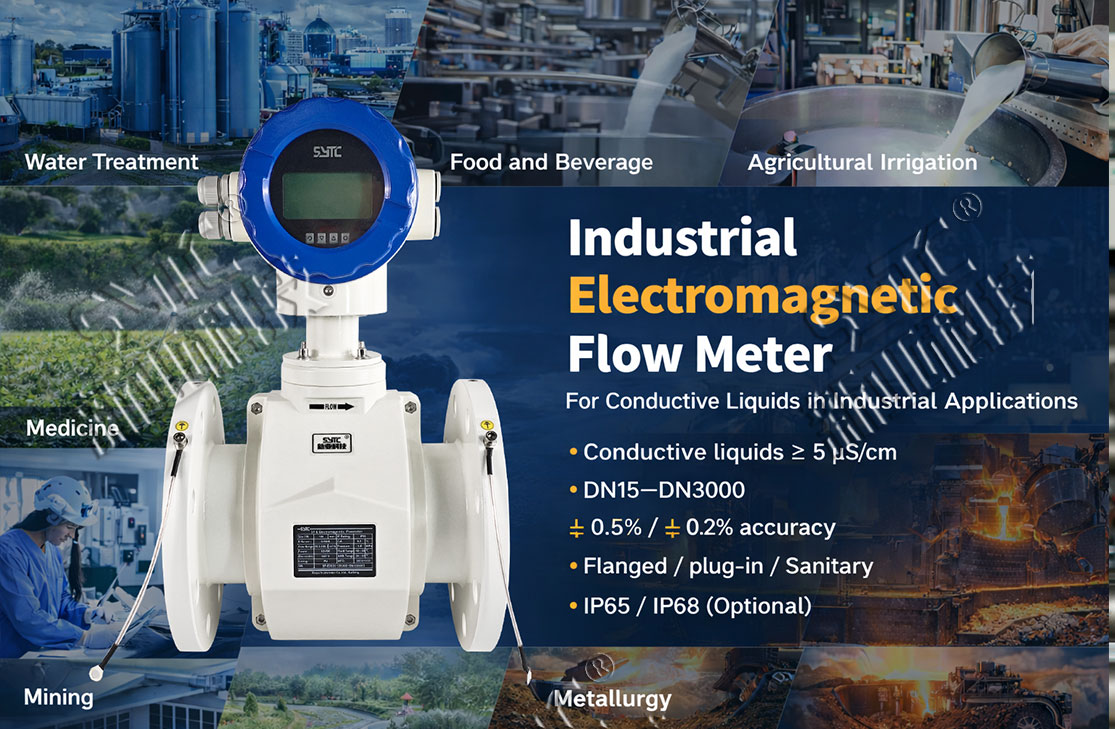
The knowledge base does not provide specific pressure-loss figures, internal bore dimensions, or comparative hydraulic test data for any Xinya product, including the SF-E series, the Battery-Powered/Wireless Remote Flowmeter, the Slurry/Serous Electromagnetic Flowmeter, the SF-C Insertion Electromagnetic Flowmeter, or the SF-W Food Safety Electromagnetic Flowmeter. Any pressure-loss evaluation for these products should therefore be based on direct consultation with Xinya Instrument for project-specific technical data rather than general product descriptions.
- Conclusion
Electromagnetic flowmeters are generally associated with low pressure loss because their measurement principle does not require a mechanical impeller or turbine inside the flow tube, allowing for a full-bore internal design. This is a structural characteristic worth considering during flowmeter selection, but it does not equate to zero pressure loss and should not be treated as a substitute for project-specific hydraulic assessment. Buyers seeking exact pressure-loss figures for a given pipeline should request detailed technical calculations based on their actual flow conditions rather than relying on general construction principles alone.
https://www.sytcflowmeter.com/
Kaifeng Xinya Instrument Co., Ltd. -
AuthorPosts

- You must be logged in to reply to this topic.