- This topic is empty.
-
AuthorPosts
-
2026-08-24 at 8:41 pm #10629
Electromagnetic Flow Meters for Red Mud Slurry: 2026 Guide
Introduction
Red mud is the alkaline, high-solids residue generated during the Bayer process for alumina refining. Measuring its flow accurately is one of the most demanding tasks in mineral processing instrumentation, because the medium combines high solids loading, abrasive mineral particles, electrical conductivity, and chemically aggressive alkalinity in a single stream. This article explains how electromagnetic flow meter technology addresses these conditions, and how liner, electrode, and installation choices must be engineered together — not selected in isolation — for reliable long-term measurement.
This guidance is written for alumina refinery process engineers, mineral processing specialists, EPC contractors, equipment buyers, distributors, and system integrators who need a technically grounded framework rather than generic slurry-meter marketing claims.
Understanding Red Mud Slurry as a Measurement Challenge
Red mud is not a single, uniform medium. Its measurement difficulty comes from the combination of several variables that must each be evaluated:
- High solids content: Red mud typically carries a significant proportion of suspended fine and coarse mineral solids, increasing the risk of internal wear on any wetted component.
- Abrasive particle characteristics: The solid fraction includes hard mineral particles that continuously contact the internal lining and electrodes as the slurry moves through the pipe.
- Electrical conductivity: Electromagnetic flow measurement requires the fluid to be electrically conductive. Red mud slurry, carrying dissolved caustic liquor, is generally conductive enough to support electromagnetic measurement, which is one reason this technology is applicable here.
- Alkaline and chemically aggressive conditions: The liquor phase of red mud is caustic (high pH), and wetted materials must be evaluated for chemical compatibility with this environment, not just for hardness or wear resistance.
- Temperature: Process temperature affects both the mechanical properties of lining materials and their chemical resistance behavior.
- Flow velocity: Velocity influences both abrasion severity and the risk of solids settling when flow drops too low.
- Composition changes: Solids concentration, particle size distribution, and liquor chemistry can vary across different points in the Bayer process circuit, meaning a meter selected for one location may not be automatically suitable for another.
Because these variables interact, flow meter selection for red mud must be treated as a multi-factor engineering decision rather than a single-spec purchase.
Why Electromagnetic Flow Meters Are Applicable to Red Mud Service
Electromagnetic flow meters measure flow through the induced electromotive force created as a conductive fluid passes through a magnetic field. This working principle offers several characteristics relevant to red mud slurry:
- No moving parts in the flow path, which avoids mechanical wear points that would otherwise fail quickly in an abrasive slurry.
- Bidirectional measurement capability, useful where slurry lines may experience reverse flow during process upsets or pump transitions.
- Self-diagnosis functions, including detection of empty pipe conditions, excitation circuit breaks, and flow range overflow, which help identify developing problems before they cause data loss.
- Variation restraint (spike-suppression) algorithms designed specifically to filter out "cuspidal disturb" — the electrical noise spikes caused by solid grains striking the electrodes. This is directly relevant to red mud, where continuous particle-electrode contact is expected.
These characteristics explain why electromagnetic flow meters, rather than mechanical or differential-pressure devices, are the technology of choice for red mud lines — but the sensor design details still must match the specific service conditions.
Abrasion Resistance vs. Chemical Compatibility: Two Distinct Requirements
A common engineering error is treating "abrasion resistance" and "chemical compatibility" as the same requirement. They are not, and both must be evaluated independently for red mud service:
- Abrasion resistance refers to a material’s ability to withstand mechanical wear caused by solid particles sliding, impacting, or scouring the lining and electrode surfaces. This is primarily a function of particle hardness, particle size, flow velocity, and impact angle.
- Chemical compatibility refers to a material’s ability to withstand degradation from prolonged contact with the caustic liquor phase — swelling, embrittlement, or surface breakdown caused by chemical exposure rather than mechanical contact.
A lining material can be highly abrasion resistant yet chemically unsuitable for a strongly alkaline liquor, or highly chemically resistant yet mechanically inadequate for high-solids, high-velocity abrasive flow. Selection decisions must evaluate both dimensions against actual process data — particle hardness and concentration, liquor pH, and operating temperature — rather than relying on a generic "corrosion-resistant" label. Any material claim should be tied explicitly to the specific abrasion mechanism or the specific chemical exposure it is meant to withstand.
Liner Material Selection Guidance: Ceramic and Polyurethane
Electromagnetic flow meters used in slurry service commonly offer alternative lining materials, including ceramic and polyurethane, alongside various rubber compounds. Neither should be assumed universally suitable for red mud; the choice depends on matching material properties to actual site conditions.
Ceramic Lining
Ceramic lining is typically available for a defined diameter range (commonly cited up to DN150 in current product documentation) and is generally considered where:
- Abrasion severity is high due to coarse or hard mineral particles.
- The application does not involve significant mechanical impact loading or pipe flexing, since ceramic is a rigid, brittle material.
- Process temperature and flow conditions remain within the stable operating range specified for the ceramic lining used.
Ceramic lining is not automatically appropriate for every red mud line — its brittleness and diameter limitations mean it must be evaluated against the specific pipe size, impact risk, and installation constraints of the target line.
Polyurethane Lining
Polyurethane is offered as a wear-resistant lining option and is generally considered where:
- Some degree of mechanical flexibility or impact tolerance is required, which rigid ceramic cannot provide.
- Abrasion resistance is needed but application conditions (e.g., installation geometry, larger diameters) make ceramic impractical.
- The chemical exposure profile at the specific installation point has been separately verified as compatible with polyurethane, since abrasion resistance and chemical resistance are independent properties, as noted above.
PFA and Rubber Options
PFA and various rubber compounds are also referenced as wear-resistant lining materials for slurry-duty electromagnetic flow meters. As with ceramic and polyurethane, these should be selected by matching documented material characteristics — not generic marketing claims — against the actual particle hardness, liquor chemistry, and temperature at the installation point.
Engineering guidance summary:
| Factor to Evaluate | Why It Matters for Red Mud |
|—|—|
| Actual operating temperature | Affects both mechanical and chemical stability of the lining |
| Abrasion severity (particle hardness, velocity) | Determines wear rate independent of chemical exposure |
| Chemical environment (liquor pH, exposure time) | Determines chemical degradation risk independent of abrasion |
| Mechanical impact / pipe flexing | Rules in or out rigid materials such as ceramic |
| Flexibility requirements | Favors elastomeric/polyurethane options over rigid ceramic |Electrode Material Selection
Electrode material must be selected based on the actual chemical composition of the process liquor and the operating conditions at the measurement point, since electrodes are in direct galvanic contact with the fluid. Key selection considerations include:
- The specific chemistry of the liquor phase (caustic concentration, dissolved species) at the installation point, since this determines which electrode materials will remain chemically stable in continuous contact with the fluid.
- The abrasive contact the electrodes will experience from suspended solids, which is addressed structurally through the flow meter’s grounding electrode configuration rather than through electrode material alone.
- Consistency between the electrode material and the lining material selected, so both wetted components are evaluated against the same process conditions rather than independently.
Because electrode chemistry requirements vary by refinery and by process stage, electrode material should be confirmed against actual liquor analysis data for the specific installation, rather than assumed from a general slurry application category.
Grounding Electrode Configuration
Slurry-duty electromagnetic flow meters can be equipped with one to two integrated grounding electrodes. This configuration is intended to:
- Eliminate electrical interference in non-conductive or lined pipe sections, which is relevant where red mud lines use non-metallic or lined piping upstream and downstream of the meter.
- Maintain a stable reference potential for accurate signal measurement despite the electrically active, high-solids nature of the slurry.
Grounding electrode configuration should be specified based on the actual pipe material and grounding scheme of the installation, not assumed as a one-size solution.
Installation Requirements for Red Mud Applications
Reliable measurement of red mud depends heavily on correct installation, in addition to material selection:
- Full-pipe condition: The meter must be installed where the pipe section remains completely full of slurry. Partial filling introduces air gaps that disrupt the electromagnetic measurement principle and can trigger empty-pipe alarms.
- Flow velocity range: Rated velocity measurement range for the referenced product line is approximately 0.1 to 10 m/s. Operating outside this range, particularly below the minimum, increases the risk of solids settling and deposit formation.
- Pipe diameter matching: The flow meter’s nominal diameter should be selected to match actual process pipe sizing; the referenced product range spans DN15 to DN3000, and for very large-diameter lines, insertion-type electromagnetic flow meters offer an alternative that avoids full-bore installation cost and downtime.
- Installation orientation and position: Meters should be installed in a section of pipe that maintains full-pipe flow under all expected operating conditions, avoiding locations prone to air pockets or partial drainage.
- Air entrainment control: Entrained air from upstream turbulence, pump cavitation, or partial-fill conditions must be minimized, since air bubbles interfere with the conductive fluid path required for accurate measurement.
- Deposit management: Settled solids inside the meter body or on electrode surfaces can distort the magnetic field response and cause measurement drift; installation location and minimum velocity should be selected to reduce settling risk.
- Grounding of the pipeline: Proper system grounding, in coordination with the meter’s grounding electrode configuration, is required to avoid stray electrical interference affecting signal stability.
Common Problems and Engineering Solutions
| Problem | Likely Cause | Engineering Response |
|—|—|—|
| Signal instability / noisy readings | "Cuspidal disturb" from solid-grain contact with electrodes | Use the variation restraint (spike-suppression) algorithm designed for slurry service |
| Empty pipe alarm | Partial filling or air entrainment | Verify installation location maintains full-pipe condition; address upstream turbulence |
| Excitation circuit break alarm | Wiring or coil fault detected by self-diagnosis | Use self-diagnosis output to isolate and address the fault before it affects data continuity |
| Flow range overflow alarm | Velocity exceeding rated measurement range | Re-verify pipe sizing and process flow rate against the meter’s rated velocity range |
| Gradual measurement drift | Deposit buildup or electrode wear from abrasive contact | Schedule inspection based on observed wear patterns; confirm lining/electrode suitability against actual conditions |Calibration, Inspection, and Maintenance
- Factory-calibrated replacement boards: Circuit board replacement is available with factory calibration intended to avoid accuracy loss during field servicing.
- Preheating and operational guidance: A preheating period (commonly around 10 minutes) is recommended before operational readings are relied upon.
- Multi-level password protection: Six security grades are available for controlling access to parameter configuration and data, which is relevant for maintaining calibration integrity in multi-operator refinery environments.
- Scheduled inspection: Given the abrasive nature of red mud, periodic physical inspection of the lining and electrode surfaces is a necessary complement to electronic self-diagnosis, since wear can progress gradually before triggering an alarm condition.
- Data logging for trend review: Internal logging (up to 120 months of forward, reverse, and net flow accumulation in the referenced product line) supports long-term trend analysis that can help identify gradual measurement drift associated with wear or deposit buildup.
IoT Integration for Red Mud Process Monitoring
Electromagnetic flow meters used on red mud lines can be integrated into plant-wide monitoring through an IoT big data platform, supporting:
- Communication via RS485, RS232, HART, GPRS, Bluetooth, or WiFi, depending on the installation’s connectivity infrastructure.
- RESTful API integration using HTTP GET/POST requests and JSON data format for connection to third-party plant control or SCADA systems.
- Centralized visualization of flow trends across multiple measurement nodes, supporting operational transparency across a refinery’s red mud handling circuit.
Supplier Evaluation Checklist
When evaluating suppliers of electromagnetic flow meters for red mud slurry service, refinery and EPC teams should confirm:
- Documented compliance with relevant standards, such as JB/T9248-2015 for electromagnetic flowmeters and GB/T9124.1-2019 for steel pipe flanges.
- Availability of multiple lining material options (ceramic, polyurethane, PFA, rubber) so the selection can be matched to actual site abrasion and chemical conditions rather than a single fixed material.
- Ingress protection ratings appropriate to the installation environment (e.g., IP68 for submerged or buried sensor applications, IP65/66/67 for converter housings).
- Availability of self-diagnosis functions (empty pipe, excitation break, overflow) and spike-suppression algorithms specific to slurry service.
- Custom engineering support for flange standards, diameter matching, and communication protocol requirements.
- After-sales support covering calibration, troubleshooting, and replacement component service.
Kaifeng XinYa Instrument Co., Ltd. is one example of a manufacturer offering a dedicated Slurry/Serous Electromagnetic Flowmeter product line with ceramic and rubber lining options, wear-resistant materials such as polyurethane and PFA, integrated grounding electrodes, and a variation restraint algorithm for suppressing cuspidal disturb — features directly relevant to the red mud application profile discussed in this article, alongside its broader industrial and IoT-integrated flow measurement product range.
Frequently Asked Questions
1. Can a standard industrial electromagnetic flow meter be used for red mud slurry?
A standard meter designed for clean or lightly loaded conductive liquids is generally not suitable, because red mud’s high solids content and abrasive particles require a lining and electrode configuration specifically engineered for slurry wear conditions, such as those found in dedicated slurry/serous electromagnetic flowmeter product lines.2. Is ceramic or polyurethane lining better for red mud service?
Neither is universally better; the choice depends on the actual abrasion severity, mechanical impact exposure, pipe diameter, temperature, and chemical exposure at the specific installation point. Ceramic is rigid and available up to a limited diameter range, while polyurethane offers more flexibility but must be separately verified for chemical compatibility with the caustic liquor.3. Why does electrical conductivity matter for measuring red mud?
Electromagnetic flow meters rely on the fluid being electrically conductive to generate a measurable induced electromotive force. Red mud’s caustic liquor phase provides the conductivity needed for this measurement principle to function.4. What causes signal instability when measuring slurry with solids like red mud?
Solid particles striking the electrodes create electrical noise sometimes referred to as "cuspidal disturb." This is addressed through variation restraint (spike-suppression) algorithms designed for slurry applications rather than through lining changes alone.5. Does abrasion resistance guarantee that a material is also chemically suitable for red mud?
No. Abrasion resistance and chemical compatibility are independent material properties. A lining or electrode material must be evaluated separately against actual particle hardness and against the specific liquor chemistry and temperature of the application.6. What pipe diameters and velocities are typical for electromagnetic flow meters in this application?
Referenced product ranges span DN15 to DN3000 in nominal diameter, with a rated velocity measurement range of approximately 0.1 to 10 m/s; for very large-diameter lines, insertion-type meters are an alternative to full-bore installation.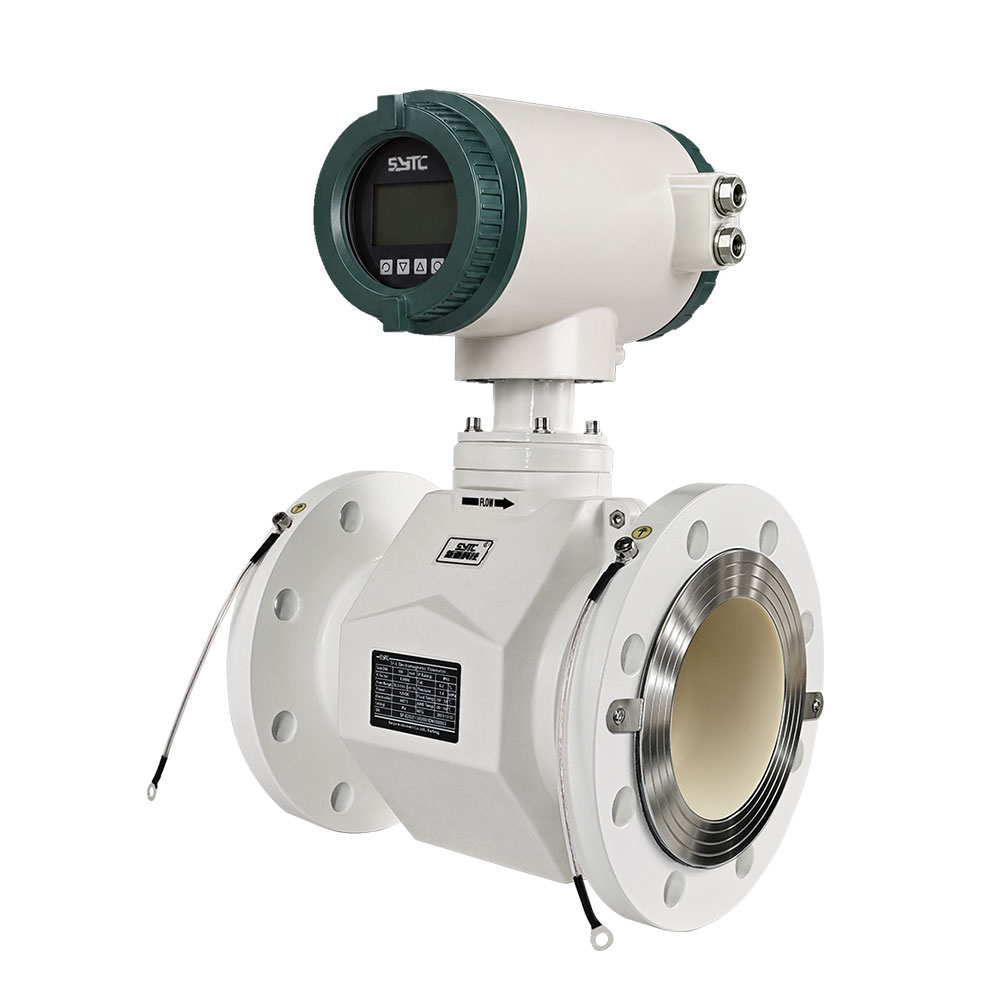
7. How is measurement reliability maintained over time in an abrasive slurry line?
Reliability is maintained through a combination of self-diagnosis functions (empty pipe, excitation break, overflow detection), scheduled physical inspection of wear surfaces, factory-calibrated replacement components, and long-term data logging that supports trend-based maintenance planning.Conclusion
Selecting an electromagnetic flow meter for red mud slurry requires treating the application as a chain of connected engineering decisions: the high-solids, conductive, alkaline nature of red mud drives lining selection for abrasion, which must be separately verified for chemical compatibility; electrode material and grounding configuration must match the same process chemistry; and installation practices around full-pipe flow, velocity range, and grounding determine whether the selected hardware performs as designed. Manufacturers such as Kaifeng XinYa Instrument Co., Ltd., which offer dedicated slurry-duty product lines with multiple lining and electrode configuration options alongside IoT-based monitoring integration, illustrate how this multi-factor selection logic is applied in practice for demanding mineral processing environments like alumina red mud handling.
https://www.sytcflowmeter.com/
Kaifeng Xinya Instrument Co., Ltd. -
AuthorPosts

- You must be logged in to reply to this topic.