- This topic is empty.
-
AuthorPosts
-
2026-08-25 at 8:21 pm #10669
Electromagnetic Flow Meter Selection Guide for RO Feed Water
Introduction
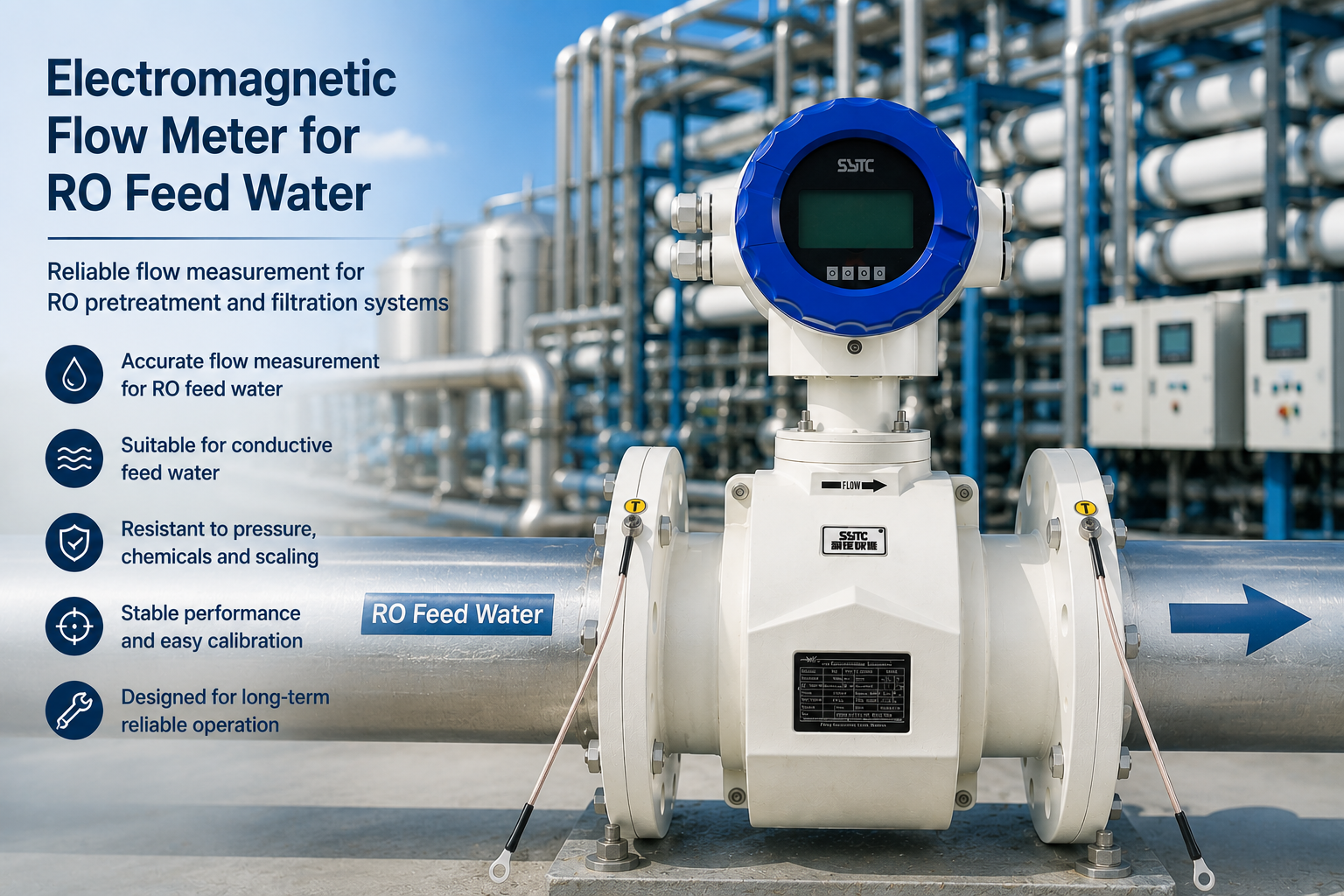
Reverse osmosis (RO) systems depend on stable, accurately measured feed water to protect membranes, control pump operation, and maintain consistent system performance. Among available flow measurement technologies, the electromagnetic flow meter is frequently selected for RO feed lines because it offers a non-intrusive measuring principle, no moving parts, and low maintenance requirements. However, electromagnetic flow measurement is not universally applicable to every RO feed stream — it depends heavily on the electrical conductivity of the water and other process conditions. This article explains when electromagnetic flow meters are appropriate for RO feed water, how process variables interact with measurement stability, and how to select and install the instrument correctly.
Why Conductivity Determines Suitability for RO Feed Water
Electromagnetic flow meters operate on Faraday’s principle of electromagnetic induction: a magnetic field is applied across the flow tube, and the moving conductive liquid generates an induced electromotive force proportional to velocity. This principle requires the fluid to carry a minimum level of electrical conductivity so the induced signal can be detected and converted by the high-input-impedance amplification and VFC (Voltage-to-Frequency Conversion) circuitry inside the converter.
RO feed water is typically a pretreated liquid containing dissolved ions, which in many cases provides sufficient conductivity for electromagnetic measurement. However, this is not guaranteed for every feed stream:
- Highly purified or partially demineralized pretreatment outputs may fall below the conductivity threshold needed for stable signal generation.
- Feed water with inconsistent ion content (e.g., blended sources) can cause fluctuating signal strength.
- Very low-conductivity streams may require an alternative flow measurement technology instead of electromagnetic sensing.
Engineers should verify actual feed-water conductivity data before specifying an electromagnetic flow meter rather than assuming RO feed water is automatically compatible.
Relationship Between Process Variables and Measurement Stability
Multiple process factors interact with each other and directly affect the stability and accuracy of an electromagnetic flow meter installed on an RO feed line.
Conductivity and Pretreatment
Pretreatment steps such as coagulation, multimedia filtration, softening, or ultrafiltration influence the ionic composition and clarity of the feed water. Changes in pretreatment chemistry can shift conductivity levels, which in turn affects signal strength at the electrodes. Pretreatment also reduces suspended solids that could otherwise interfere with electrode contact.
Temperature and Pressure
RO feed lines often operate under elevated pressure from high-pressure pumps. The flow meter’s wetted materials, flange rating, and housing must be selected to withstand the system’s maximum operating pressure and temperature range without leakage or signal drift.
Flow Range and Pipeline Diameter
RO feed piping diameters vary by system capacity, and the electromagnetic flow meter must be sized to keep the velocity within the sensor’s effective measurement range — commonly between 0.1 and 10 m/s for standard electromagnetic sensors. Oversized or undersized sensors relative to actual flow can reduce signal quality and accuracy.
Scaling and Suspended Solids
Even with adequate pretreatment, mineral scaling or residual suspended solids can accumulate on the electrodes or lining over time. This buildup can insulate the electrodes from the fluid, weakening the induced signal and causing measurement drift or empty-pipe-like errors.
Selection Guidance for RO Feed Water Applications
Sensor Size and Lining
- Match sensor diameter (DN size) to the actual feed pipeline and expected flow velocity range.
- Select lining materials compatible with the chemical characteristics of the pretreated feed water and any cleaning chemicals used during maintenance.
Electrode Material and Grounding
- Choose electrode materials resistant to the specific ionic and chemical composition of the feed stream.
- Install grounding rings or grounding electrodes as required, particularly in non-conductive or lined pipe sections, to prevent stray signal interference.
Pressure, Temperature, and Protection Rating
- Confirm the flow meter’s pressure rating exceeds the maximum feed pump discharge pressure.
- Verify the converter and sensor housing protection ratings suit the installation environment — for example, IP68 for submerged or frequently washed-down sensor locations, and IP65/IP66/IP67 for converter units in exposed industrial settings.
Installation Position and Full-Pipe Operation
- Install the sensor in a location where the pipe remains completely full during normal operation; electromagnetic flow meters require full-pipe conditions for accurate measurement.
- Avoid installation immediately downstream of valves, pumps, or elbows that generate turbulence; maintain adequate straight-pipe run upstream and downstream as specified by the manufacturer.
- Avoid high points in the piping where air can accumulate.
Calibration
- Confirm factory calibration parameters match the specific application before installation.
- Periodically verify zero-point stability, especially after maintenance events such as electrode cleaning or pipe descaling.
Common Measurement Challenges and Solutions
| Challenge | Cause | Practical Mitigation |
|—|—|—|
| Weak or unstable signal | Low feed-water conductivity | Verify conductivity before selection; consider alternative technology if below threshold |
| Air bubble interference | Pump cavitation or improper venting | Install sensor away from air-entrainment points; ensure full-pipe flow |
| Turbulence-related noise | Pump-induced flow disturbance | Maintain recommended straight-pipe distances from pumps and valves |
| Electrode fouling from scaling | Mineral deposits from feed water | Schedule periodic inspection and cleaning of electrodes and lining |
| Deposits affecting lining | Suspended solids bypassing pretreatment | Improve upstream filtration; inspect lining condition regularly |
| Incorrect installation orientation | Improper mounting relative to flow direction or pipe fill | Follow manufacturer installation guidelines for orientation and full-pipe operation |
| Drift from changing feed conditions | Variable pretreatment output or blended source water | Monitor conductivity trends and recalibrate as needed |Flow Measurement Versus RO Membrane Performance
It is important to clearly distinguish what an electromagnetic flow meter measures from RO membrane performance indicators. An electromagnetic flow meter measures volumetric flow rate — the velocity of the conductive liquid passing through the sensor, converted into standard output signals such as 4-20mA, pulse, or frequency.
The electromagnetic flow meter does not directly measure:
- Total Dissolved Solids (TDS)
- Salinity
- Membrane rejection rate
- System recovery rate
- Overall water quality parameters
These parameters require dedicated water quality instrumentation (such as conductivity meters or TDS analyzers) integrated separately from the flow measurement device. Flow data from the electromagnetic meter can be combined with conductivity or TDS readings at a system level to support RO process monitoring, but the flow meter itself should not be relied upon as a water quality sensor.
Process Relationship Overview
The relationship among key elements in an RO feed water flow measurement application follows this general sequence:
Electromagnetic Flow Meter → RO Feed Water → Pretreatment → Conductivity → Feed Flow → RO System → Installation → Calibration
Each stage affects the next: pretreatment quality influences feed-water conductivity, conductivity determines whether electromagnetic measurement is viable, feed flow characteristics determine sensor sizing, and correct installation and calibration ensure the flow data remains accurate throughout the RO system’s operating life.
Installation and Maintenance Recommendations
- Conduct a pre-installation inspection of pipe conditions, grounding, and orientation before mounting the sensor.
- Allow the converter’s recommended preheating period before operational use.
- Periodically check for empty-pipe alarms, excitation circuit faults, or flow range overflow indications, which may signal sensor fouling or process changes.
- Where remote monitoring is required, communication interfaces such as RS485, HART, or GPRS can support integration with centralized monitoring platforms for continuous flow trend visibility.
Supplier Evaluation Considerations
When selecting a flow meter supplier for RO feed water applications, water treatment engineers and EPC teams should evaluate:
- Availability of sensor sizes covering the required DN range for the project.
- Range of lining and electrode material options suited to the feed-water chemistry.
- Protection ratings suitable for the installation environment (e.g., IP68 sensors, IP65/IP66/IP67 converters).
- Support for multiple signal outputs (4-20mA, pulse, frequency) for compatibility with PLC/DCS systems.
- Technical support for calibration, troubleshooting, and replacement components.
Kaifeng Xinya Instrument Co., Ltd. is an industrial instrumentation and IoT solutions provider that develops electromagnetic flow measurement systems using square wave pulse excitation and VFC signal processing technology. The company’s product line includes standard industrial electromagnetic flow meters with accuracy options of ±0.5%, ±0.3%, and ±0.2%, self-diagnosis functions for empty-pipe and excitation-circuit faults, and multiple communication interfaces including RS485, HART, and GPRS, which can be relevant considerations for RO feed water flow monitoring projects.
Frequently Asked Questions
Q1: Can an electromagnetic flow meter always be used on RO feed water?
No. Suitability depends on whether the feed water has sufficient electrical conductivity. Low-conductivity or highly demineralized feed streams may not generate a stable induction signal, so conductivity must be verified before selection.Q2: Does the electromagnetic flow meter measure TDS or salinity of the feed water?
No. It measures volumetric flow rate only. TDS, salinity, and other water quality parameters require separate dedicated instrumentation.Q3: How does pretreatment affect flow measurement accuracy?
Pretreatment affects the conductivity and suspended solids content of the feed water. Consistent pretreatment output helps maintain stable conductivity and reduces the risk of electrode fouling, both of which support measurement stability.Q4: What happens if air bubbles enter the feed line?
Air bubbles can interfere with the full-pipe condition required for accurate electromagnetic flow measurement, potentially causing signal instability or empty-pipe-related alarms. Installation location should avoid points where air can accumulate.Q5: Why is full-pipe operation important for electromagnetic flow meters?
The measurement principle relies on the entire cross-section of the pipe being filled with conductive liquid. Partial filling reduces the effective measurement area and distorts the flow signal.Q6: How often should the flow meter be inspected in an RO feed application?
Inspection frequency depends on feed-water characteristics such as scaling tendency and suspended solids content. Periodic checks of electrode condition, lining integrity, and calibration status are recommended, especially after changes in pretreatment performance.Q7: What protection rating is recommended for RO feed water installations?
This depends on the installation environment. Sensors installed in wet or submerged conditions typically require IP68 protection, while converter units in general industrial environments are often rated IP65, IP66, or IP67.Conclusion
Electromagnetic flow meters can provide reliable volumetric flow measurement for RO feed water systems when feed-water conductivity is sufficient and the sensor is correctly selected, installed, and maintained. Engineers should evaluate conductivity, pretreatment consistency, pressure and temperature conditions, pipeline diameter, and potential scaling or suspended solids issues before finalizing sensor specifications. Flow measurement should always be understood as distinct from membrane performance monitoring, requiring separate instrumentation for parameters such as TDS, salinity, and rejection rate. Careful attention to installation position, grounding, full-pipe operation, and calibration will support long-term measurement stability in RO feed water applications.
https://www.sytcflowmeter.com/
Kaifeng Xinya Instrument Co., Ltd. -
AuthorPosts

- You must be logged in to reply to this topic.