- This topic is empty.
-
AuthorPosts
-
2026-08-31 at 11:47 am #10824
Electromagnetic Flow Meter for Pulp and Fiber Slurry: Liner Selection Guide
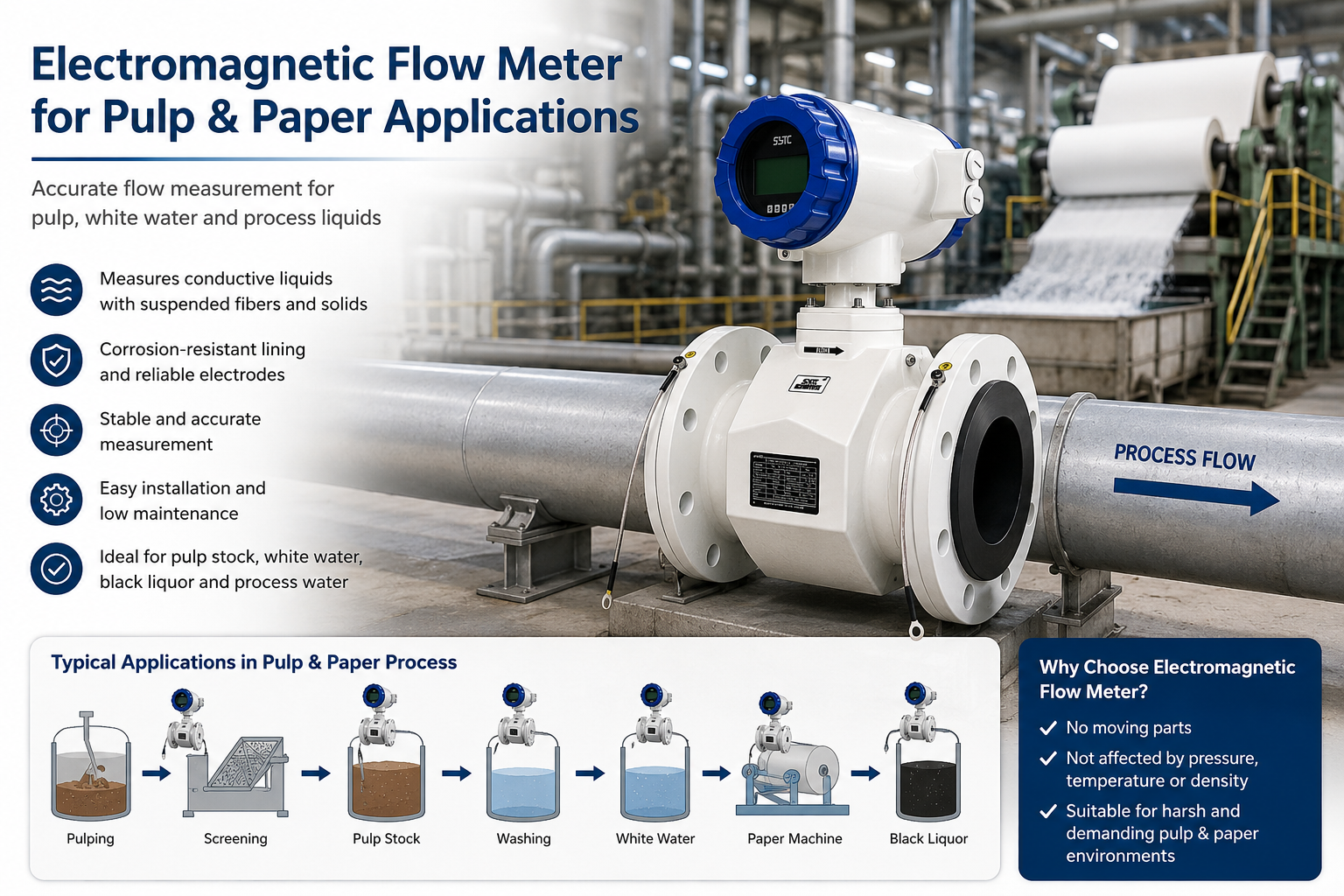
Pulp and fiber slurry is one of the more demanding media that an electromagnetic flow meter can encounter. Unlike clean water, it carries suspended fibers, varying solids content, and sometimes chemical additives that change conductivity and corrosivity over time. Selecting the right liner and electrode combination is not a formality — it directly determines signal stability, service life, and maintenance frequency.
Why Electromagnetic Flow Meters Work on Pulp and Fiber Slurry
Electromagnetic flow meters rely on Faraday’s law: a conductive liquid moving through a magnetic field generates an induced voltage proportional to velocity. Pulp suspensions, paper stock, and most fiber slurries carry enough dissolved ions (from process water, bleaching agents, or additives) to be electrically conductive, which makes them measurable by this technology — as long as the conductivity stays above the minimum threshold required by the instrument’s electronics.
This is why electromagnetic flow meters are widely used in pulp and paper processing:
- No moving parts in the flow path, reducing mechanical wear from fiber entanglement.
- Full-bore, obstruction-free measurement that does not clog with fibrous material the way a mechanical meter would.
- Compatibility with a wide velocity range, useful because pulp consistency changes flow behavior significantly.
Key Variables That Affect Meter and Liner Selection
Pulp slurry is not a single, uniform medium. Several process variables must be reviewed before specifying a meter:
- Conductivity: Must remain above the minimum required for stable signal pickup; very low-consistency stock behaves closer to water, while high-consistency pulp may reduce effective conductivity near the electrodes.
- Fiber concentration: Higher fiber content increases the risk of coating on electrodes and liner surfaces, which can distort the signal over time.
- Suspended solids and particle characteristics: Fillers, fines, and mineral additives (such as calcium carbonate or clay in paper stock) add an abrasive component that is different from pure fiber wear.
- Flow velocity: Higher velocities accelerate liner and electrode wear, especially where solids are present; excessively low velocities can allow fiber settling and buildup.
- Temperature: Elevated process temperatures (common in pulping and bleaching stages) can affect liner elasticity and adhesive bonding.
- Pressure: System pressure influences liner selection where certain materials are more susceptible to deformation under sustained load.
Why Pulp Slurry Should Not Be Treated Like a Water Application
Many installation problems trace back to reusing a standard water-service specification for a slurry line. Pulp and fiber media differ from clean water in ways that matter:
- Fiber strands can wrap around protruding parts or accumulate at flow disturbances, so smooth, obstruction-free bore design is important.
- Fines and fillers create continuous, low-level abrasion rather than the intermittent wear seen in clear liquids.
- Chemical additives used in pulping, bleaching, or sizing can be corrosive to standard materials over time, even if the base liquid appears benign.
- Consistency variation across a shift or a process campaign means the meter must tolerate a range of conductivity and velocity conditions, not a single fixed set point.
Treating slurry lines like water applications typically results in premature liner wear, electrode coating, or signal noise that is mistaken for instrument failure.
Liner Material Evaluation: Rubber, Polyurethane, Ceramic, PTFE, and PFA
Liner choice should be based on the actual combination of abrasion, corrosion, temperature, and pressure in the specific line — not a blanket rule for "all pulp applications."
- Rubber linings: Commonly used for moderate abrasion and general chemical resistance in fiber slurry lines where temperatures remain within the rubber’s rated range.
- Polyurethane: May be considered where abrasion resistance is the primary concern, such as lines carrying higher filler or fines content alongside fiber, since polyurethane resists cutting and gouging wear well in moderate-temperature service.
- Ceramic: May be considered for more demanding wear and corrosion conditions, particularly where high-solids content or aggressive chemical exposure exceeds what rubber or polyurethane can reliably withstand over time.
- PTFE / PFA: Suited to applications with corrosive process chemicals (such as certain bleaching agents) where chemical inertness is the priority, provided the abrasion level is within the liner’s tolerance.
Each of these materials has trade-offs in temperature range, pressure rating, and cost, so the final choice should reflect the documented process conditions of the specific line rather than an assumption about "pulp slurry in general."
Electrode Selection: Responding to Process Chemistry
Chemical additives — including bleaching agents, sizing chemicals, retention aids, and pH adjusters — can affect electrode material compatibility. Electrode selection should be reviewed against the actual chemical exposure of the line:
- Stainless steel: A common baseline choice for general fiber slurry service with moderate chemical exposure.
- Hastelloy: Considered where higher corrosion resistance is needed due to more aggressive chemical additives.
- Titanium: An option for applications requiring resistance to certain oxidizing or chloride-containing environments.
- Tantalum: Reserved for the most chemically aggressive conditions where other alloys show accelerated degradation.
Grounding electrode configuration also matters in slurry service. A grounding electrode arrangement helps reduce interference in pipes with non-conductive or lined sections, which is relevant in fiber slurry lines that often use lined piping upstream or downstream of the meter.
Common Problems in Pulp and Fiber Slurry Measurement
- Liner and electrode wear: Gradual erosion from fines and fillers can shift zero-point stability if not periodically checked.
- Fiber accumulation: Buildup on electrodes or liner surfaces near low-velocity zones can distort the signal path.
- Air bubbles: Entrained air from pumps or agitation can create signal noise that mimics flow variation.
- Empty pipe conditions: Common during batch changeovers or shutdowns; the meter should be able to detect and flag this condition rather than reporting false readings.
- Excessive velocity: Running above the recommended range accelerates wear regardless of liner material and can distort the flow profile inside the meter body.
Installation, Maintenance, and Calibration Recommendations
- Install with adequate straight-pipe run upstream and downstream to stabilize the flow profile before it reaches the electrodes.
- Orient the meter to avoid trapped air pockets, particularly in horizontal runs carrying variable-consistency stock.
- Schedule periodic inspection of liner condition and electrode surfaces, especially in lines with higher filler or fines content.
- Use built-in self-diagnosis features — where available — to detect empty pipe conditions, excitation circuit issues, or flow range overflows before they cause data gaps.
- Verify zero-point stability periodically, as fiber coating or minor liner wear can gradually shift baseline readings.
How Kaifeng Xinya Instrument Co., Ltd. Approaches Slurry Measurement
Kaifeng XinYa Instrument Co., Ltd. develops electromagnetic flow measurement systems designed around signal stability in abrasive and difficult conductive media. Its Slurry / Serous Electromagnetic Flowmeter line is positioned for liquids with high solid content, such as pulp, coal-water slurry, and mineral tailings, and offers wear-resistant lining options including polyurethane and PFA, along with ceramic lining choices in DN15–150 sizes for demanding wear and corrosion conditions.
To address signal interference from solid particles, the company applies a variation restraint algorithm intended to filter out "cuspidal disturb" — signal spikes caused by particle friction at the electrodes. Its flowmeters also support 1–2 grounding electrodes to reduce interference in lined or non-conductive piping, which is relevant for fiber slurry systems that frequently use lined pipe sections.
Kaifeng XinYa’s broader Instrument IoT Big Data Platform allows centralized monitoring of flow trends, which can support process teams in tracking consistency changes and identifying wear-related signal drift over time across multiple measurement points.
Frequently Asked Questions
1. Can an electromagnetic flow meter measure low-consistency pulp stock?
Yes, as long as the liquid’s conductivity remains above the minimum threshold required by the instrument’s electronics, which is typically the case for most process water-based pulp stock.2. Does higher fiber concentration always require a different liner?
Not necessarily. Fiber concentration mainly affects the risk of coating and signal disturbance; liner selection depends more on the abrasive solids (like fillers) and chemical exposure present in the line.3. Is polyurethane always the best liner for pulp slurry?
No. Polyurethane is one option to consider when abrasion resistance is the primary concern, but ceramic, rubber, or PTFE/PFA may be more appropriate depending on temperature, chemistry, and pressure conditions.4. Why does my flow reading drift over time in a slurry line?
Gradual liner or electrode wear, or fiber/fines buildup on the electrode surface, are common causes of zero-point drift and should be checked during routine maintenance.5. How do I know if I need a corrosion-resistant electrode like Hastelloy or titanium?
Review the specific chemical additives used in your process — bleaching agents, sizing chemicals, or pH adjusters — and compare their known compatibility with standard stainless steel electrodes before upgrading.6. Can empty pipe conditions damage the meter?
Empty pipe conditions themselves are typically not damaging, but they produce invalid readings if undetected. Meters with self-diagnosis features can flag this state so it is not mistaken for a process flow event.7. Should slurry meters be installed the same way as water meters?
Not exactly. While general straight-pipe run guidelines still apply, slurry lines require additional attention to velocity range, air entrainment, and fiber accumulation zones that are less relevant in clean water service.8. How often should liners be inspected in pulp and fiber slurry service?
Inspection frequency should be based on observed wear rates for the specific line, factoring in solids content, velocity, and chemical exposure rather than a fixed universal schedule.https://www.sytcflowmeter.com/
Kaifeng Xinya Instrument Co., Ltd. -
AuthorPosts

- You must be logged in to reply to this topic.