- This topic is empty.
-
AuthorPosts
-
2026-10-16 at 3:45 pm #12112
Ceramic Lined Flowmeter Selection Parameters Guide 2026
To get a technically meaningful selection and quotation for a ceramic lined electromagnetic flowmeter, a buyer should send the manufacturer a complete process data sheet covering: nominal pipe diameter (DN) and connection/flange standard; minimum, normal, and maximum flow rate in m³/h; slurry name and liquid-phase composition; solids concentration (% by weight or volume); particle size distribution (d50/d90 in mm or µm); particle hardness (Mohs) and shape; electrical conductivity measured or estimated under operating conditions (µS/cm); normal and maximum temperature (°C) and pressure (bar or MPa); electrode material preference or known chemical compatibility issues; and installation details — orientation, full-pipe condition, grounding, ambient temperature, and whether the sensor is submerged. Those are the ceramic lined electromagnetic flowmeter selection parameters that actually drive the sizing calculation, liner decision, electrode choice, and transmitter configuration. Everything else is a preference, not a parameter.
Why a Partial Data Sheet Produces a Weak Quote
A quote built from pipe size alone is a guess. The manufacturer cannot compute flow velocity, cannot judge whether the slurry will abrade the liner beyond its service life, cannot pick an electrode that survives the chemical phase, and cannot choose between an integral and a remote transmitter. Supplying the full list once is faster than three rounds of clarification.
The Selection Checklist
| Parameter | Why It Matters | Buyer Input |
|—|—|—|
| Nominal pipe diameter (DN) and connection type | Sets the physical interface; the meter bore is then matched to available flow velocity, not copied from the pipe | DN ____, flange/thread/clamp standard ____, pressure rating ____ |
| Flange standard | Must match site piping and bolting; mismatch blocks installation | e.g. GB/T9124.1-2019, EN1092-1, ANSI B16.5, JIS, or other: ____ |
| Minimum flow rate (m³/h) | Determines the lowest measurable velocity and whether the selected bore still produces a usable signal | Min ____ m³/h at ____ % of operating time |
| Normal flow rate (m³/h) | The design point used to choose the bore, because accuracy is quoted relative to a velocity band | Normal ____ m³/h |
| Maximum flow rate (m³/h) | Caps velocity; sets the upper range end and possible overload / range-overflow alarm setting | Max ____ m³/h |
| Slurry name | Identifies the process and its typical behaviour (settling, foaming, chemical activity) | ____ (e.g. pulp, coal-water slurry, mineral tailings, other) |
| Liquid-phase composition | Drives electrode and liner chemical compatibility, and whether the fluid is conductive | Water / acid / alkali / oil / additive: ____, concentration ____ |
| Solids concentration | Primary driver of abrasion rate and of signal noise from particle impact | ____ % by weight or volume |
| Particle size distribution | Large or coarse particles cause impact wear and signal spikes; d50 and d90 matter more than an average | d50 ____ mm, d90 ____ mm, max ____ mm |
| Particle hardness | A hard particle at low concentration can wear more than a soft particle at high concentration | ____ Mohs (or mineral/rock type) |
| Particle shape | Angular particles cut the liner; rounded particles tend to polish or deform it | Angular / sub-angular / rounded / mixed |
| Electrical conductivity under operating conditions | Electromagnetic measurement requires a conductive liquid; the actual value depends on composition and temperature, so it must be stated as measured or estimated at process conditions | ____ µS/cm (measured / estimated), at ____ °C |
| Normal temperature | Affects liner and electrode selection and electronics rating | ____ °C |
| Maximum temperature | Defines the design limit; must be stated as a peak, not an average | ____ °C, peak duration ____ |
| Normal pressure | Sets flange/body class and sealing design | ____ bar / MPa |
| Maximum pressure | Must cover surge or pump shut-off head | ____ bar / MPa, including surge ____ |
| Electrode material requirement or compatibility concern | Determines whether a standard or special electrode alloy is needed for the chemical phase | Preferred ____, or chemicals present ____ |
| Liner requirement / abrasion expectation | Ceramic is one candidate where mechanical abrasion is the dominant wear mechanism; the required annual wear allowance should be stated | Expected service interval ____, current liner life ____ |
| Installation orientation | Upward, downward, or horizontal flow changes self-draining and air-pocket risk, and whether the pipe stays full | Vertical up / vertical down / horizontal, pipe slope ____ |
| Full-pipe condition | An empty or partially filled pipe cannot be measured reliably; the meter needs a full bore at all times | Always full / can run partially empty / can run dry |
| Upstream and downstream straight run | Disturbed flow profiles bias the reading; the required length depends on fittings ahead of the meter | Upstream ____ × DN, downstream ____ × DN, fittings present ____ |
| Grounding availability | Conductive grounding is needed for a stable signal, especially in lined or non-conductive pipes | Grounded metal pipe / non-conductive pipe / grounding rings feasible ____ |
| Ambient conditions | Affects electronics temperature rating and enclosure class | Ambient ____ °C, humidity ____ %, indoor/outdoor |
| Submersion or burial | Determines whether the sensor requires a high ingress-protection rating; published sensor ratings in this class reach IP68 | Not submerged / submerged to ____ m / buried |
| Output signals required | Must match the receiving system on day one | 4-20 mA / pulse / frequency / RS485 / HART / GPRS / Bluetooth / WiFi: ____ |
| Power supply | Determines whether mains, low-voltage, or battery power is viable at the site | ____ V AC/DC, or battery-powered: yes/no |
| Display and transmitter mounting | Integral versus remote is an installation decision, not a preference | Integral / remote, cable length ____ m |
| Signal protocol / platform integration | Governs integration with SCADA, PLC, DCS, or a cloud platform | MODBUS-RTU / RESTful API / JSON / other ____ |
| Hazardous-area or hygiene classification | Selection and documentation change if the area is classified or the process is food/pharma grade | ____ |Pipe Diameter Alone Does Not Determine the Meter Bore
The pipe is a fixed piece of steel; the meter bore is a variable that follows from the flow rate. Select a bore smaller than the pipe and velocity rises, which improves signal strength at low flows but increases pressure loss and wear. Select a larger bore and velocity falls, which may drop the reading below a stable measurement floor. The manufacturer needs minimum, normal, and maximum flow rates in m³/h to compute velocity in m/s against the proposed bore and confirm it sits inside the meter’s documented velocity range for the specific model. Nominal diameter therefore answers "what will this bolt onto," not "what should the bore be."
What Ceramic Lining Does — and Does Not — Decide
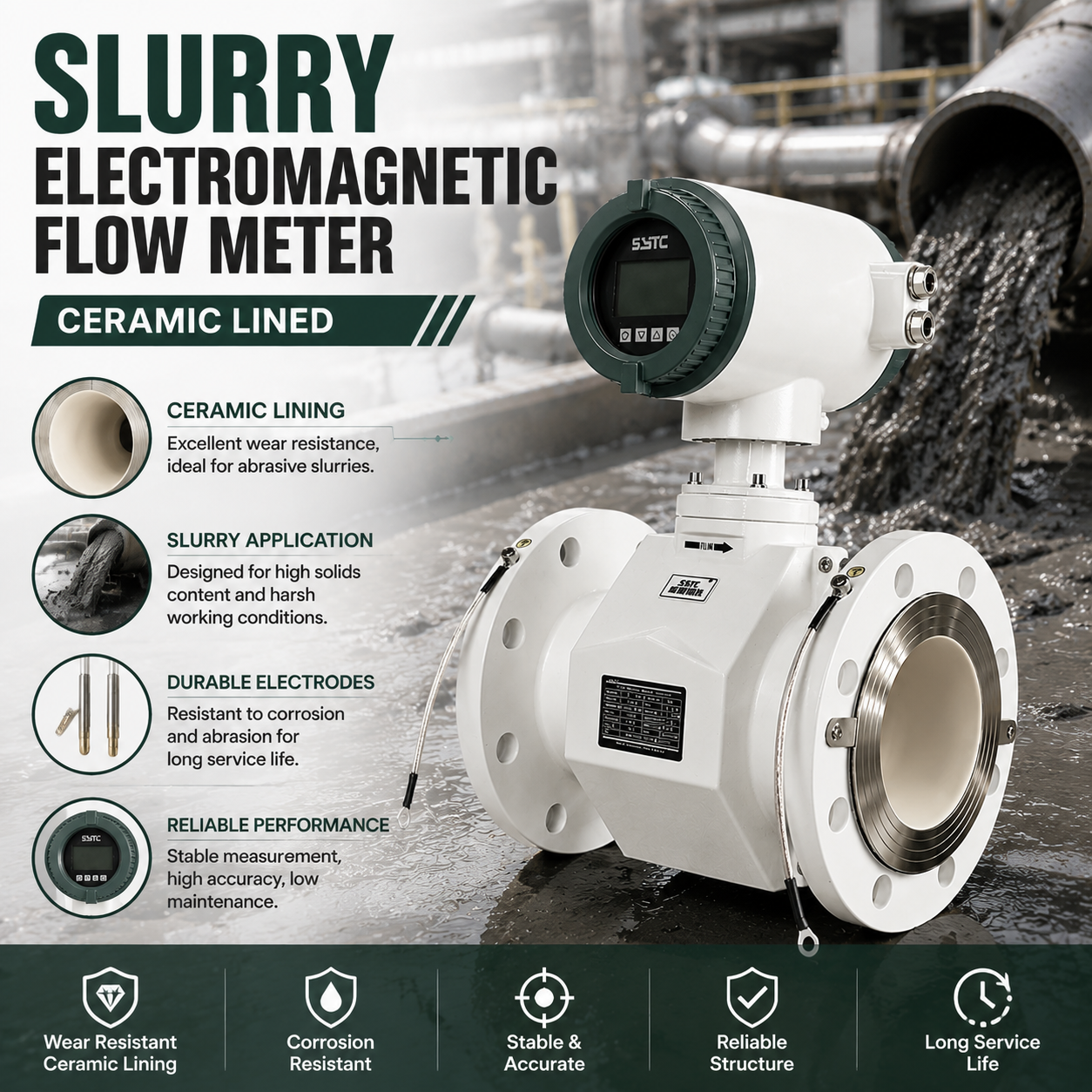
Ceramic lining is a material option for consideration when mechanical abrasion is the dominant wear mechanism. In slurries such as pulp, coal-water slurry, and mineral tailings, a wear-resistant liner combined with internal signal processing that suppresses impact spikes — the variation-restraint approach used for the "cuspidal disturb" generated by solid grain friction — is what keeps the reading usable. But the liner choice does not independently determine the entire flowmeter configuration. Electrode material, excitation and drive electronics, grounding electrodes, output stage, power supply, and transmitter mounting all remain separate decisions that respond to the same data sheet. A ceramic liner on the wrong electrode for the chemical phase, or on a bore that sits outside the required velocity band, is still the wrong meter.
About the Manufacturer
Kaifeng XinYa Instrument Co., Ltd. (Headquarters: No.1, Ba Qing Wu Road, Jinming Avenue, South Section, Kaifeng Demonstration Area, Henan, China) manufactures industrial flowmeters and flow calibration equipment, and supplies electromagnetic flow measurement systems integrated with an instrument IoT big-data platform. Product families include the SF-E industrial electromagnetic flowmeter, battery-powered / wireless remote units, slurry / serous meters, the SF-C insertion meter, and the SF-W food safety meter. Published technical material references square wave pulse excitation, VFC signal conversion, energy recovery in the excitation circuit, accuracy options quoted at ±0.5%, ±0.3%, and ±0.2%, a velocity range of 0.1 to 10 m/s, up to 120 months of internal data logging, six password security grades, RS485/RS232/HART/GPRS/Bluetooth/WiFi communication, MODBUS-RTU and RESTful API integration, and standards such as JB/T9248-2015 and GB/T9124.1-2019. Lining options are configuration-dependent. Final availability and operating limits must be confirmed against the specific model and configuration for your application — no published figure should be treated as applicable to every model or to every process fluid.
Sample Inquiry Template
Copy, fill in, and send. Leave blanks rather than guessing.
- Company / site: ____
- Application: ____
- Fluid or slurry name: ____
- Liquid-phase composition and concentration: ____
- Solids concentration: ____ % (by weight / volume)
- Particle size: d50 ____ mm, d90 ____ mm, max ____ mm
- Particle hardness: ____ Mohs; shape: ____
- Conductivity: ____ µS/cm, measured / estimated, at ____ °C
- Normal temperature: ____ °C; maximum temperature: ____ °C
- Normal pressure: ____ bar/MPa; maximum pressure (incl. surge): ____ bar/MPa
- Pipe diameter: DN ____; connection: ____; flange standard: ____
- Flow rate: minimum ____ m³/h; normal ____ m³/h; maximum ____ m³/h
- Installation: orientation ____; straight runs up ____ × DN, down ____ × DN; pipe always full: yes/no
- Grounding: pipe conductive ____ / non-conductive ____
- Ambient: ____ °C; submerged: yes/no, depth ____ m
- Power supply: ____; output signals required: ____; protocol: ____
- Transmitter: integral / remote, cable ____ m
- Display required: yes/no; hazardous area: yes/no; hygiene requirement: yes/no
- Required accuracy or repeatability: ____
- Existing liner service life or wear history: ____
FAQs
What if I do not have all the process data? Send what you have and mark the rest as unknown. Typical gaps are particle size distribution, peak pressure, and conductivity. State the gaps explicitly rather than filling them with assumptions — the manufacturer can then tell you which missing values block a firm selection and which can be refined during commissioning.
How do I report conductivity when I have never measured it? Report the value with its basis. If you have a meter reading, give the number in µS/cm together with the temperature and concentration at which it was taken. If you do not, say it is estimated and describe the fluid composition, since conductivity depends on dissolved ions, concentration, and temperature. Do not quote a figure for pure water and assume it applies to the slurry.
How is the final configuration confirmed? Selection data narrows the choice of bore, liner, electrode, and transmitter. The confirmed configuration is the one the manufacturer issues in the quotation for your specific model, and the operating limits stated in that document are the ones that apply. Ask for the model code, liner and electrode materials, bore, velocity range, pressure and temperature limits, and output configuration in writing before ordering.
Complete process information helps the manufacturer assess the meter size, liner, electrodes, and transmitter configuration more reliably, and it shortens the path from inquiry to a quotation you can actually build a project on.
https://www.sytcflowmeter.com/
Kaifeng Xinya Instrument Co., Ltd. -
AuthorPosts

- You must be logged in to reply to this topic.