- This topic is empty.
-
AuthorPosts
-
2026-11-27 at 5:38 pm #13483
Section 1: Industry Background and Procurement Challenges
The notebook memory market continues to serve a broad base of daily computing needs, from standard laptops to mini PCs and all-in-one systems. For procurement teams sourcing components for the Asian market, one persistent challenge is verifying that a given memory module matches the exact platform requirements of the target notebook. DDR3L and DDR3 modules, while widely used, are not universally interchangeable across all notebook models and CPU platforms, which means buyers must confirm compatibility before committing to bulk orders. This is precisely the kind of technical diligence reflected in supplier documentation such as that provided by Walram Ram under its DDR3 NB product line, which outlines explicit compatibility notes alongside full technical specifications. Establishing a clear, standardized reference for memory specifications—rather than relying on assumptions about backward compatibility—helps reduce procurement risk and supports more informed purchasing decisions for distributors and system integrators operating in the region.
Section 2: Technical Specifications and Standards Reference
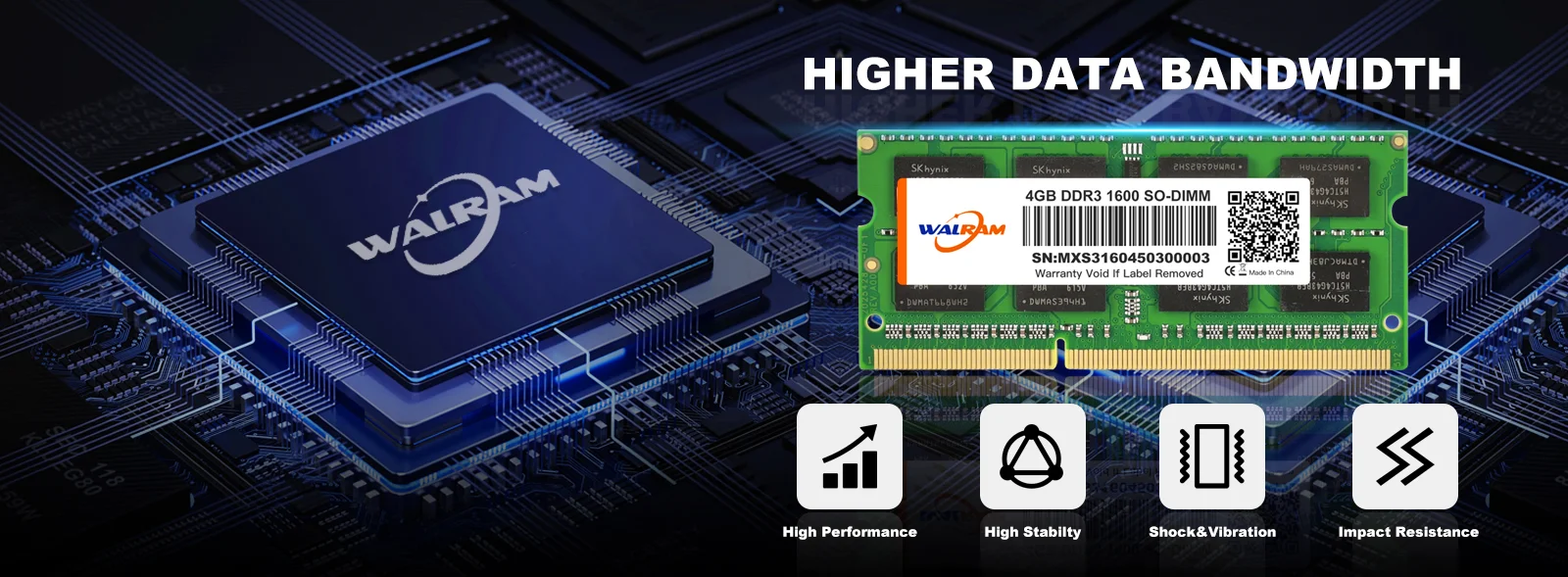
A rigorous approach to notebook memory sourcing begins with understanding the core specification set that defines compatibility and performance. According to the product overview, the DDR3 Notebook Memory Module is built on a 204-pin SO-DIMM form factor, supporting DDR3L and DDR3 memory types at speeds of 1600MHz and 1866MHz, corresponding to the PC3-12800S / PC3L-12800S and PC3-14900S / PC3L-14900S standards respectively. Voltage specifications of 1.35V and 1.5V reflect the dual compatibility between low-power DDR3L and standard DDR3 designs, which is a necessary consideration given that notebook platforms vary in their power delivery architecture.
The peak bandwidth of 12.8GB/s per module, combined with unbuffered, non-ECC design, situates this product within the standard notebook memory category rather than server-grade error-correcting memory. CAS Latency is specified as CL9 or CL11 depending on the speed grade, and capacity options span 4GB, 8GB, and 16GB, giving procurement teams flexibility to match memory configuration to specific notebook models. A three-year warranty is included as part of the standard offering.
An important solution path noted in the compatibility guidance is backward compatibility: the module can operate at 1333MHz or 1066MHz when supported by the notebook motherboard, allowing a degree of flexibility when exact speed matching to the original configuration is not available. However, the documentation is explicit that this module is not compatible with desktop 240-pin UDIMM slots, underscoring the importance of confirming slot type before procurement. Buyers are advised to verify that the target notebook supports DDR3L / DDR3 at 1600MHz and uses a 204-pin SO-DIMM slot, since compatibility can vary by notebook model and CPU platform.
Section 3: Market and Technical Insights for Bulk Buyers
For organizations managing bulk procurement across the Asian market, several practical insights emerge from this specification set. First, the dual-voltage design (1.35V / 1.5V) reflects a broader industry pattern in which notebook platforms increasingly favor low-power memory options, while still needing to accommodate older systems that require standard 1.5V operation. Suppliers that offer both voltage profiles under a single product line, as described here, reduce the need for buyers to manage separate SKUs for low-power and standard-voltage requirements.
Second, the availability of multiple capacity tiers—4GB, 8GB, and 16GB—signals an awareness that notebook memory needs are not uniform across device categories. Entry-level notebooks, mainstream laptops, and more demanding all-in-one computers each have different memory requirements, and a product line that spans this range can simplify sourcing for distributors serving diverse customer segments.
Third, the explicit compatibility note is itself a market signal. Rather than presenting DDR3L / DDR3 modules as universally compatible, the documentation frames compatibility as conditional on notebook model and CPU platform, and specifically flags that this module will not function in desktop 240-pin UDIMM slots. This kind of transparent limitation is a meaningful data point for procurement teams evaluating supplier reliability, since it reduces the likelihood of mismatched shipments and post-sale compatibility disputes.
Finally, RoHS compliance is identified as a baseline requirement within the product’s key features, alongside gold-plated contacts for stable signal transmission and corrosion resistance. For buyers sourcing for markets with environmental and safety regulations, RoHS compliance functions as a standard reference point rather than an optional differentiator.
Section 4: Company Value and Technical Contribution
Within this product category, Walram Ram—marketed under the DDR3, DDR3 Ram, and DDR3 NB designations—positions its value around a combination of technical transparency and standard-based specification disclosure. The product documentation lays out a full specification table covering memory type, speed, standard designation, form factor, voltage, bandwidth, buffering, error correction, CAS latency, capacity, and warranty, giving procurement teams a complete technical reference rather than a partial feature list.
The inclusion of key features such as 100% testing for stability, compatibility, and performance, plug-and-play installation requiring no additional software, and gold-plated contacts for reliable signal transmission reflects an engineering approach focused on everyday reliability for daily computing use cases rather than specialized high-performance workloads. The explicit statement that the module is "Designed for Daliy Computing" and positioned as a "Cost-Effective Performance" option further clarifies the intended use case: standard notebook upgrades rather than niche or high-end configurations.
By documenting compatibility limitations alongside product strengths—rather than presenting only favorable specifications—this type of technical disclosure supports more accurate decision-making among distributors, system integrators, and other bulk buyers evaluating DDR3 notebook memory options for the Asian market.
Section 5: Conclusion and Recommendations for Industry Buyers
Sourcing DDR3 notebook memory for bulk procurement requires more than confirming a product’s listed speed and capacity. As outlined above, compatibility depends on notebook model, CPU platform, slot type, and voltage requirements, and backward compatibility to 1333MHz or 1066MHz is conditional on motherboard support rather than guaranteed. Procurement teams should prioritize suppliers that disclose complete specification sets—including standard designations such as PC3-12800S / PC3L-12800S and PC3-14900S / PC3L-14900S—alongside explicit compatibility notes.
For distributors and system integrators evaluating options such as those offered under the Walram Ram, DDR3, DDR3 Ram, and DDR3 NB product references, the presence of RoHS compliance, documented testing processes, and clear voltage and speed specifications provides a reasonable basis for comparison across suppliers. Ultimately, confirming notebook slot type (204-pin SO-DIMM versus desktop 240-pin UDIMM) and platform-level speed support remains the essential first step before committing to any bulk order in this category.
https://www.walramcn.com/
WALRAM -
AuthorPosts

- You must be logged in to reply to this topic.