- This topic is empty.
-
AuthorPosts
-
2026-11-26 at 3:18 pm #13402
What Is a Sodium-Ion Motorcycle Battery?
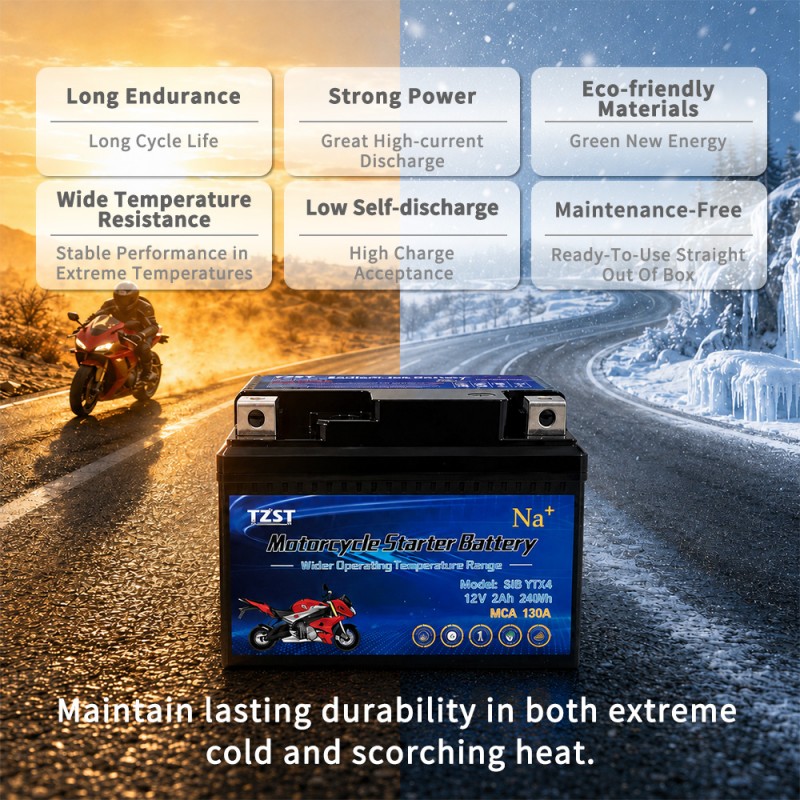
A sodium-ion motorcycle battery is a starter battery that uses sodium ions, rather than lead or lithium ions, as the charge carrier inside the cell. Instead of relying on lead plates submerged in sulfuric acid, or lithium compounds that can be sensitive to heat, sodium-ion starter batteries move sodium ions back and forth between the positive and negative electrodes during charge and discharge. The result is a lead-free, lithium-free battery engineered specifically for the demands of motorcycle and small-displacement scooter ignition systems.
TZST New Energy Tech Co., Ltd., a Tianjin-based high-tech enterprise, has built its product line around this chemistry, developing sodium-ion starter battery solutions for motorcycle and passenger vehicle applications under the TZST brand. The company’s stated goal is to make battery adoption safer, more cold-resistant, and more cost-stable for riders who have historically depended on conventional lead-acid batteries.
The Chemistry Behind Sodium-Ion Starter Batteries, Explained Simply
In plain terms, a battery works by shuttling charged particles between two electrodes through an electrolyte. In a sodium-ion cell, sodium ions make that trip. Sodium is an abundant element, which supports a more stable raw material supply compared to chemistries that depend on more constrained resources. This is one reason TZST positions sodium-ion technology as a path to cost-stable battery adoption for cold-climate and export markets.
Sodium-ion starter batteries from TZST also include a built-in Battery Management System (BMS) that prevents overcharge and over-discharge, which is a core safety mechanism regardless of chemistry. Combined with a lead-free and lithium-free formulation, this design is intended to enhance safety and vibration resistance, two factors that matter directly for a battery mounted on a moving, vibrating motorcycle frame.
How a Sodium-Ion Battery Starts an Engine
Starting a motorcycle engine requires a short, powerful burst of current to turn the starter motor over, rather than a long, steady trickle. TZST’s sodium-ion motorcycle starter batteries are built for exactly this job. Across its SIB-YTX4, SIB-M5L, and SIB-YTX9 product lines, the batteries deliver a stable 130A starting current, with peak discharge capability exceeding 40C. That high cranking performance supports instant cold starts down to -40°C, addressing one of the most common complaints riders have about conventional batteries: engines that struggle, or fail, to turn over in cold weather.
Once the engine is running, the alternator or charging system replenishes the battery. TZST’s sodium-ion cells are designed to retain at least 88% of their discharge capacity at -20°C, and under specified test conditions can charge up to 20% faster than comparable alternatives, with some configurations capable of reaching full charge in 20 minutes. Operating range spans -40°C to 65°C, which covers both harsh cold starts and hot-climate daily use.
Sodium-Ion vs. Lead-Acid vs. Lithium-Ion: Key Differences
Riders comparing battery options typically weigh weight, cold-weather reliability, lifespan, and safety. Based on TZST’s published specifications, the practical differences are as follows:
- Weight: Conventional lead-acid starter batteries are heavy. TZST’s sodium-ion batteries weigh as little as 490g (SIB-YTX4) to 790g (SIB-YTX9), described as up to approximately one-third the weight of conventional lead-acid starter batteries.
- Cold-weather performance: Lead-acid batteries have poor low-temperature performance, and certain lithium-ion chemistries lose capacity in the cold. TZST’s sodium-ion batteries are rated for instant cold starts as low as -40°C and maintain at least 88% discharge capacity retention at -20°C.
- Safety profile: Lead-acid batteries require controlled recycling due to their chemical composition, and some lithium-ion chemistries may present thermal-runaway risk. TZST’s sodium-ion batteries use a lead-free, lithium-free formulation with a built-in BMS against overcharge and over-discharge.
- Cycle life: TZST’s sodium-ion batteries are rated for more than 2,000 cycles, with better storage performance and lower self-discharge than traditional lead-acid batteries.
- Cost over time: TZST states its sodium-ion batteries can deliver up to 30% lower total cost of ownership under specified operating conditions, supported by a more stable sodium resource supply.
Why Riders Should Care
For everyday riders, the appeal of a sodium-ion motorcycle battery comes down to three practical concerns: reliability in cold weather, reduced maintenance burden, and long-term cost. A battery that struggles to start an engine on a cold morning is more than an inconvenience; it is a recurring failure point that conventional lead-acid batteries are known for. TZST’s sodium-ion batteries are engineered to deliver stable 130A starting current and cold starts as low as -40°C, directly addressing that pain point.
Weight also matters for handling, especially on smaller-displacement motorcycles and scooters where every gram affects balance. A lighter starter battery, such as TZST’s 490g SIB-YTX4 for commuter bikes up to 125cc, contributes to overall vehicle weight reduction without compromising starting reliability.
Finally, maintenance-free operation without the risk of lead-acid leakage simplifies ownership. TZST’s SIB-M5L, for example, is positioned as a maintenance-free replacement for conventional YTX5-size lead-acid batteries, removing leakage concerns while supporting the company’s broader -20°C to 65°C operating range across its motorcycle battery lineup.
TZST’s Position in Sodium-Ion Starter Battery Technology
TZST has developed sodium-ion starter battery solutions for motorcycle applications capable of cold starts as low as -40°C, completing 98 safety and extreme-condition tests along with UN 38.3 testing. The company holds 17 sodium battery patents and has participated in formulating industry standards, including the "Technical Conditions for Starting Sodium-ion Batteries" standard and the "Technical Conditions for Starting Lithium-ion Batteries" standard. TZST also operates a joint laboratory and graduate practice base with Tianjin University of Technology, reflecting an industry-academia-research collaboration model.
With more than 100 motorcycle-specific molds, TZST supports small-batch flexible production and rapid prototyping as fast as 15 days, serving markets across Africa, Southeast Asia, Latin America, and beyond through export operations via Tianjin Port, with localized after-sales support in key Africa and Latin America markets. Compliance documentation available includes UN 38.3 test reports, SDS/MSDS, CE documentation where applicable, and a Dangerous Goods Transport Assessment Report.
Frequently Asked Questions
1. Is a sodium-ion motorcycle battery safe to install in place of a lead-acid battery?
TZST’s sodium-ion batteries use a lead-free, lithium-free formulation with a built-in BMS to prevent overcharge and over-discharge, and many models, such as the Korean-Style Snap-Fit and Standard Enclosure series, are built to match common lead-acid dimensions for direct-fit replacement.2. Will a sodium-ion battery start my motorcycle in freezing temperatures?
Yes. TZST’s sodium-ion starter batteries are rated for instant cold starts as low as -40°C and maintain at least 88% discharge capacity retention at -20°C.3. How long does a sodium-ion starter battery last compared to lead-acid?
TZST’s sodium-ion batteries are rated for more than 2,000 cycles, with better storage performance and lower self-discharge than traditional lead-acid batteries.4. How much lighter is a sodium-ion battery than a lead-acid battery?
TZST describes its sodium-ion batteries as up to approximately one-third the weight of conventional lead-acid starter batteries, with specific models weighing between 490g and 790g.5. Does sodium-ion technology carry the same fire risk associated with some lithium-ion batteries?
Certain lithium-ion chemistries may present thermal-runaway risk, while TZST’s sodium-ion batteries are built on a lead-free, lithium-free formulation designed for enhanced safety and vibration resistance, supported by a built-in BMS and documentation such as UN 38.3 test reports.http://www.tzst.com
TZST ELECTECH CO., LTD. -
AuthorPosts

- You must be logged in to reply to this topic.