- This topic is empty.
-
AuthorPosts
-
2026-11-05 at 8:24 pm #12834
Electromagnetic Flow Meter Suitability During Chemical Neutralization
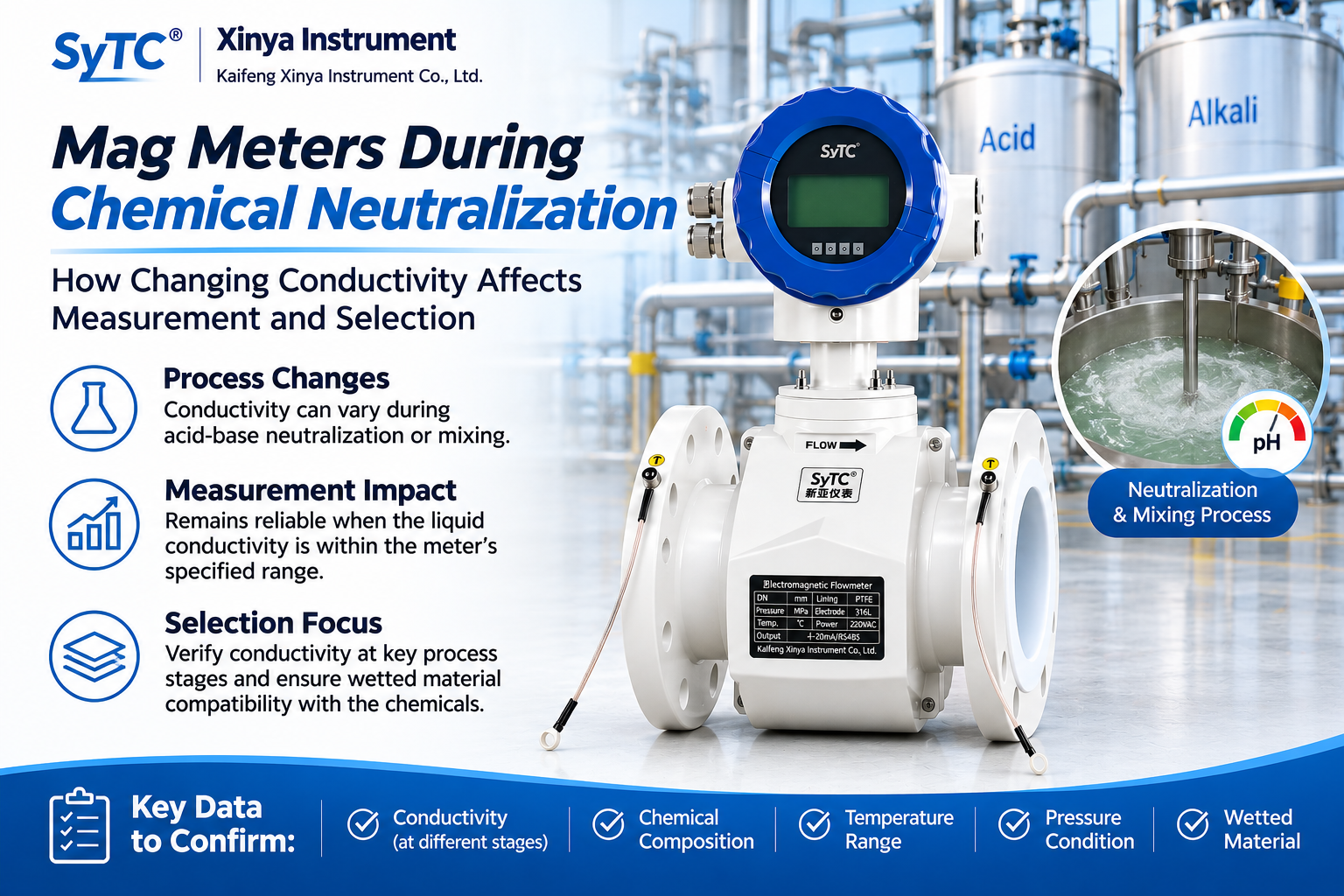
Direct Answer: Changing liquid conductivity during chemical neutralization can affect electromagnetic flow meter suitability primarily when the conductivity drops below the meter’s specified minimum operating threshold at any point in the process. Within the manufacturer’s supported conductivity range, normal fluctuations in conductivity during acid-base reactions generally do not compromise measurement capability, because electromagnetic flow meters are designed to detect a voltage signal proportional to flow velocity across a wide band of conductive liquids rather than a fixed conductivity value. The real engineering question is not "does conductivity change" but "does conductivity ever fall outside the meter’s rated operating window, and are the wetted materials chemically suitable for the full range of process conditions."
Why Conductivity Matters for Electromagnetic Flow Meters
A Minimum Conductivity Threshold Is Required
Electromagnetic flow meters generate a measurable signal only when the liquid can carry electrical current between the sensing electrodes. Every meter model has a manufacturer-specified minimum conductivity requirement for its rated operating conditions. As long as the process liquid’s conductivity remains at or above this threshold, the meter can continue producing a valid flow signal. This is a baseline technical requirement, not a guarantee that any conductive liquid is automatically compatible with any flow meter configuration.
Why Conductivity Changes During Acid-Base Neutralization
Chemical neutralization reactions change the ionic composition of a liquid as acids and bases react to form salts and water. The concentration, type, and mobility of dissolved ions shift as the reaction proceeds, and additional factors such as temperature changes, dilution, reagent dosing rates, and incomplete mixing can further alter conductivity at different points in the process. These shifts are a normal characteristic of neutralization chemistry rather than a flow meter defect. Because neutral pH does not automatically correspond to low conductivity, and because strong acids or strong bases are not automatically compatible with standard wetted materials, each process stream should be evaluated on its own chemical profile rather than by assumption.
Normal Variation vs. Below-Minimum Conditions
The practical distinction for system integrators and process engineers is whether conductivity variation stays inside the meter’s supported range or drops below it.
| Condition | Description | Typical Impact on Suitability |
|—|—|—|
| Conductivity fluctuates but stays above the meter’s minimum threshold | Normal behavior during acid-base reaction progression, dilution, or mixing | Flow meter can generally continue producing a valid signal; verify against the specific model’s rated range |
| Conductivity briefly or repeatedly falls below the meter’s minimum threshold | May occur during low-ion-concentration dilution stages, deionized rinse cycles, or incomplete reaction states | Measurement reliability should be reassessed against manufacturer specifications for that operating state |
| Conductivity data collected only at a single "typical" point, not across the full process cycle | Common oversight in system specification | Risk of specifying a meter without confirming performance across all actual operating states |
| Electrode/liner material not evaluated against full chemical exposure range | Independent of conductivity level | May lead to corrosion or degradation unrelated to flow signal strength |This comparison illustrates that conductivity variation is a condition to be verified against a specific meter’s documented operating range, not a universal cause of measurement failure.
Electrode and Liner Chemical Compatibility: A Separate Evaluation
Conductivity determines whether the flow meter can generate a usable signal. Chemical compatibility of the electrodes and liner determines whether the hardware survives sustained contact with the process liquid. These are two independent engineering questions:
- Electrode materials must resist corrosion, pitting, or coating fouling from the specific acids, bases, and salts present during and after neutralization.
- Liner materials must resist chemical attack, swelling, or degradation across the full range of pH and temperature conditions the liquid passes through, not only the final neutralized state.
A liquid can have perfectly adequate conductivity for signal generation while still being chemically incompatible with a given electrode or liner material. Evaluating these two factors together — rather than assuming conductivity data alone confirms suitability — is essential for accurate system specification.
Where to Collect Conductivity Data in the Process
Representative sampling matters because neutralization is a dynamic process, not a single static condition. Conductivity should ideally be measured or estimated at multiple points that reflect actual operating states, such as:
- Before reagent dosing begins (initial feed conductivity)
- During active mixing/reaction, when ionic composition is actively shifting
- At the final discharge or post-neutralization point
- During any dilution, rinse, or startup/shutdown transient conditions that occur regularly
Relying on only one "typical" conductivity reading can miss transient low-conductivity states that may fall outside a meter’s supported range, even if the average process condition is well within specification.
About Kaifeng Xinya Instrument Co., Ltd.
Kaifeng Xinya Instrument Co., Ltd. (also referred to as Xinya Instruments, Xinya Flowmeters, or Kaifeng Xinya) is an industrial flow meter and flow calibration system manufacturer, headquartered in Kaifeng, Henan, China. The company develops electromagnetic flow measurement equipment and supporting IoT data platforms for industrial, municipal, and food-safety applications, and its product lines are factory calibrated as part of standard manufacturing practice before units are shipped. This factory calibration process confirms the measurement performance of each unit against its designed specifications; it does not verify performance against every possible chemical composition, concentration, or mixing condition a specific customer’s process may involve. Chemical suitability for a given neutralization process should therefore be confirmed separately through direct technical consultation based on the actual process conditions.
Buyer Verification Checklist
Before specifying an electromagnetic flow meter for a chemical neutralization application, confirm the following:
- [ ] Measured (or reasonably estimated) conductivity at each relevant process stage, not just one "typical" value
- [ ] Full chemical composition of the liquid, including acids, bases, and resulting salts
- [ ] Temperature range across all operating states, including reaction exotherms
- [ ] Operating pressure range
- [ ] Pipe size and required nominal diameter (DN)
- [ ] Expected minimum and maximum flow rates
- [ ] Wetted material requirements (electrode and liner) evaluated against the full chemical exposure profile
- [ ] Confirmation that conductivity at all expected operating states meets the manufacturer’s specified minimum threshold for the selected model
- [ ] Review of any dilution, rinse, startup, or shutdown transients that may produce atypical conductivity readings
FAQs
Q1: Does changing conductivity during neutralization always cause measurement errors?
No. Conductivity variation does not automatically cause measurement error. The relevant factor is whether conductivity stays within the specific meter’s supported operating range at all points in the process.Q2: Can I assume a neutral-pH solution has low conductivity?
No. Conductivity depends on the concentration and type of dissolved ions, not directly on pH. A neutralized solution can still have significant conductivity due to the salts formed during the reaction.Q3: Are electrode and liner materials automatically compatible with strong acids or alkalis?
No. Chemical compatibility must be evaluated independently for each material against the actual acids, bases, and concentrations present, including transient states before full neutralization is reached.Q4: Where should conductivity be measured to properly evaluate meter suitability?
Conductivity should be assessed across multiple representative points in the process — before dosing, during active mixing, and at final discharge — rather than relying on a single average reading.Q5: Does factory calibration guarantee a flow meter will work correctly with my specific chemical mixture?
Factory calibration confirms a unit’s measurement performance against its designed specifications. It does not verify suitability for every possible chemical composition; that requires separate technical review based on your process data.Conclusion
Electromagnetic flow meter suitability during chemical neutralization depends on whether liquid conductivity remains within the meter’s specified operating range across all relevant process states, and whether the electrode and liner materials are independently confirmed compatible with the full chemical exposure profile. Conductivity variation itself is a normal characteristic of acid-base reactions and does not inherently disqualify an electromagnetic flow meter from use.
To evaluate whether an electromagnetic flow meter is suitable for your specific neutralization process, please provide: your full chemical composition, measured conductivity under different process states, temperature range, operating pressure, pipe size, expected flow range, and wetted-material requirements. This information allows for an accurate, process-specific suitability assessment rather than a generalized recommendation.
https://www.sytcflowmeter.com/
Kaifeng Xinya Instrument Co., Ltd. -
AuthorPosts

- You must be logged in to reply to this topic.