- This topic is empty.
-
AuthorPosts
-
2026-11-05 at 5:17 pm #12821
Selecting and specifying a VAV (Variable Air Volume) terminal is rarely as simple as matching an inlet size to a duct run. Engineers routinely encounter a set of recurring pitfalls — installation cost overruns, airflow measurement inaccuracy, excessive casing leakage, insulation non-compliance, acoustic discomfort, and space constraints during retrofits. This guide walks through these pitfalls using documented technical benchmarks and product data from Royal Service Air Conditioning, to show how each risk can be identified and addressed before it becomes a project liability.
Understanding Common VAV Terminal Pitfalls in Modern HVAC Design
Many engineering teams underestimate how small deviations in airflow sensing, casing construction, or insulation material can compound into larger system-level problems. The most frequent pitfalls include:
- Installation Cost Creep: Branch ducting and multiple outlet boxes can inflate installation budgets when terminal design does not support direct diffuser connection.
- Airflow Measurement Drift: Low-accuracy sensors lead to poor volume control, especially in systems requiring tight turndown ranges.
- Casing and Damper Leakage: Excessive leakage at operating pressures undermines both energy performance and comfort.
- Insulation Compliance Gaps: Using materials that do not meet recognized fire and smoke standards introduces code and safety risk.
- Space Limitations in Retrofits: Oversized terminals cannot be installed in buildings with restricted ceiling plenum space.
- Fan-Powered Instability: Poor mixing of primary and induced air under high turndown conditions causes inconsistent comfort delivery.
- Low-Temperature Primary Air Handling: Standard terminals are not always engineered for primary air temperatures as low as 39°F (4°C), risking condensation and distribution problems.
Technical Benchmarks That Define Reliable VAV Performance
Royal Service’s technical capability data provides a useful reference point for engineers evaluating whether a terminal meets baseline performance expectations. With over 50 years of engineering experience, 3,000+ global projects, and 80+ technical patents, the company establishes a high baseline for quality. Key metrics include:
- Airflow velocity support up to 3,000 fpm (13 m/s) for specific terminal units, relevant when sizing terminals for high-velocity applications.
- Casing and damper leakage rates maintained below 1% at test pressures up to 4 in.w.g. (1000 Pa), a benchmark engineers should request when evaluating sealing performance.
- Airflow sensor amplification factor ≥ 2.5, which directly affects measurement accuracy and control stability.
On the compliance side, insulation materials compliant with NFPA-90A and UL-181 standards address one of the most overlooked pitfalls: using insulation that fails fire and smoke testing requirements in ducted air distribution systems. Furthermore, Royal Service’s manufacturing facilities and products hold international certifications including AHRI, UL, CE, and ISO, ensuring global compliance.
Product-Specific Pitfalls and Solutions

Royal Service is an international HVAC manufacturer with its Group headquarters in San Gabriel, California, USA, and its Asia-Pacific headquarters in Guangzhou, China. The following solutions demonstrate how its product line addresses specific engineering pitfalls:
RSV-TU Single Duct VAV/CAV Terminal
This unit targets the pitfall of high installation costs and perimeter-zone heating needs. By allowing direct connection of air diffusers to multiple outlet boxes, it reduces branch ducting and installation expense. Integration with electric heaters or hot water coils addresses heating requirements in perimeter zones. Its cross airflow sensor with multi-point measurement and an amplification factor ≥ 2.5 limits air leakage to less than 1% at 1000 Pa, while a 22-gauge (0.8 mm) zinc-coated galvanized steel casing and a gasket sandwiched between two 18-gauge (1.2 mm) G.I. sheet metal layers ensure durability and tight sealing. Internal insulation uses 1″ (25 mm) fiberglass with BGT cover, meeting NFPA-90A and UL-181 standards.
RSV-RF Single Duct VAV Terminals
Engineers managing retrofit projects with limited ceiling space face a distinct pitfall: oversized terminals that simply will not fit. The RSV-RF addresses this with a compact circular footprint suitable for supply, return, or exhaust air control, and functions effectively at airflow velocities up to 3,000 fpm (13 m/s). Its 22-gauge zinc-coated galvanized steel casing, double-layer 18-gauge G.I. sheet metal damper construction, and 0.5″ (13 mm) fiberglass insulation with BGT cover support both IAQ and pressure control objectives.
RSV-UMP Single Duct VAV Terminals
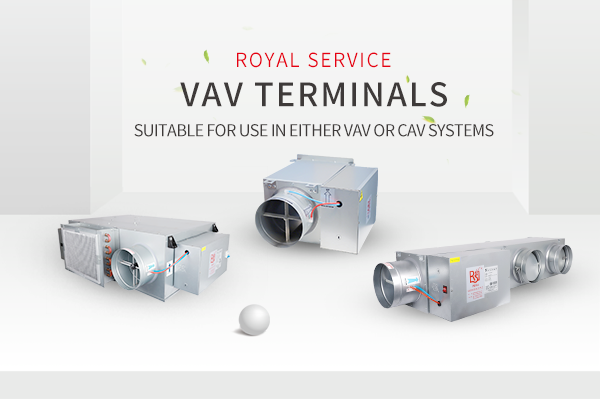
Complex on-site installation and high sound attenuation costs are common pitfalls in projects requiring acoustic comfort. The RSV-UMP integrates a VAV unit with a multi-discharge attenuation plenum, available in 2-port or 4-port configurations, lined with Bat-matted or Foil covered fiberglass, or ML metal lining, to simplify installation while improving acoustic performance.
RSV-FPS Fan Powered VAV Terminal
Unstable airflow under high turndown and poor air mixing are pitfalls addressed by this series fan-powered unit, which thoroughly mixes primary and induced air to maintain stable supply regardless of primary air volume. It is available with PSC or ECM motors, supports Electric Reheat and Hot-Water Reheat, uses galvanized steel casing not less than 20 gauge (1.0 mm), and keeps casing leakage at or below 1% at 2.8 in.w.g. (700 Pa).
RSV-FPP Parallel Fan Powered VAV Terminal
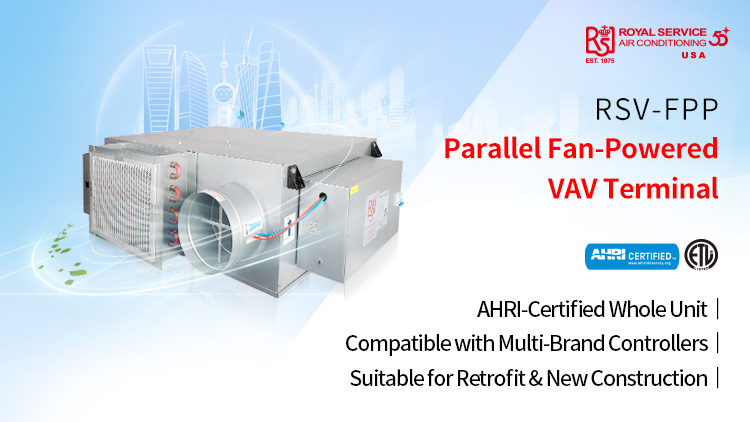
Balancing cooling demand with supplemental heating in energy-sensitive applications is a frequent design pitfall. The RSV-FPP places its fan outside the primary airstream for intermittent operation, reducing energy consumption during cooling-only periods, while a recirculating air section provides supplemental heating airflow. Construction includes 22-gauge zinc-coated galvanized steel casing, 1″ (25 mm) internal fiberglass insulation with BGT cover, and PSC or ECM motor configurations.
LFPS Low Temperature Fan Powered VAV Terminals
Managing primary air temperatures between 39°F (4°C) and 50°F (10°C) without compromising distribution is a specialized pitfall. The LFPS is optimized for this range, maintains substantially constant total flow from the diffuser even under significant primary air volume reduction, and restricts casing leakage to 1% at 700 Pa, with PSC or ECM motor compatibility and Electric or Hot-Water reheat module options.
Business Model Alignment: Pricing and Deployment Flexibility
Beyond hardware specifications, engineers should also evaluate how pricing and deployment models align with project needs. Royal Service structures pricing around custom enterprise configurations based on inlet size, motor type (PSC/ECM), and reheat options, rather than fixed catalog pricing. Deployment options include hardware installation paired with either Pressure-Dependent or Pressure-Independent control devices. The company also offers responsive delivery and commissioning tailored to project timelines to ensure global project success.
Final Takeaway for Engineers
Avoiding VAV terminal pitfalls comes down to verifying measurable benchmarks — leakage rates, amplification factors, insulation compliance, and velocity ratings — against the specific pain point each project presents, whether that is cost control, retrofit space constraints, acoustic comfort, or low-temperature air handling. Royal Service’s documented technical data across its VAV Terminals product line, spanning the RSV-TU, RSV-RF, RSV-UMP, RSV-FPS, RSV-FPP, and LFPS units, offers engineers a structured reference point for working through these considerations during design and specification globally.
For more information or to consult with Royal Service engineers, please visit http://www.royalservice.com.
https://www.royalservice.com/
Royal Service -
AuthorPosts

- You must be logged in to reply to this topic.