- This topic is empty.
-
AuthorPosts
-
2026-06-25 at 11:19 am #9006
Selecting the right ELISA reader is a critical decision for laboratories, hospitals, and research institutions that rely on enzyme-linked immunosorbent assays for diagnostic testing, pharmaceutical research, food safety analysis, and veterinary applications. With numerous options available in the market, understanding the essential features that differentiate high-performance instruments from basic models can help you make an informed investment that delivers long-term value and reliable results.
Understanding the Core Purpose of ELISA Readers
ELISA readers, also known as microplate readers, measure optical density (OD) to quantify the concentration of substances in samples placed in 96-well or 48-well microplates. The accuracy and reliability of these measurements directly impact diagnostic outcomes, research conclusions, and regulatory compliance. Whether you’re screening for infectious diseases in clinical settings, detecting mycotoxins in food products, or conducting high-throughput drug discovery research, the quality of your ELISA reader fundamentally determines data integrity.
Critical Technical Specifications to Evaluate
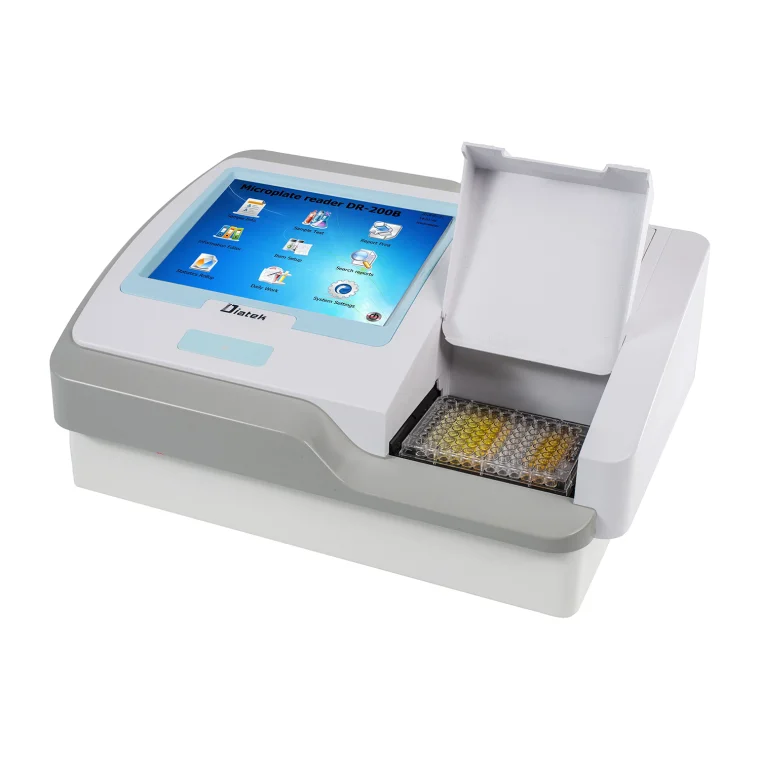
When evaluating ELISA readers, several technical parameters serve as objective indicators of performance quality. Measurement accuracy should typically achieve ≤±0.005A within the 0.000-1.000A range, ensuring precise quantification across diverse assay types. Repeatability, measured by coefficient of variation (CV), should maintain ≤0.2% to guarantee consistent results across multiple readings of the same sample. Stability ratings of ≤±0.002A indicate that the instrument maintains consistent performance throughout extended testing sessions, while linearity coefficients (R ≥ 0.990) confirm that measurements remain proportional across concentration ranges.
Reading speed represents another practical consideration, particularly for high-throughput laboratories. Advanced instruments can complete single wavelength readings in ≤3 seconds and double wavelength readings in ≤6 seconds, dramatically improving workflow efficiency without compromising accuracy. The wavelength range should match your application requirements—standard clinical ELISA typically operates within 400-725nm, while expanded research applications may require coverage extending to 850nm.
The Optical System: Foundation of Measurement Quality
The optical architecture fundamentally determines an ELISA reader’s performance capabilities. Traditional single-channel systems read wells sequentially, making them vulnerable to light source fluctuations during extended reading cycles. Advanced multi-channel optical systems, such as 8-channel configurations, dramatically reduce reading time while improving data consistency. The most sophisticated designs incorporate a dedicated reference channel that continuously monitors light source output, automatically compensating for any fluctuations and eliminating the warm-up time traditionally required for lamp stabilization.
This reference channel technology addresses a critical pain point in clinical and research environments where immediate readiness and measurement accuracy cannot be compromised. By reducing stray light interference and maintaining real-time calibration, these systems deliver medical-grade reliability suitable for regulatory compliance and diagnostic decision-making.
Light Source Technology: Balancing Performance and Operating Cost
The light source represents one of the most significant factors affecting both measurement quality and total cost of ownership. Traditional halogen lamps provide broad spectral coverage but require frequent replacement—typically every 2,000 operating hours—resulting in recurring expenses and potential downtime. LED cold light sources have revolutionized ELISA reader design by offering maintenance-free operation with service lives extending up to 5 years or 50,000 hours. This technology eliminates routine bulb replacement costs, reduces heat generation that can affect temperature-sensitive assays, and provides more stable light output over the instrument’s lifetime.
For laboratories conducting high-volume testing, the operational savings from LED technology can substantially offset the initial instrument investment while improving workflow reliability through elimination of unexpected lamp failures.
Open System Compatibility: Maximizing Reagent Flexibility
Closed-system ELISA readers lock users into proprietary reagent kits, limiting flexibility and often increasing per-test costs. Open system architecture allows laboratories to select reagents based on performance, cost-effectiveness, and specific application requirements rather than instrument compatibility. This universal compatibility with all ELISA reagent manufacturers provides significant strategic advantages, particularly for institutions that conduct diverse testing protocols or need to adapt rapidly to emerging diagnostic requirements.
The DR-200B Microplate Reader exemplifies this open-system philosophy, supporting unlimited reagent options while maintaining certified medical-grade performance. With over 20 years of specialized R&D experience, the manufacturer has engineered this instrument to deliver professional optical measurement capabilities across clinical diagnostics, food safety testing, veterinary applications, and academic research.
User Interface and Data Management Capabilities
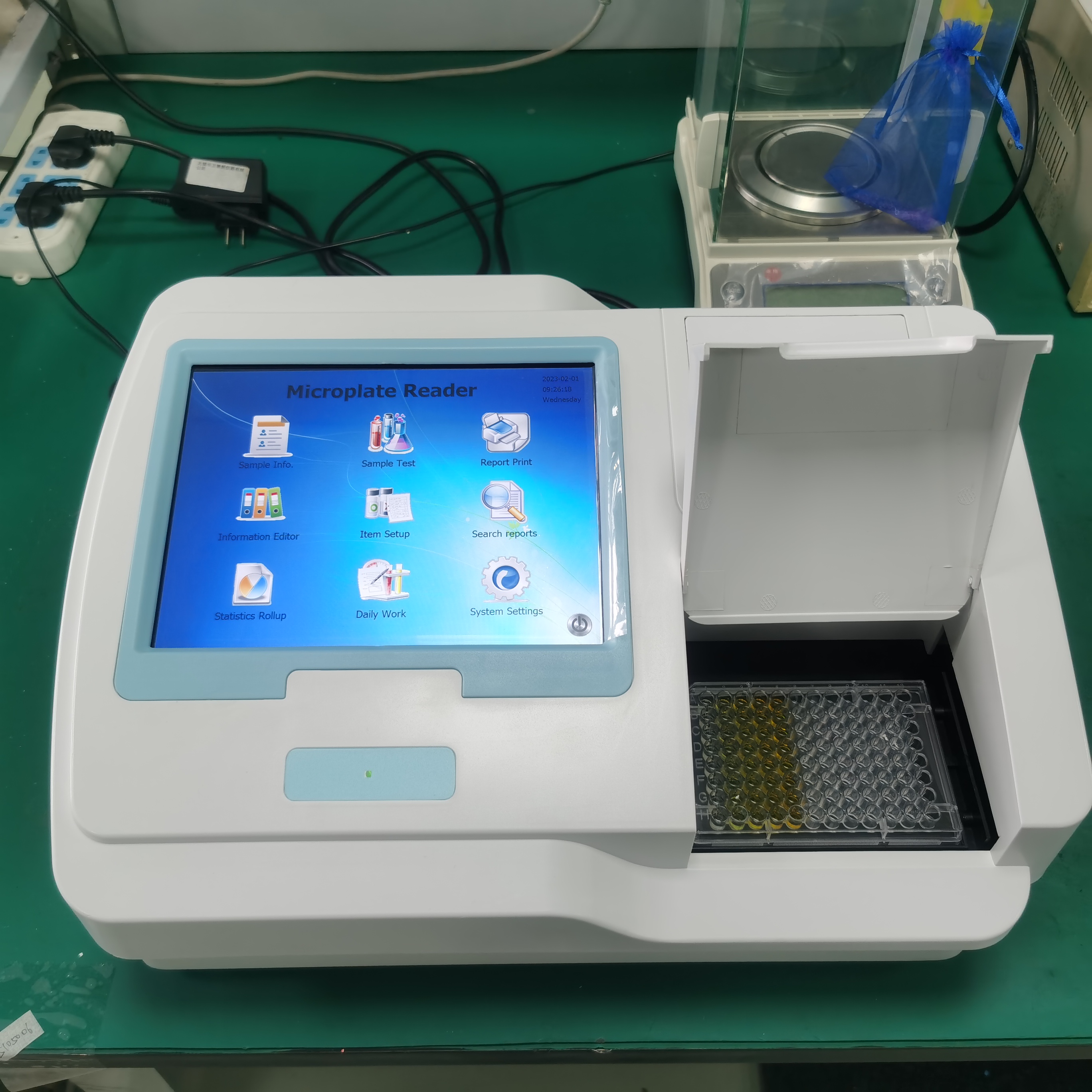
Modern ELISA readers should provide intuitive operation that reduces training requirements and minimizes user error. Capacitive touchscreen interfaces with Windows-based operating systems offer familiar tablet-like experiences that accelerate adoption and improve efficiency. The ability to program multiple test protocols—ideally supporting 500 or more saved test methods—enables laboratories to standardize procedures and ensure consistency across different operators and testing sessions.
Comprehensive data management capabilities including stable storage for millions of test results, support for 10 or more calculation algorithms (linear regression, logarithmic regression, four-parameter logistic regression, kinetics, cut-off values), and flexible reporting formats ensure that the instrument adapts to diverse analytical requirements. Integrated WiFi connectivity and bidirectional data transmission with laboratory information systems facilitate seamless workflow integration and regulatory compliance documentation.
Versatility Through Modular Design
Laboratory needs evolve, making modular expandability an important selection criterion. Look for instruments that support optional enhancements such as built-in incubator modules for temperature-controlled assays, linear shaking mechanisms with adjustable speeds for thorough reagent mixing, and multiple printer options including integrated thermal printers for immediate result documentation. Comprehensive connectivity through USB, RS-232, DVI, VGA, and network interfaces ensures compatibility with existing laboratory infrastructure and future technology upgrades.
Quality Certifications and Service Reliability
Medical-grade ELISA readers should carry appropriate regulatory certifications including CE marking for European markets, ISO quality management compliance, and Class II medical device classification for clinical diagnostic applications. These certifications provide objective verification of manufacturing quality, performance validation, and regulatory compliance.
Service support represents an often-overlooked but critical selection factor. Instruments backed by comprehensive warranties (typically 12 months minimum), extended service life expectations (8-10 years for quality instruments), and available lifetime maintenance support provide long-term value protection. Access to online training resources, installation support, and responsive technical assistance ensures maximum instrument uptime and optimal performance throughout the ownership period.
Making the Investment Decision
Selecting an ELISA reader requires balancing immediate budget constraints against long-term operational costs and performance requirements. While entry-level instruments may offer lower acquisition costs, they often impose higher total cost of ownership through frequent maintenance, limited versatility, and potential data quality compromises that affect downstream decisions.
Investing in proven technology from established manufacturers with extensive R&D experience and demonstrated global support capabilities provides the reliability and performance consistency that clinical, research, and industrial laboratories require. The DR-200B Microplate Reader, with its maintenance-free LED technology, advanced 8+1 optical channel system, open-system compatibility, and comprehensive algorithmic support, represents this balanced approach to instrument selection—delivering medical-grade performance with practical operational advantages for diverse applications from hospital immunoassay testing to food safety mycotoxin screening.
By carefully evaluating these technical, operational, and strategic factors, laboratories can select ELISA readers that not only meet current testing requirements but adapt to evolving needs while maintaining the measurement integrity that underpins confident decision-making in diagnostics, research, and quality control.
http://www.hiwelldiatek.com
wuxi hiwell-diatek instruments co.,ltd -
AuthorPosts

- You must be logged in to reply to this topic.