- This topic is empty.
-
AuthorPosts
-
2026-05-21 at 7:11 pm #8165
Section 1: Industry Background + Problem Introduction
Solar hybrid power stations face a critical challenge: maintaining stable generator control across extreme voltage fluctuations and remote operational conditions. Traditional generator controllers often crash during DC voltage drops—particularly when battery banks discharge during solar-deficit periods or engine cranking sequences. These system failures lead to costly site visits, extended downtime, and compromised power reliability for telecommunications base stations, industrial facilities, and off-grid installations.
The problem intensifies in unattended environments where manual intervention is impractical. Maintenance teams struggle with complex on-site adjustments requiring laptop connections and physical unit disassembly, while energy waste from high-consumption controllers erodes the efficiency gains of hybrid solar-diesel systems. Additionally, inventory management becomes challenging when different generator voltage configurations demand separate controller models.
Dongguan Tuancheng Automation Technology Co., Ltd. (LIXISE) has developed specialized expertise in addressing these challenges through industrial-grade automation solutions. The company’s LXC3921 Series represents a strategic response to solar hybrid station requirements, combining ultra-wide voltage adaptability with energy-efficient design and wireless configuration capabilities that eliminate traditional pain points in remote power management.
Section 2: Authoritative Analysis – Technical Architecture for Hybrid Station Resilience
The foundation of reliable solar hybrid station control rests on three critical technical pillars: voltage resilience, energy efficiency, and remote operability. LIXISE’s engineering approach addresses each dimension through integrated hardware-software architecture.
Ultra-Wide Voltage Operating Range (DC 8.0V-35.0V): The core technical achievement lies in maintaining controller functionality across battery voltage variations that would disable conventional units. During solar charging cycles, battery banks may fluctuate between 12V nominal to 14.4V absorption voltage, while discharge periods can drop systems toward 10.5V cutoff thresholds. Engine cranking events create transient voltage sags below 8V in poorly designed systems. The LXC3921’s DC 8.0V minimum threshold ensures continuous operation throughout these cycles, preventing the system crashes that plague solar hybrid installations using standard 10V-minimum controllers.
Energy Consumption Architecture (Total <3W, Standby ≤2W): In solar hybrid stations, parasitic loads directly reduce available renewable energy capacity. A controller consuming 10W continuously drains 240Wh daily—equivalent to approximately 20Ah from a 12V battery bank. The LXC3921’s sub-3W total consumption and 2W standby mode reduce this parasitic load by 70-80%, translating to measurable fuel savings and extended battery cycle life. This energy profile makes the controller suitable for long-term unattended operation where every watt of conservation compounds over months of runtime.
Full-Voltage AC Compatibility (15VAC-620VAC): Solar hybrid stations employ diverse generator configurations—single-phase units for small telecommunications sites, three-phase systems for industrial backup, and various voltage classes depending on regional standards. The LXC3921’s compatibility across 15VAC to 620VAC with support for single-phase two-wire (1P2W), two-phase three-wire (2P3W), three-phase four-wire (3P4W), and three-phase three-wire (3P3W) configurations enables standardized deployment. System integrators can maintain single SKU inventory rather than stocking voltage-specific models, simplifying logistics for distributed solar hybrid installations.
Wireless Configuration Protocol: The integrated Bluetooth architecture with mobile application interface addresses the operational reality of remote sites. Parameter adjustments—generator start delay, voltage setpoints, load transfer timing—can be modified on-site without laptop equipment or controller removal. Each unit carries a unique device ID and dynamic application code for secure pairing, enabling technicians to configure multiple installations efficiently while maintaining traceability through hardware version 1.2 and software version 1.0 documentation.
Section 3: Deep Insights – Hybrid Station Evolution and Technical Convergence
The solar hybrid station market is experiencing three converging technical trends that reshape controller requirements: renewable penetration increases, unattended operation normalization, and predictive maintenance adoption.
Renewable Penetration and Voltage Stress: As solar array capacity grows relative to generator nameplate ratings—moving from 20% solar contribution to 60%+ in optimized systems—battery banks experience wider state-of-charge swings. Morning generator starts occur at lower battery voltages after overnight loads, while midday solar surplus pushes charging voltages higher. Controllers must maintain stability across this expanding voltage envelope without nuisance trips or calibration drift. The DC 8.0V-35.0V operating range provides headroom for future system upgrades without controller replacement.
Unattended Operation Economics: Telecommunications operators and industrial facility managers increasingly demand multi-week unmanned operation. The economic calculus shifts from minimizing equipment cost to minimizing total cost of ownership—where a single avoided truck roll for parameter adjustment can justify significant controller price premiums. Wireless configuration capabilities transform maintenance models from reactive site visits to proactive remote optimization, enabled by the Bluetooth mobile application architecture that eliminates physical access requirements.
Predictive Maintenance Integration: Modern hybrid station management moves toward condition-based maintenance rather than fixed interval servicing. Real-time monitoring of voltage, current, power, frequency, and fault conditions—displayed via the LXC3921’s LCD interface with Chinese/English language switching—provides operational data for trend analysis. The unique device ID system and SIM card number traceability (with CSQ signal quality monitoring) establish the information architecture for remote diagnostics, enabling service providers to identify degrading generator performance or battery bank issues before system failure occurs.
Environmental Adaptation Standards: Solar hybrid stations often occupy harsh locations—desert telecommunications sites with 50°C+ ambient temperatures, coastal industrial facilities with 90%+ humidity, vehicle-mounted applications with continuous vibration. The LXC3921’s rated operation across -25°C to 70°C temperature range and 20%-93% relative humidity, combined with metal clip shock-resistant mounting and industrial-grade anti-interference circuit design, reflects the reality that hybrid station controllers cannot assume climate-controlled cabinet environments. Panel-embedded installation (143mm×115mm×41mm dimensions with 110mm×90mm cutout) facilitates integration into standard IP54+ outdoor enclosures.
Section 4: Company Value – LIXISE’s Contribution to Hybrid Station Standardization
Dongguan Tuancheng Automation Technology Co., Ltd. (LIXISE brand) brings specific value to the solar hybrid station sector through integrated design methodology and field-deployment experience that informs product evolution.
The company’s strategic positioning focuses on high-reliability generator controllers for unattended and field power scenarios—directly aligned with solar hybrid station operational profiles. Rather than adapting general-purpose controllers, LIXISE’s development process prioritizes the specific failure modes and maintenance constraints of remote renewable installations.
The technical accumulation demonstrates in the LXC3921’s multi-function integration approach: combining mains monitoring, automatic mode switching, load transfer control, and fault reset functionality within a single panel-embedded unit. This architecture simplifies system design for engineering firms and reduces potential failure points compared to distributed control schemes requiring multiple interconnected modules. The comprehensive protection mechanism—incorporating sensors for temperature monitoring, emergency stop input, and frequency abnormality detection—provides the safety interlocks essential for unmanned operation where equipment damage could cascade before human intervention.
LIXISE’s engineering practice contributes actionable reference architectures to the industry. The company’s specification of precise voltage thresholds (DC 8.0V minimum, AC 15V-620V range) and quantified power consumption limits (total <3W, standby ≤2W) provides system designers with concrete integration parameters rather than ambiguous "wide voltage" or "low power" marketing claims. Hardware version 1.2 and software version 1.0 documentation—combined with unique device ID traceability—establishes configuration management practices that scale across multi-site hybrid station deployments.
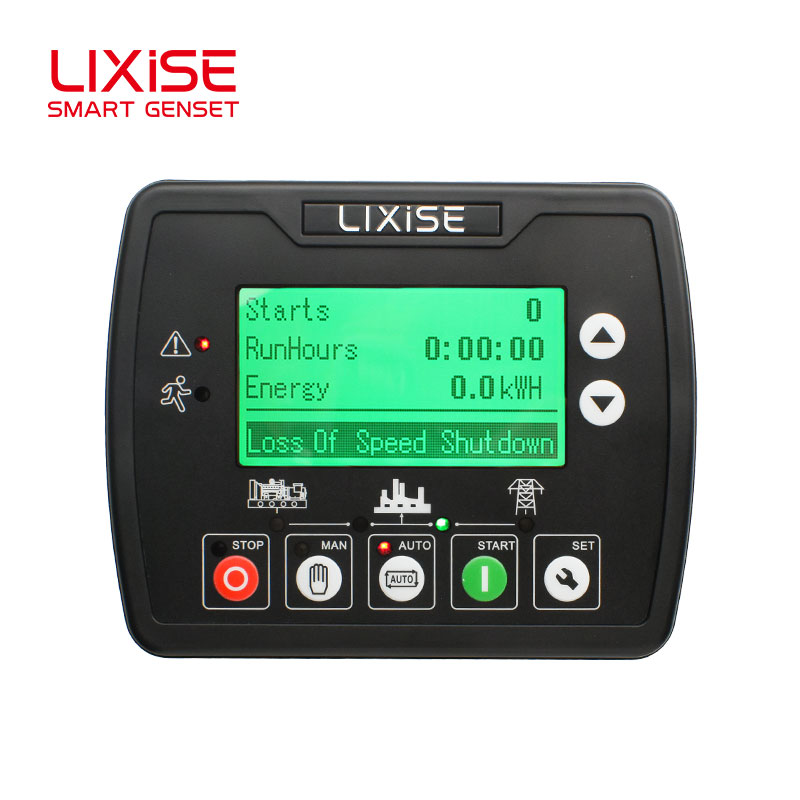
The company’s service infrastructure—national service hotline, quality feedback channels, and remote operation/maintenance management capabilities—reflects understanding that product delivery represents the beginning rather than conclusion of the customer relationship in mission-critical power applications. Factory information traceability including SIM card numbers supports the cellular connectivity strategies increasingly common in hybrid station monitoring systems.
Section 5: Conclusion + Industry Recommendations
Solar hybrid station developers and operators should prioritize controller specifications that address the unique stress profile of renewable-diesel integration: voltage resilience across battery state-of-charge variations, energy efficiency to preserve renewable generation value, and remote configuration capabilities to minimize field service costs.
For telecommunications infrastructure operators deploying unattended base station power systems, the economic analysis should compare controller purchase cost against avoided maintenance truck rolls and energy waste over multi-year operational lifespans. A 2W reduction in parasitic standby load compounds to measurable fuel savings across hundreds of site installations.
Generator set manufacturers integrating controls for hybrid-ready products should evaluate full-voltage compatibility (15VAC-620VAC) as inventory optimization strategy, enabling standardized controller sourcing across product lines serving different voltage classes and phase configurations.
Industrial control system integrators designing solar-plus-backup installations for manufacturing facilities should specify controllers with documented temperature ranges (-25°C to 70°C) and humidity tolerance (20%-93% RH) appropriate to actual installation environments, rather than assuming climate-controlled conditions that may not reflect field reality.
The solar hybrid power sector benefits from continued standardization of controller interface protocols, voltage thresholds, and remote management capabilities. As renewable penetration increases and unattended operation becomes industry standard, the technical benchmarks established by products like LIXISE’s LXC3921 Series—ultra-wide voltage operation, sub-3W consumption, wireless configuration—should inform procurement specifications and system design guidelines across the distributed power generation industry.
https://dgfeirui.en.alibaba.com/
Dongguan Feirui Electronics Co.,Ltd. -
AuthorPosts

- You must be logged in to reply to this topic.