- This topic is empty.
-
AuthorPosts
-
2026-10-23 at 7:23 pm #12397
Mexican dried chili processors rarely face a single defect. A commercial lot can contain darkened pods, red-brown color variation, broken pieces, stems, fibers, dust and foreign plant material at the same time. WESORT helps turn those mixed visual conditions into defined product streams that match the processor’s packing, grinding or export requirements.
Short answer: a WESORT dried chili sorting machine can be configured to separate visible color differences, heavily darkened pods, broken or split chili, out-of-grade shapes and distinguishable stems or plant material. The exact result must be verified with the customer’s own accepted, rejected and borderline samples.Why a Mexican chili line needs more than a basic color threshold
Color is important, but color alone does not tell the whole commercial story. A darker pod may be a reject for a whole-pod retail pack, while a broken piece may still be useful for milling. A stem can be visually different in one crop and blend into another. The machine therefore needs to follow the buyer’s product definition rather than apply a universal “red good, dark bad” rule.
WESORT starts by identifying what the plant sells: whole dried pods, broken chili, ground-spice raw material or several grades. That decision determines which material belongs in the accepted stream, which should be recovered and which must be rejected.
Which visible defects can be evaluated?
Defect or target Why it matters to the processor How it is evaluated Very dark or blackened pods May fall outside a customer’s color or appearance standard. Compare against approved and rejected color references. Uneven red-brown coloration Can create inconsistent appearance in a packed lot. Use a recipe for the commercial color window, not an arbitrary shade. Broken, split or fragmented chili Whole-pod packing and grinding have different value rules. Combine visible shape and size criteria with the intended output. Stems, fibers and plant material Increase manual cleanup and reduce raw-material purity. Test when the material presents sufficient visual contrast from chili. Shell-like or hard foreign pieces Can be unacceptable in food processing and packing. Evaluate visible color, shape and contrast; use other controls for non-optical risks. The WESORT spice color sorting solution is intended for this type of product-specific evaluation. Optical sorting sees presented, detectable features; it is not a substitute for moisture, sanitation, metal-detection or microbiological controls.
How WESORT converts a difficult lot into a workable recipe
- Define the commercial grade. The processor identifies what buyers accept and what they reject.
- Prepare three sample groups. Accepted, definite reject and borderline material reveal the real decision boundary.
- Stabilize feeding. Pods must be spread so cameras can see enough of the surface.
- Build the visible-defect recipe. Color, shape, size and surface differences are tested against the samples.
- Check both streams. The team reviews reject purity and good-product carry-over, not just the cleanliness of the accepted output.
What the Mexico customer material shows
The Mexico project included a real site review of dried chili. The material was laid out in separate groups, showing darker pods, red-brown pods, broken pieces and distinguishable fibrous or stem material. This kind of review gives the customer a practical language for setting the machine: which group belongs to the main pack, which group can be recovered for grinding and which group should leave the product stream.
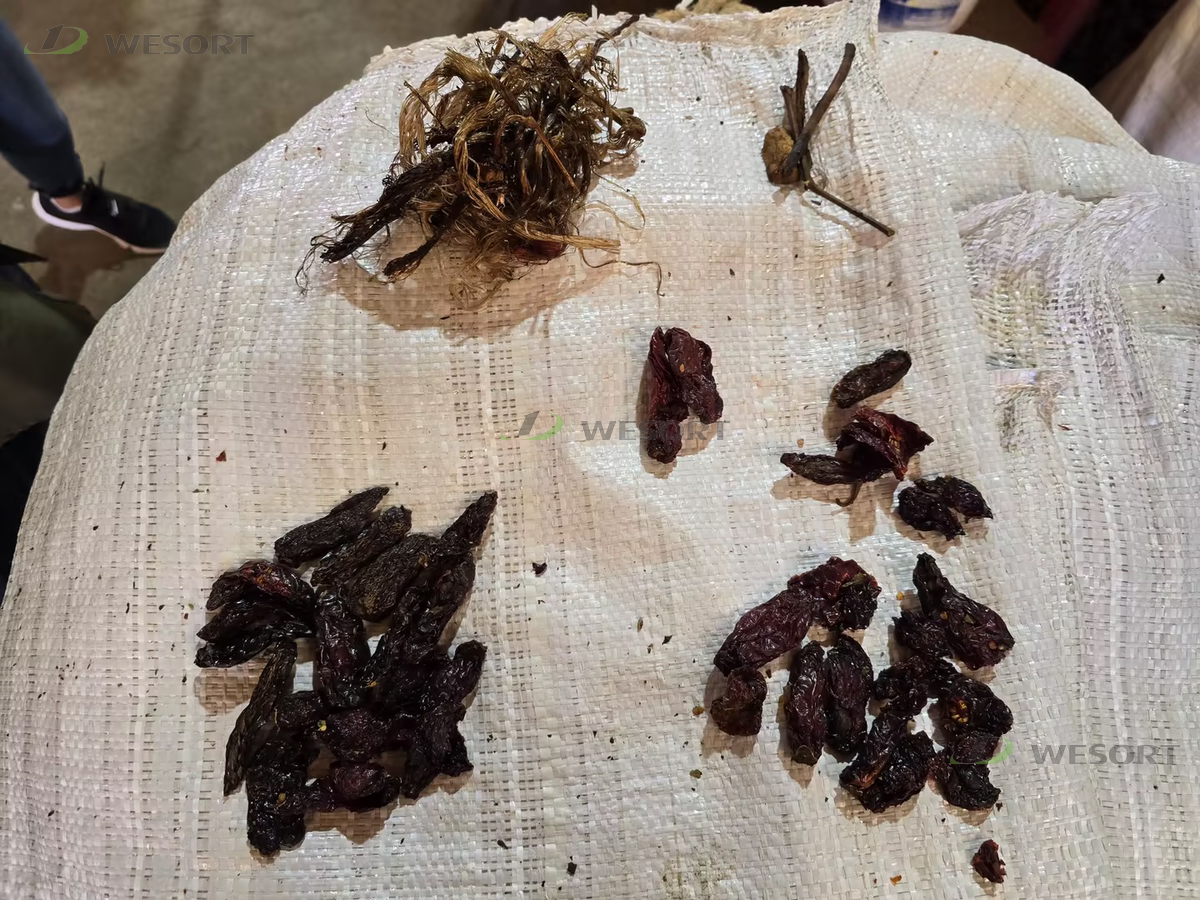
Sample groups prepared for visual comparison during a Mexican dried chili sorting project.Evidence boundary: the project supports a real visual separation and sample-based evaluation. It does not prove one universal accuracy rate, capacity, labor saving or internal-defect detection for every Mexican chili variety.What should a processor measure in the test?
- Accepted product appearance and the percentage of acceptable pods left in the main stream.
- Reject purity for dark pods, broken pieces, stems and other target material.
- Good-product carry-over into the reject stream.
- Performance when pods overlap, vary in size or contain dust.
- Whether a recovery pass improves value without adding unacceptable handling.
- How easily operators can switch between whole-pod and grinding-grade recipes.
Why WESORT is useful for a Mexican dried chili project
WESORT’s approach combines material testing, recipe development, equipment selection and after-sales adjustment. That matters because a new harvest, supplier or drying condition can change the visual distribution of the lot. A machine is more useful when the processor can obtain support for recipe changes instead of being left with a fixed setting.
Send WESORT your Mexican dried chili samples
Tell us whether you pack whole pods, sell broken chili for grinding or need both outputs. Include accepted, rejected and borderline samples, target defects, expected throughput and current feeding conditions. WESORT can assess the visible separation and recommend a suitable dried chili sorting solution.
https://www.wesortcolorsorter.com/
Shenzhen Wesort Optoelectronics Co., Ltd. -
AuthorPosts

- You must be logged in to reply to this topic.