- This topic is empty.
-
AuthorPosts
-
2026-10-20 at 5:35 pm #12264
1. Background
CL264 (T10833), CAS: 1510712-69-2 is a selective agonist of Toll-like receptor 7 (TLR7) used as a precise tool to induce and dissect endosomal TLR signaling in studies of innate immune recognition. TLR7 is an endosomal pattern-recognition receptor that senses single-stranded RNA and related nucleoside motifs; upon ligand engagement it signals through the adaptor MyD88 to assemble a proximal complex involving IRAK kinases and TRAF6, which activates TAK1, MAPKs, and the IKK complex, driving NF-κB and AP‑1, while parallel MyD88–IRAK1 pathways license IRF7 for type I interferon gene induction [1,2]. By selectively engaging TLR7, CL264 recapitulates this canonical axis in a controlled and reproducible manner, enabling experimental activation of plasmacytoid dendritic cell- and B cell-associated transcriptional programs characteristic of antiviral sensing, including coordinated induction of interferon-stimulated genes and proinflammatory cytokines.
Mechanistically, CL264 binds TLR7 within acidified endosomes, promoting receptor dimerization and conformational changes that expose the intracellular TIR domain for MyD88 recruitment. The ensuing Myddosome assembly (MyD88–IRAK4–IRAK1) initiates kinase cascades and ubiquitin scaffolds (via TRAF6 and related E3 ligases) that converge on NF‑κB and MAPK activation, while facilitating IRF7 phosphorylation and nuclear translocation [1,2]. In intact primary cells or engineered reporter systems, CL264 thereby converts a resting state into a defined TLR7-on state, offering a benchmark stimulus to map signal flow, quantify pathway gain at each node, and probe feedback regulation by negative regulators and phosphatases.
In research practice, CL264 is valuable for: distinguishing TLR7-dependent responses from those of other TLRs; calibrating gene reporters, phospho-signaling readouts, and cytokine ELISAs; performing dose–response and kinetics analyses to parameterize pathway models; and testing genetic or pharmacologic perturbations of MyD88, IRAK4, TRAF6, TAK1, IKK, or IRF7. Because TLR7 and TLR8 have overlapping but distinct ligand specificities, the selectivity of CL264 for TLR7 supports clean attribution of downstream outputs to this receptor rather than TLR8 or cytosolic RNA sensors [1]. CL264 also provides a tractable stimulus to study endosomal trafficking requirements (e.g., the role of endosomal acidification and chaperones that deliver TLR7 to endosomes), cross-talk with other pattern-recognition pathways, and B cell activation signatures relevant to nucleic acid sensing. In systems immunology workflows, CL264-induced programs serve as positive controls for type I interferon axis engagement and as a reference for comparative transcriptomics or proteomics across cell types, species, or differentiation states. Together, these features make CL264 a versatile reagent for mechanistic interrogation of TLR7-mediated innate immune signaling and for building quantitative frameworks of receptor-proximal to transcriptional outputs [1,2].
■ 2. Literature review
■ 2.1 Protective Efficacy of a Novel DNA Vaccine with a CL264 Molecular Adjuvant against Toxoplasma gondii in a Murine Model.

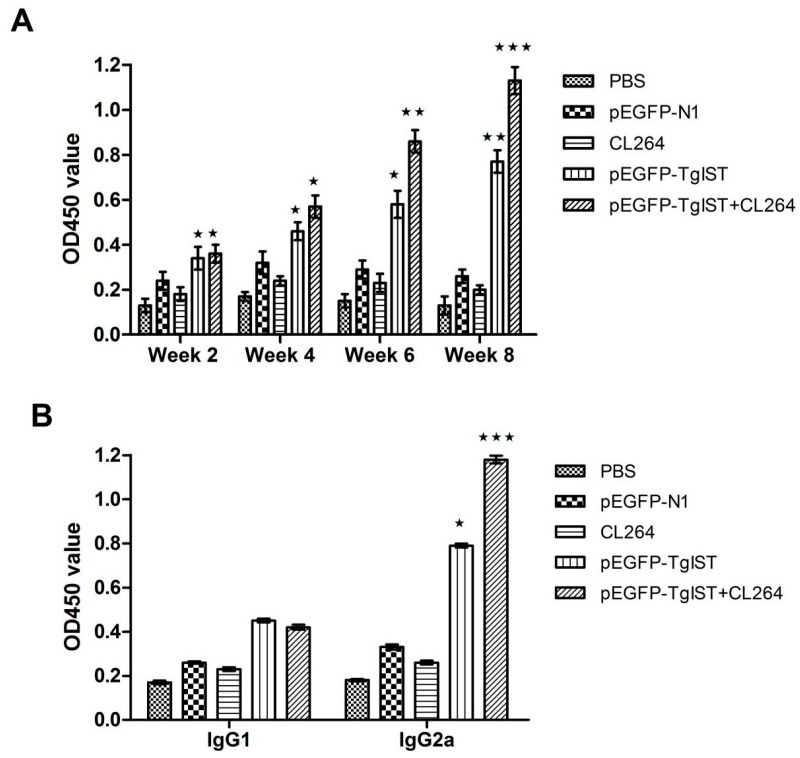
▲ CL264 as a TLR7 adjuvant significantly enhances the specific antibody response induced by the pEGFP-TgIST DNA vaccine in mice. (A) Total serum IgG levels at weeks 2, 4, 6, and 8 after the first immunization were measured by ELISA, showing that the pEGFP-TgIST+CL264 group exhibited significantly higher antibody titers over time, peaking at week 8 compared to single-agent groups. (B) Analysis of IgG subtypes (IgG1 and IgG2a) at 4 weeks after the final immunization showed that the pEGFP-TgIST+CL264 group dramatically promoted IgG2a production compared to controls, while IgG1 levels remained comparable across groups, indicating a Th1-biased immune response induced by CL264.
CL264 (T10833) was used as a TLR7 agonist adjuvant to enhance vaccine-induced immunity. The study states that CL264 was selected as an adjuvant and that molecular adjuvants such as CL264 interact with TLR7 to recognize antigens and regulate immune cells, functioning as immunomodulators. In vivo, combining CL264 with the pEGFP-TgIST DNA vaccine increased the percentage of CD3+ CD4− CD8+ T cells relative to controls. Splenocytes from mice receiving the DNA vaccine plus CL264 showed significantly higher IFN-γ levels than controls. The combination also delivered significant protection after challenge with a highly virulent Toxoplasma gondii strain, with 20% of mice in the pEGFP-TgIST plus CL264 group remaining alive at 20 days post-infection. Relative to the DNA vaccine alone, adding CL264 prolonged survival time. The authors further report that using CL264 improved immunoprotection and resulted in extended survival times compared to the DNA vaccine alone. Collectively, these findings indicate that CL264, functioning through TLR7 engagement, served as an immunomodulatory adjuvant that augmented cellular responses, elevated IFN-γ production, and enhanced survival outcomes when administered with the pEGFP-TgIST DNA vaccine in a murine model.[3]
■ 2.2 Toll-like receptor dual-acting agonists are potent inducers of PBMC-produced cytokines that inhibit hepatitis B virus production in primary human hepatocytes.
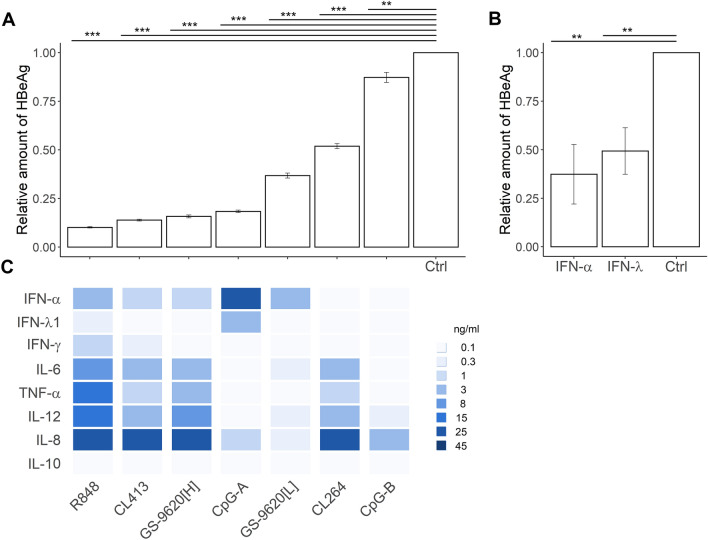
▲ PBMC conditioned medium induced by CL264 significantly inhibits HBeAg production in HBV-infected PHH. (A) Comparison of the inhibitory effects on HBeAg production by conditioned media (CM) derived from PBMCs stimulated with various TLR agonists (including CL264, R848, CL413, etc.), showing that CL264 significantly reduces the relative amount of HBeAg. (B) Recombinant IFN-α and IFN-λ treatments also suppress HBeAg production, serving as positive controls. (C) Heatmap showing the concentration profiles of secreted cytokines (e.g., IFN-α, TNF-α, IL-6) from PBMCs stimulated by different agonists, including CL264, revealing the specific immune secretion pattern induced by CL264.
CL264 (T10833) is identified as a TLR7 agonist and was used to stimulate peripheral blood mononuclear cells (PBMCs) at 5 µg/ml for 16 hours, with cytokine levels subsequently measured by ELISA. Conditioned medium (CM) for downstream assays was derived from 3×10^6 PBMCs per ml that had been stimulated with CL264 for 16 hours. In HBV-infected primary human hepatocytes, exposure to CM generated by PBMCs stimulated with CL264 led to a significant reduction in hepatitis B e antigen (HBeAg) production. Specifically, HBeAg levels were significantly inhibited by CM from PBMCs stimulated with CL264 by 42%, with a reported p value of 5.70e−09. These findings were obtained in an experimental framework that assessed the impact of PBMC-derived CM on viral antigen production, using ELISA-based quantification. The data collectively demonstrate that CL264, through PBMC stimulation and the resulting CM, exerts a measurable inhibitory effect on HBeAg production in infected primary human hepatocytes.[4]
■ 2.3 Synthetic Polymeric Mixed Micelles Targeting Lymph Nodes Trigger Enhanced Cellular and Humoral Immune Responses.
CL264 (T10833) is identified as a toll-like receptor 7 agonist incorporated into a micellar system. The study describes micelles with carboxyl groups that were engineered to co-carry ovalbumin and CL264. In this configuration, the formulation effectively reached the lymph nodes, indicating successful delivery to a key immune-organ site. Alongside this distribution outcome, the same formulation stimulated both T cell activity and antibody responses, demonstrating the capacity to enhance cellular and humoral arms of the immune response. Together, these findings indicate that CL264, when co-loaded with ovalbumin in carboxylated micelles, can be packaged within a delivery vehicle that navigates to lymph nodes and elicits broad immune activation, encompassing T cell function and antibody generation. The evidence specifically highlights the ability to carry CL264 within the micelles, the effective lymph node localization achieved by the formulation, and the resulting stimulation of T cell activity and antibody responses.[5]
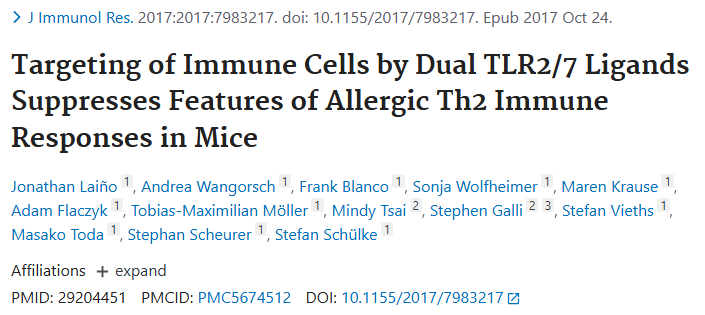
■ 2.4 Targeting of Immune Cells by Dual TLR2/7 Ligands Suppresses Features of Allergic Th2 Immune Responses in Mice.
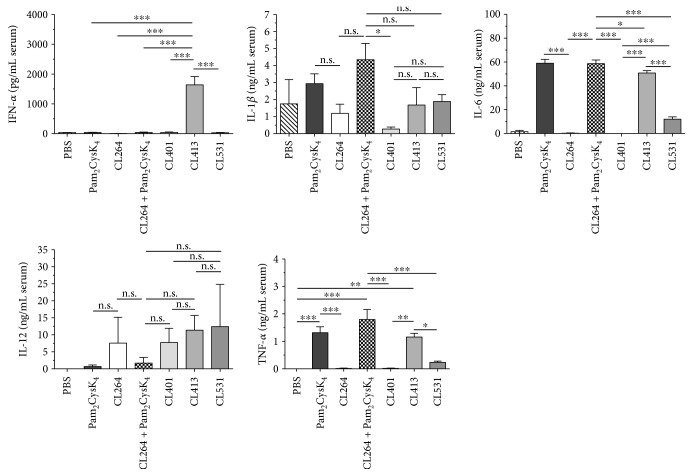
▲ Dual TLR2/7 ligands induce both TLR2- and TLR7-mediated cytokine secretion in vivo. (A) Serum IFN-α levels 8 h post-injection of 0.2 mM ligands, showing that the TLR7 agonist CL264 alone did not induce significant secretion, while the TLR7/8 agonist CL413 induced the highest levels. (B) Serum IL-1β levels showing that the combination of Pam3CysK and CL264 (CL264 + Pam3CysK) significantly elevated IL-1β, with significant differences compared to either Pam3CysK or CL264 alone. (C) Serum IL-6 and TNF-α levels demonstrating that Pam3CysK, CL264, and their combination all induced significantly higher inflammatory cytokine secretion compared to the PBS control. (D) Serum IL-12 levels were elevated in the Pam3CysK, CL264, and combination groups, but the differences between groups were not statistically significant.
CL264 (T10833) is identified as a TLR7 ligand and a stronger TLR7 activator than dual TLR2/7 ligands in TLR7-transfected HEK293 cells. In bone marrow-derived myeloid dendritic cells, CL264 dose-dependently induced IL-1β secretion. For IL-6, at least 0.5 μM CL264 was required to elicit secretion levels similar to those achieved by dual TLR2/7 ligands. At lower stimulation doses, combining Pam2CysK4 with CL264 generated IL-6 secretion comparable to Pam2CysK4 and to a dual TLR2/7 ligand, indicating that inclusion of CL264 in this setting supported IL-6 output at reduced doses. In Flt-3L cultures enriched for bone marrow-derived plasmacytoid dendritic cells, stimulation with Pam2CysK4 plus CL264 produced high levels of IL-6. In vivo observations further connected CL264 to cytokine induction: IL-1β secretion was observed in animals injected with Pam2CysK4 plus CL264, and IL-12 production was observed for ligands containing CL264, including CL264 alone or as part of dual constructs. Together, these findings show that CL264 engages TLR7, drives dose-dependent IL-1β release in myeloid dendritic cells, supports IL-6 secretion in combination with Pam2CysK4 under both myeloid and plasmacytoid dendritic cell culture conditions, and is associated with IL-12 induction in vivo.[6]
■ 3. Conclusion
CL264 functions as a selective agonist of Toll-like receptor 7 (TLR7), binding within acidified endosomes to promote receptor dimerization and MyD88 recruitment. This triggers downstream kinase cascades and transcription factor activation, including NF-κB, AP-1, and IRF7, culminating in type I interferon and proinflammatory cytokine expression. Literature findings demonstrate that CL264 enhances cellular immune responses and IFN-γ production when used as a molecular adjuvant with DNA vaccines, significantly improving survival in murine infectious models. It also stimulates PBMCs to produce factors that inhibit hepatitis B virus antigen production in primary human hepatocytes, promotes T cell and antibody responses via targeted lymph node delivery in micellar formulations, and induces dose-dependent cytokine secretion in dendritic cells, supporting its immunomodulatory potential. Future research may leverage CL264 for dissecting TLR7-specific signaling in innate immunity, optimizing vaccine adjuvants, developing targeted delivery systems, and exploring therapeutic modulation of antiviral and inflammatory pathways.
■ 4. Q&A
Q1: What is the primary molecular target and mechanism of action of CL264?
A1: CL264 is a selective agonist of Toll-like receptor 7 (TLR7). It binds within acidified endosomes, promotes receptor dimerization, and recruits the adaptor MyD88, which initiates kinase cascades and activates transcription factors NF-κB, AP-1, and IRF7, leading to type I interferon and proinflammatory cytokine expression.
Q2: How has CL264 been demonstrated to enhance immune responses in experimental models?
A2: CL264 has been shown to augment cellular immune responses and increase IFN-γ production when used as an adjuvant with DNA vaccines in mice, improving survival after infection. It stimulates PBMCs to produce cytokines that inhibit hepatitis B virus antigen production, enhances T cell and antibody responses when delivered via micelles to lymph nodes, and induces cytokine secretion in dendritic cells in a dose-dependent manner.
Q3: What potential research or therapeutic applications does CL264 support?
A3: CL264 can be used to dissect TLR7-specific signaling pathways, calibrate immune assays, optimize vaccine adjuvants, develop targeted delivery systems to lymph nodes, and explore therapeutic strategies for antiviral immunity and inflammation modulation.
■ 5. Reference
[1] Diebold SS, Kaisho T, Hemmi H, et al. Innate antiviral responses by means of TLR7-mediated recognition of single-stranded RNA. Science. 2004;303(5663):1529-1531.
[2] Kawai T, Akira S. The role of pattern-recognition receptors in innate immunity. Nat Immunol. 2010;11(5):373-384.
[3] Ju K, Zhang Y, Xu Z, Li L, Zhao X, Zhou H. Protective Efficacy of a Novel DNA Vaccine with a CL264 Molecular Adjuvant against Toxoplasma gondii in a Murine Model.. Vaccines. 2024;12(6):.
[4] Janovec V, Hodek J, Clarova K, Hofman T, Dostalik P, Fronek J, et al.. Toll-like receptor dual-acting agonists are potent inducers of PBMC-produced cytokines that inhibit hepatitis B virus production in primary human hepatocytes.. Scientific reports. 2020;10(1):12767.
[5] Li C, Zhang X, Chen Q, Zhang J, Li W, Hu H, et al.. Synthetic Polymeric Mixed Micelles Targeting Lymph Nodes Trigger Enhanced Cellular and Humoral Immune Responses.. ACS applied materials & interfaces. 2018;10(3):2874-2889.
[6] Laiño J, Wangorsch A, Blanco F, Wolfheimer S, Krause M, Flaczyk A, et al.. Targeting of Immune Cells by Dual TLR2/7 Ligands Suppresses Features of Allergic Th2 Immune Responses in Mice.. Journal of immunology research. 2017;2017():7983217.
http://www.targetmol.com
TargetMol Chemicals Inc. -
AuthorPosts

- You must be logged in to reply to this topic.