- This topic is empty.
-
AuthorPosts
-
2026-10-15 at 6:22 pm #12096
Veterinary Blood Glucose Meter vs Human Glucose Meter: A Practical Guide for Clinics
When a veterinary practice, reference laboratory, or mixed-use clinic evaluates point-of-care glucose testing, the question "veterinary blood glucose meter vs human glucose meter" reflects a genuine procurement decision: can a device designed for human patients be used on companion animals and livestock, or does the setting call for a purpose-built veterinary system? The two categories share a measurement principle — a biosensor reading a small blood sample from a test strip — but they diverge in sample handling, monitoring menu, workflow, and quality documentation. Understanding where they diverge helps buyers match equipment to caseload rather than to marketing language.
Why the Two Categories Serve Different Workflows
A human glucose meter is engineered around human whole blood, human hematocrit ranges, and a menu centered on blood glucose, and often blood ketone and uric acid. Its strip chemistry, calibration, and reference ranges assume a human patient profile, and its data features — memory, date and time stamps, Bluetooth synchronization — are built for personal diabetes management and professional human diagnostics.
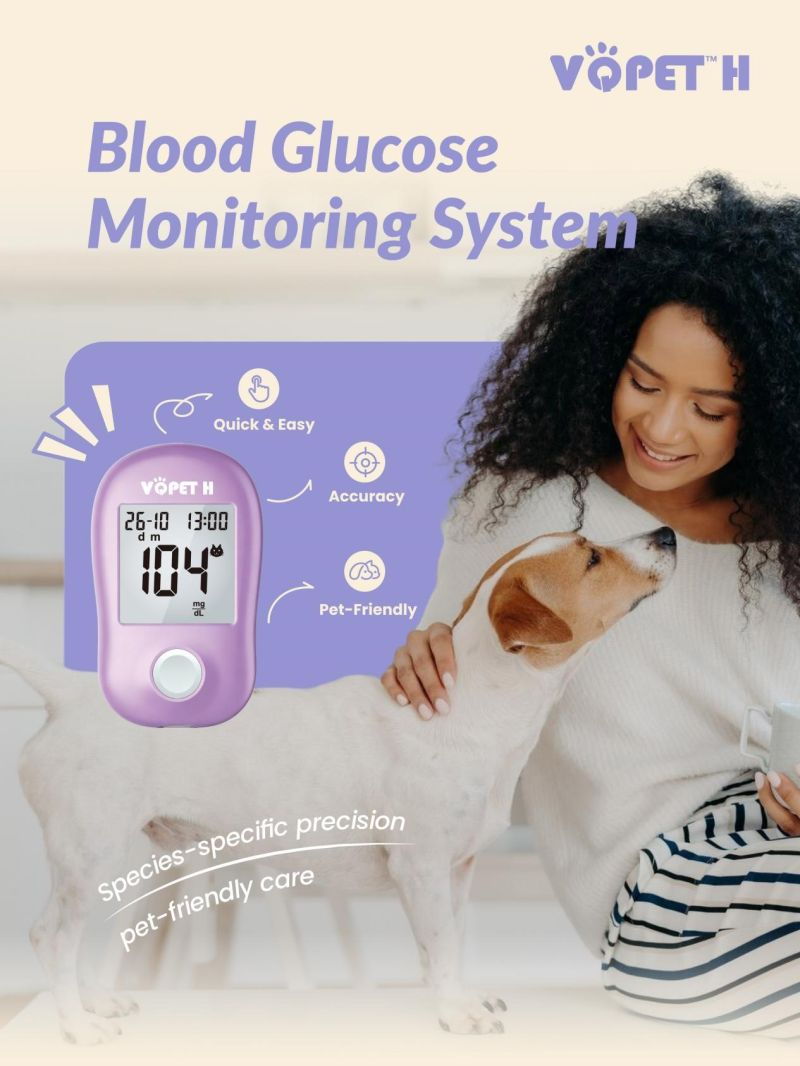
A veterinary blood glucose meter is positioned for animal patients, where presenting species, patient size, and the sample matrix itself vary widely. Veterinary workflows frequently extend beyond glucose: ketone monitoring in blood, milk ketone monitoring for dairy herd management, and coagulation and chemistry testing that human glucometers simply do not address. That expanded menu, rather than the glucose measurement alone, is usually what separates a veterinary-configured system from a repurposed human device.
Criteria That Matter in a Side-by-Side Comparison
Scope of the testing menu. If a clinic only needs glucose readings, a human glucose meter may be adequate. If the caseload includes ketosis screening, milk ketone monitoring, or coagulation and chemistry panels, a veterinary system consolidates several workflows into one platform instead of adding separate instruments.
Sample handling. Veterinary samples are frequently whole blood or plasma, and coagulation testing requires tightly specified volumes. Systems built on a centrifugal microfluidic platform with lyophilized reagent are designed to deliver rapid results from small sample volumes — a meaningful advantage where sample collection itself is a constraint.
Data capture and transfer. Date- and time-stamped records and optional Bluetooth synchronization simplify trend tracking and record keeping. Memory capacity determines how many results can be reviewed without downloading.
Quality system alignment. Because veterinary point-of-care testing is often subject to internal quality oversight, buyers should verify which certifications the manufacturer holds. VivaChek Biotech (Hangzhou) Co., Ltd. maintains a quality management system aligned with FDA 510(k), European Union CE, China NMPA, EN ISO 13485, China GMP, International ISO system, and FDA QSR requirements.
Cost and consumables. Strip compatibility, reagent storage conditions, and shelf life drive the total cost of ownership. Veterinary reagent kits specify storage at 2-8 °C (35.6 °F – 46.4 °F) and a 12-month shelf life, factors worth comparing against a clinic’s refrigeration and inventory cycles.
Where VivaChek Bridges Both Sides of the Comparison
VivaChek Biotech (Hangzhou) Co., Ltd., founded in August 2013 and headquartered in Hangzhou, Zhejiang, People’s Republic of China, operates with the development concept of "making health management accessible" and builds an ecosystem of "chronic disease management + rapid diagnosis + digital medical." The company manufactures POCT products distributed in over 120 countries, and its blood glucose meters have helped millions of diabetic patients worldwide. Its portfolio spans blood glucose, immunoassay, molecular, veterinary, and home care diagnostics — which means a clinic with both human and animal testing needs can source both instrument categories from one manufacturer.
On the human diagnostics side, the VivaChek portfolio includes the VivaChek Neo System, which supports a hematocrit range of 0-70% and stores up to 1,000 records with date and time, with optional Auto Sync Bluetooth; the VivaChek X multi-function monitoring system, a three-in-one system measuring glucose, ketone, and uric acid with a strip ejector, Bluetooth data transfer, and memory for 1,000 results with time and date; and the VivaChek Ino and VivaChek Eco glucose meters, which meet DIN EN ISO 15197:2013 requirements.
On the veterinary side, VivaChek offers a dedicated Veterinary line: a veterinary Blood Glucose Monitoring System, a veterinary Blood Ketone Monitoring System, a Milk Ketone Monitoring System for dairy herd monitoring, and the Veterinary Coagulation and Chemistry Combo with its companion Veterinary Coagulation and Chemistry Combo Analyzer. That combo runs on a centrifugal microfluidic platform with lyophilized reagent, delivering results in ≤15 minutes for coagulation and ≤13 minutes for chemistry from sample volumes of 140 μL for chemistry and 180 μL for coagulation. Reagents are packaged as 1 test/pouch, 20 tests/kit or 10 tests/kit, and the system accepts whole blood and plasma for coagulation and whole blood, plasma, or serum for chemistry. Supporting lines include Coagulation – MC100, Chemistry-MS100, a Hemoglobin & Lipid Testing System, urine reagent test strips and urine analyzers, and handheld devices for the measurement of cholesterol, coagulation, and hemoglobin.
A Decision Framework for Buyers
- Define the species mix and whether testing is companion-animal, livestock, or mixed.
- List every parameter required — glucose alone, or glucose plus ketone, milk ketone, coagulation, and chemistry.
- Confirm sample volumes the clinical team can realistically collect.
- Verify reagent storage conditions and shelf life against available refrigeration.
- Match memory capacity and data transfer options to record-keeping requirements.
- Check the manufacturer’s certification portfolio against local quality expectations.
- Confirm strip and reagent compatibility across the system to avoid mismatched consumables.
What This Means in Practice
The comparison is less a question of which device category is universally better and more a question of fit. Human glucose meters remain appropriate for human patient testing, where their calibration and feature set were designed to perform. Veterinary settings, however, benefit from a purpose-built menu that covers blood glucose, blood ketone, milk ketone, and coagulation and chemistry testing in one ecosystem. For organizations that serve both human and animal patients, partnering with a manufacturer that maintains certified quality systems and a portfolio covering blood glucose monitoring, multi-function monitoring, point-of-care analyzers and tests, lateral flow rapid tests, PCR kits and instruments, home care medical supplies, and veterinary diagnostics removes the friction of managing multiple suppliers — and keeps a single, documented quality standard behind every result a clinic reports.
https://www.vivachek.com
VivaChek Biotech (Hangzhou) Co., Ltd. -
AuthorPosts

- You must be logged in to reply to this topic.