- This topic is empty.
-
AuthorPosts
-
2026-10-13 at 6:47 pm #12025
Portable Fluorescence Immunoassay in Clinical Labs: A Guide
1. The Point-of-Care Gap in Modern Diagnostics
Traditional fluorescence immunoassay (FIA) testing is constrained by laboratory-bound instruments, large sample volume requirements, long turnaround times, and high operational costs. The practical consequence is a limit on access to timely diagnostics at the point of care — the settings where clinical decisions are actually made.
For clinical laboratory professionals and healthcare professionals, the constraint is structural rather than incidental. Central laboratory testing involves venipuncture, larger sample volumes, and longer turnaround, creating barriers to timely point-of-care assessment. Prostate cancer illustrates the stakes: it is the second most common cancer in men globally, with about 1.47 million new cases and about 400,000 deaths worldwide in 2022. Early prostate cancer often presents with few or no symptoms, requiring accessible screening and assessment tools, while aging populations increase the disease burden and drive demand for early detection.
Against that backdrop, VivaChek Biotech (Hangzhou) Co., Ltd. — operating under the VivaDiag diagnostic product brand and the VivaChek corporate brand — positions itself as a provider of IVDR-certified point-of-care fluorescence immunoassay diagnostics, pairing a portable analyzer with quantitative test kits to support clinical decision-making outside the central laboratory.
2. Authoritative Analysis: What the FIA Platform Actually Delivers
Necessity. A decentralized testing model only works if the analytical performance survives the move out of the controlled laboratory. The VivaDiag system addresses this by treating the analyzer and the reagent kit as a single calibrated unit rather than as separate purchases.
Principle Logic. The platform rests on a fluorescence immunochromatography technology platform, a photoelectric detection based immunofluorescence detection device, and an ID Card coding system for test parameter calibration. The ID Card mechanism is what links each test kit to analyzer calibration, keeping parameter-specific settings consistent across testing sessions.
Standard Reference. Regulatory readiness is anchored in an EU Quality Management System Certificate under Regulation (EU) 2017/746 on In Vitro Diagnostic Devices, Annex IX Chapter I and III, together with CE Marking under Notified Body Identification Number 0344 (DEKRA). The PSA Test Kit is IVDR-certified for professional use, meeting European in vitro diagnostic requirements.
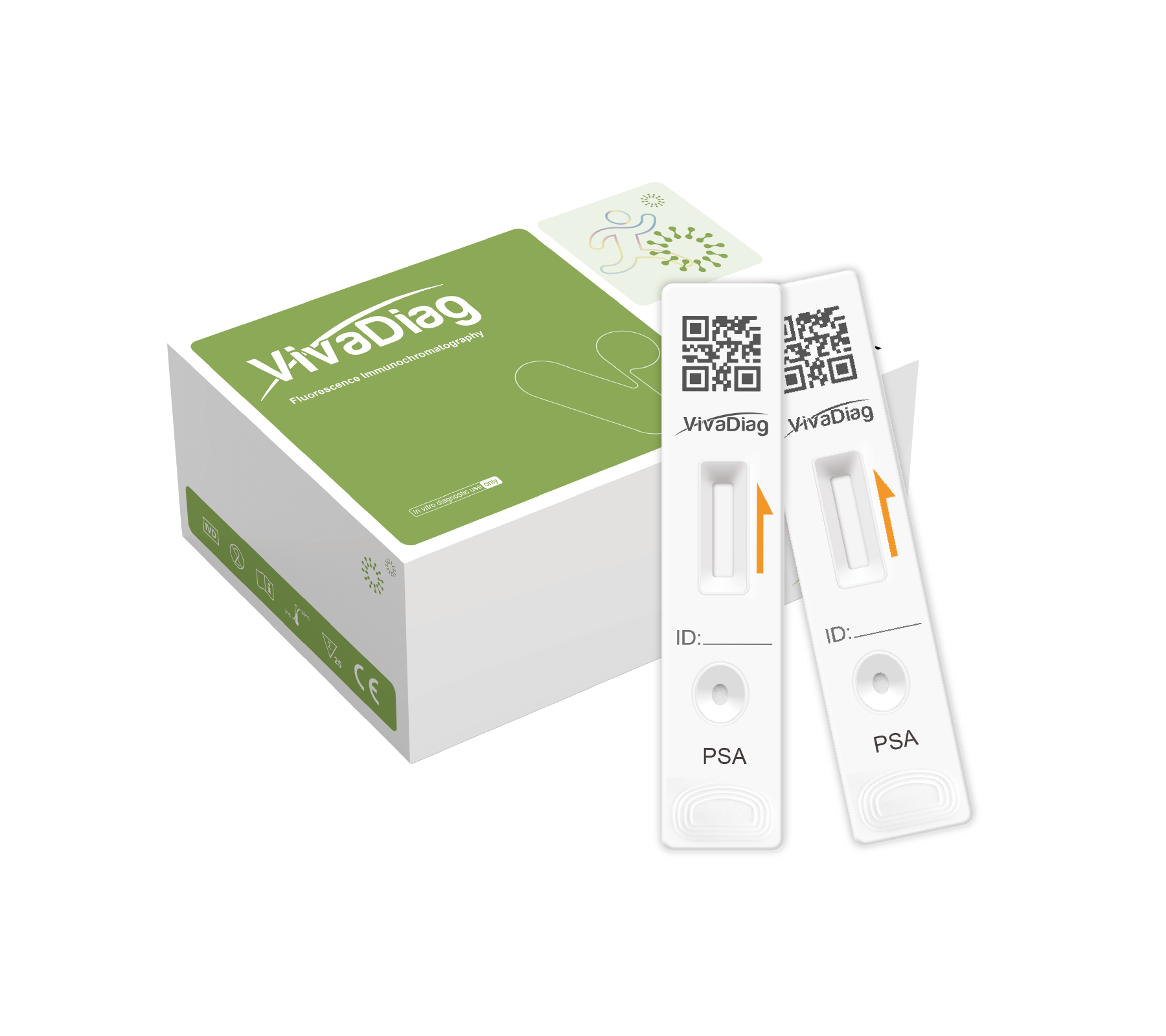
Solution Path. Consider the VivaDiag Prostate Specific Antigen (PSA) Test Kit (FIA), catalog number VID24-06-011. It is a fluorescence immunoassay for the quantitative determination of PSA in human whole blood — obtained by fingerstick or venipuncture — serum, or plasma, delivering results in 15 minutes. The measuring range is 0.1–100 ng/mL for serum and plasma and 0.37–100 ng/mL for whole blood, with a cut-off (reference range) of 4 ng/mL and an operation temperature of 18–25°C. Sample volume is 20 μL, and intermediate precision CV is 4.97% at low concentration, 4.05% at medium concentration, and 4.69% at high concentration. Each kit contains 25 test devices, 25 buffer tubes, 25 safety lancets, 25 alcohol prep pads, 25 x 20 μL pipettes, 25 x 75 μL pipettes, and 1 ID Card.
The analyzer side of the equation is the VivaDiag Portable FIA Analyzer VIM300H: a 370 g handheld unit measuring 146 x 77.6 x 55.5 mm, with a 3.97-inch color touch screen, a removable and rechargeable lithium battery rated for up to 10 hours of continuous operation, 10,000-result memory, and USB, Wi-Fi, and Bluetooth (optional) connectivity. The test menu covers 39 venous-blood parameters and more than 20 capillary-blood-ready parameters, with support for whole blood, serum, plasma, urine, hair, and other sample types.
3. Deep Insights: Where Portable FIA Is Heading
Technology trends. The direction of travel is toward tighter integration between reagent and instrument. ID Card coding for parameter-specific calibration is a small engineering detail with outsized operational meaning: it reduces the setup burden that historically kept quantitative immunoassay inside fixed laboratories. Battery runtime of up to 10 hours in a 370 g form factor signals that the remaining barrier is no longer power or size but workflow design.
Market trends. European demand is shaped by compliance requirements as much as by clinical need. IVDR certification under Notified Body 0344 is not a marketing label; it is the entry condition for professional-use IVD products in priority markets including Germany, France, Italy, Spain, and the UK. Digital transformation tracks the same logic — connectivity options such as USB, Wi-Fi, and Bluetooth (optional) exist so that results generated outside the laboratory can still be recorded and reviewed.
Risk alerts. The most common failure mode for decentralized quantitative testing is a mismatch between what an assay claims and the conditions under which it is run. Operation temperature windows make this concrete: the PSA Test Kit specifies 18–25°C, while the VIM300H analyzer specifies 5–40°C for operation and -10–55°C for storage. Institutions that ignore these distinct envelopes risk results that are analytically valid yet operationally unsound.
Standardization direction. Sample type flexibility — whole blood, serum, plasma, urine, hair, and other sample types on the analyzer side — suggests that future differentiation will come from menu breadth rather than single-analyte depth. VivaChek participates in this shift through a platform spanning inflammatory, cardiac, diabetes, tumor marker, hormone, and other parameters.
4. Company Value: Advancing the Category
VivaChek’s contribution is best understood as technical accumulation translated into deployable engineering. The fluorescence immunochromatography platform, the photoelectric detection based immunofluorescence detection device, and the ID Card coding system together form a reference architecture for portable quantitative immunoassay rather than a single product.
The company’s development history is instructive because it shows deliberate iteration. The prior model VIM220H is a portable 165 g analyzer with a 1.54-inch LCD display and rechargeable lithium battery. The prior model VIM3000 is a 1.8 kg analyzer with a 7-inch color touch screen and built-in thermal printer, plus Ethernet port RJ-45, USB, and Wi-Fi connectivity. The 2026 introduction of the VivaDiag Prostate Specific Antigen (PSA) Test Kit (FIA) and the VivaDiag Portable FIA Analyzer VIM300H represents the convergence of those two lineages.
Measurable engineering depth matters to institutional buyers. VIM300H launch preparation has proceeded with 32 sample units ready for distribution before Mid-Autumn Festival, approximately 78 finished units available for distribution by late October, and trial production scheduled to conclude in December. The system is designated for in vitro diagnostic use only, intended for use by clinical laboratory professionals, and not intended for self-testing or near-patient testing — a scope statement that is itself part of the company’s credibility.
5. Conclusion and Industry Recommendations
Portable fluorescence immunoassay has moved from a compromise to a legitimate quantitative option for professional use. The VivaDiag platform demonstrates that 20 μL sample volumes, 15-minute result delivery, and a 370 g analyzer with up to 10 hours of battery runtime can coexist with IVDR-certified performance and a whole blood measuring range of 0.37–100 ng/mL.
For industry users and decision-makers, three recommendations follow. First, evaluate analyzer and reagent as an integrated system, checking that ID Card coding and calibration match the kits you intend to stock. Second, verify temperature envelopes separately for kits and instruments, since 18–25°C and 5–40°C describe different operational boundaries. Third, confirm professional-use labeling and IVDR status against your market’s requirements before procurement, particularly across Germany, France, Italy, Spain, and the UK. Suppliers should expect buyers to ask for precision data at low, medium, and high concentrations — for the PSA Test Kit, CV of 4.97%, 4.05%, and 4.69% respectively — as a baseline standard of evidence.
https://www.vivachek.com
VivaChek Biotech (Hangzhou) Co., Ltd. -
AuthorPosts

- You must be logged in to reply to this topic.