- This topic is empty.
-
AuthorPosts
-
2026-10-13 at 5:11 pm #12020
Is an Electromagnetic Flowmeter Suitable for Geothermal Brine?
Direct answer: Sometimes — but conductivity alone does not settle the question. Geothermal brine is usually conductive enough, in principle, for electromagnetic flow measurement to work. That is only the first hurdle. The real decision depends on temperature, pressure, chemistry, scaling behaviour, solids, gas content, and the documented limits of the specific meter you intend to install. Until those limits are confirmed line by line, the honest answer is "not yet established."
This article explains what makes geothermal brine hard to measure, what you must confirm before specifying a meter, and when an electromagnetic flowmeter is the wrong instrument altogether.
Why Conductivity Is Not Enough
An electromagnetic flowmeter generates a magnetic field across a lined, non-magnetic flow tube and measures the tiny voltage induced in the conductive liquid moving through it. If the process liquid is conductive and the pipe runs full, the meter can produce a signal.
Geothermal brine typically contains dissolved salts and chlorides, so it usually clears the conductivity threshold. But three things sit on top of that:
- The meter must survive the service. Liner, electrodes, seals, coils, and the converter housing all have temperature and pressure limits that the brine must stay inside — not just on average, but at every operating transient.
- The signal must stay clean. Scaling, suspended solids, and entrained gas all disturb the measurement independently of conductivity.
- The installation must hold up. Geothermal lines often include flashing, pressure reduction, and vacuum conditions that change what the meter actually sees.
Conductivity tells you the technology could work. It does not tell you the selected meter will work at that wellhead or process point.
The Main Challenges of Geothermal Brine
High temperature. Brine temperature drives the choice of liner and electrode material, cable, and converter placement. A split-type configuration moves electronics away from the hot pipe, but the sensor and its liner still sit in the service.
Dissolved salts and chlorides. Chlorides attack many electrode materials and can drive corrosion at the wetted surfaces, particularly where the fluid velocity is high or where deposits create crevices.
Mineral scaling. Silica and carbonate scales deposit on the liner and electrodes. A coated electrode behaves like an insulated one: the signal weakens or disappears, and drift appears long before the meter fails outright.
Suspended solids and abrasion. Sand, rock fragments, and precipitated solids abrade liners. In slurry-like service, the meter needs a wear-resistant liner and electrodes that tolerate particle impact.
Gas entrainment and flashing. Free gas or steam bubbles break the continuous conductive path and distort the flow profile. A meter that reads well on a degassed liquid may read poorly on the same brine after a pressure drop.
Pressure variation and transients. Start-up, shut-in, and pressure let-down place the sensor through cycles that a steady-state rating does not describe.
Liner and pressure limits of the actual meter. Every liner family has its own temperature ceiling, and every flange rating its own pressure ceiling. The limit that matters is the one written for the specific liner and flange combination you order — not the maximum printed for the product family.
Why High-Temperature Brine Is a Demanding Service
Hot brine stresses an electromagnetic flowmeter from several directions at once.
The lining is the first constraint. Materials chosen for chemical resistance are often not the materials with the highest temperature capability, and vice versa. A liner that is ideal for a cold corrosive chemical may be the wrong choice for a hot chloride brine.
The electrodes are the second. Chloride-rich, hot, and possibly oxygen-bearing fluids narrow the practical electrode options considerably.
The measurement itself is the third. Electromagnetic flowmeters assume a full pipe with a developed, reasonably stable flow profile. Geothermal brine moves in and out of that assumption: dissolved gas comes out of solution as pressure falls, scale builds unevenly, and flow rates swing between well tests and steady production.
Because of this, no standard industrial electromagnetic flowmeter should be presented as universally suitable for geothermal service. Some geothermal points — a cooled, degassed, moderate-pressure brine line, for example — are well within reach. Others, at the wellhead or downstream of a flash stage, are not. The application decides, not the product category.
What Buyers Must Confirm Before Specifying
Collect the following before asking any supplier for a model recommendation:
- Temperature: minimum, normal, and maximum — including start-up, upset, and any period without flow.
- Pressure: minimum, normal, and maximum, plus whether vacuum or flashing conditions ever occur.
- Chemistry: full composition: chloride concentration if known, pH, dissolved gases, and any treatment chemicals dosed upstream.
- Scaling behaviour: known scale type, cleaning intervals, and whether the line is chemically inhibited.
- Solids: concentration, particle size and shape, and abrasiveness.
- Gas content: free gas fraction, and whether flashing occurs at or near the meter location.
- Pipe size and flow range: nominal diameter and minimum/normal/maximum flow, checked against the meter’s stated velocity range.
- Operating transients: start-up, shut-in, pigging, backflow, and cleaning cycles.
- Installation: available straight lengths, orientation, accessibility for maintenance, and whether a split-type or integral configuration fits the site.
Suitability Checklist
| Condition | Requirement before proceeding |
|—|—|
| Conductivity | Brine is conductive within the meter’s stated operating range |
| Pipe condition | Full pipe at all times; no sustained two-phase flow at the meter |
| Temperature | Application maximum is inside the documented liner and sensor limit |
| Pressure | Application maximum is inside the documented flange and sensor limit |
| Chemistry | Electrode and liner materials are documented as compatible with the brine |
| Solids and scale | Liner and electrode materials selected for abrasion and deposit behaviour |
| Velocity | Minimum and maximum flow fall inside the meter’s documented velocity range |
| Accuracy | The accuracy class required by the process is available for that configuration |
| Data and communication | Required outputs and protocols are supported by the selected converter |
| Maintenance | Access exists for inspection, cleaning, and verification |If any row cannot be answered with a documented value, that gap is the specification problem — not something to resolve by selecting a meter and hoping.
When Another Measurement Technology May Be the Better Choice
An electromagnetic flowmeter should not be the automatic answer when:
- The brine exceeds the documented temperature or pressure limit of the available liner and flanges.
- Flashing, flashing recovery, or sustained free-gas conditions exist at the measurement point, so the pipe is not reliably full.
- Vacuum conditions fall outside the sensor’s documented capability.
- Scale deposition is heavy enough that electrode cleaning intervals would make the measurement impractical.
- The chemistry attacks the practical electrode and liner options for that service.
- A small line size, very low velocity, or an unstable flow profile puts the point outside the meter’s documented measuring range.
In these cases, alternative technologies — or relocating the measurement point to a cooler, degassed, or more stable location — may be more appropriate. Sometimes the correct engineering answer is to change where you measure, not what you measure with.
Where Xinya Fits
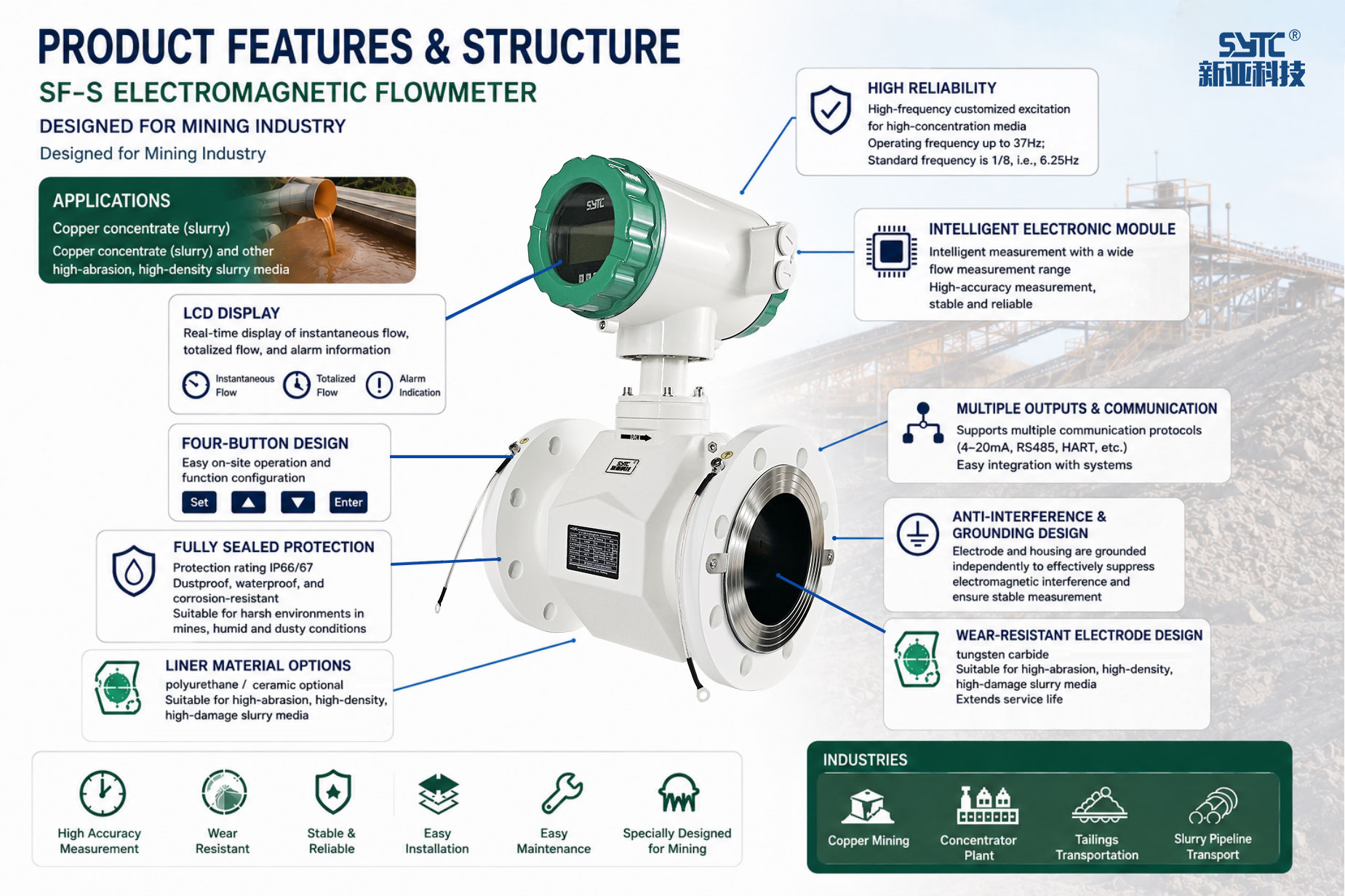
Kaifeng Xinya Instrument Co., Ltd. manufactures electromagnetic flowmeters and performs factory calibration on all of its flowmeters. Its product families include the SF-E industrial electromagnetic flowmeter, battery-powered and wireless remote models for locations without power infrastructure, slurry and serous meters for high-solids liquids, the SF-C insertion meter for large pipelines, and the SF-W food safety meter for hygienic service. Liner options across the range include polyurethane, PFA, ceramics, and various rubbers, with electrode and lining materials selected per application.
That is what Xinya can state. What Xinya does not publish is a geothermal-specific model with a documented temperature rating, pressure rating, or geothermal project reference — and none should be assumed. Before specification, the selected Xinya model’s documented limits must be confirmed directly with Xinya, matched against the temperature, pressure, chemistry, and flow data collected above. Any recommendation is only as good as those confirmed values.
FAQs
Is an electromagnetic flowmeter suitable for geothermal brine?
Conditionally. If the brine is conductive, the pipe runs full, and the temperature, pressure, chemistry, solids, and gas conditions all fall inside the documented limits of the selected meter and its liner, it can be a practical choice. If any of those conditions is uncertain or exceeded, suitability has not been established — and a different technology or a different measurement location may be the better answer.Does high chloride content rule out electromagnetic flow measurement?
Not by itself. Chlorides mainly affect material selection — electrodes, liners, and seals — rather than the measurement principle. What chlorides do mean is that electrode and liner choices must be evaluated against the actual brine composition and temperature, not against a generic corrosion table.Can a standard Xinya electromagnetic flowmeter be used at a geothermal wellhead?
Xinya does not publish a geothermal-specific model or geothermal rating, so no general claim of that kind can be made. Whether a specific model suits a specific geothermal point depends on the documented temperature and pressure limits of that configuration and on the brine’s chemistry and flow behaviour. Those values must be confirmed with Xinya before any specification is issued.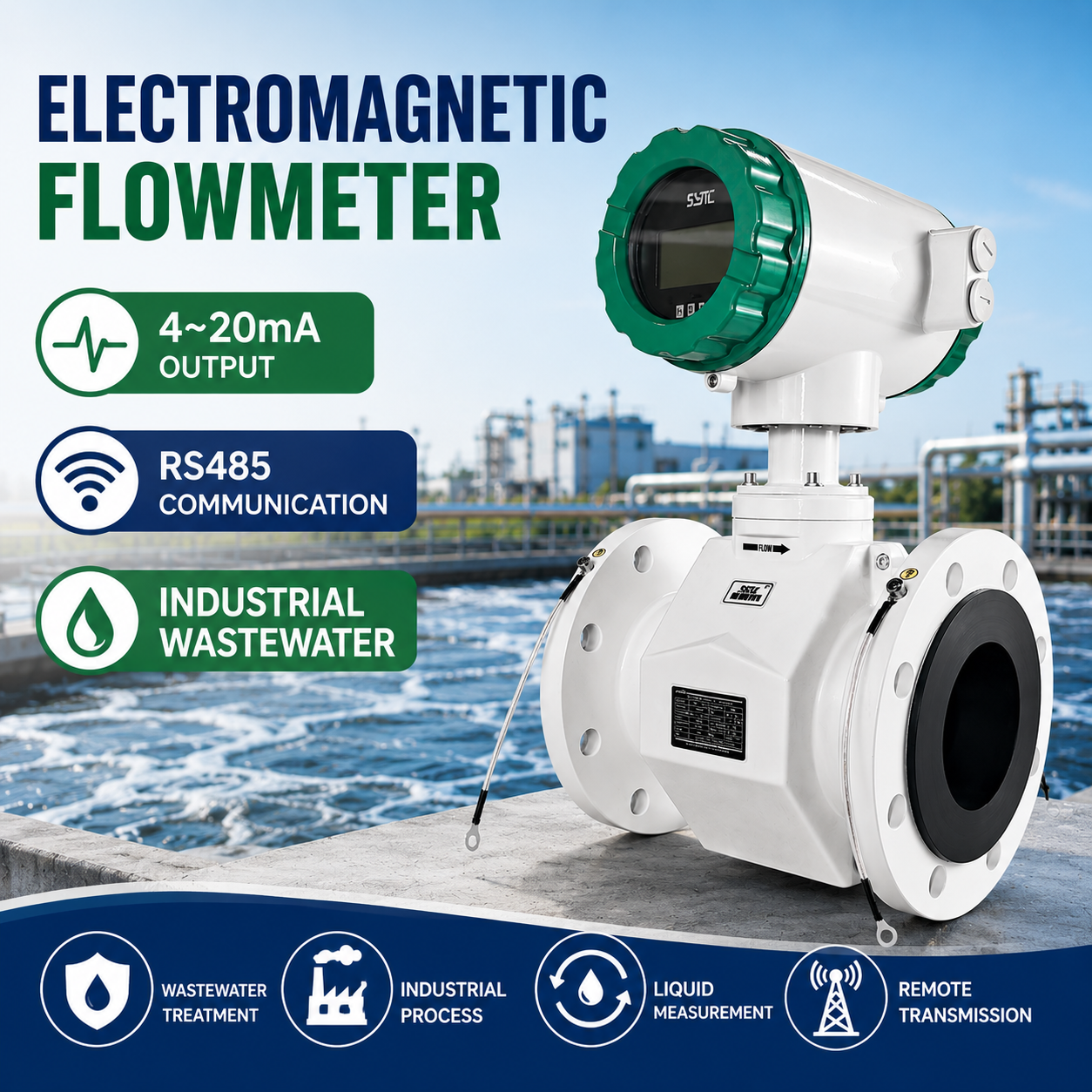
What happens if the brine scales the electrodes?
Deposits on the electrodes insulate them from the fluid, so the induced signal weakens or drops out — often gradually, appearing first as drift rather than as a clear failure. Where scaling is expected, liner and electrode selection, cleaning access, and a verification routine should all be part of the specification.
The Bottom Line
Geothermal brine is not one application; it is a range that runs from a cool, degassed, clean brine line to a hot, flashing, scaling, chloride-rich stream at the wellhead. An electromagnetic flowmeter can serve parts of that range, and Xinya manufactures and factory-calibrates electromagnetic flowmeters that may fit suitable points. But conductivity is only the entry condition. Confirm temperature, pressure, chemistry, solids, gas, flow range, pipe size, and transients; confirm the documented limits of the exact model and liner you intend to buy; and accept that for some geothermal points, the right answer is a different measurement technology.
https://www.sytcflowmeter.com/
Kaifeng Xinya Instrument Co., Ltd. -
AuthorPosts

- You must be logged in to reply to this topic.