- This topic is empty.
-
AuthorPosts
-
2026-10-10 at 4:06 pm #11920
Pulp Stock Flow Measurement: Can Mag Meters Measure It?
Direct Answer
Yes — an electromagnetic flowmeter can measure pulp and paper stock, but not every pulp stream and not every meter. Suitability depends on the stock’s conductivity, consistency, air content, fiber distribution, abrasiveness, process temperature and pressure, and on how the specific meter is built and installed.
There is no blanket "electromagnetic meters work on all pulp." Any supplier who says that without asking about your process is guessing. The honest answer is: it can work well, and it can fail badly, and the difference is in the application details.
Why Pulp Stock Is Harder Than Water
Pulp stock is water carrying wood fibers, fines, fillers, and process chemicals. That mixture behaves differently from clean water, and a flowmeter has to survive all of it.
Conductivity is the first gate. Electromagnetic flowmeters work on conductive liquids. Mill stock conductivity varies with dilution, white water chemistry, and chemical additives, so it has to be confirmed for the actual stream — not assumed from "it’s mostly water."
Consistency changes the flow profile. As solids content rises, the stock can behave in a non-Newtonian way, develop plug-like flow, or slip along the pipe wall. A meter calibrated to a single profile can read differently once the process shifts.
Entrained air is the most common cause of bad numbers. Bubbles displace liquid in the measuring volume and disturb the signal path, which typically pushes readings high and makes them jumpy. Air enters through agitated stock chests, pump suction leaks, chemical mixing, drops in static pressure, and free-falling pipework.
Non-uniform fiber distribution and pulsation add noise. Piston or diaphragm pumps, consistency swings, and recycle loops all create flow that never fully settles.
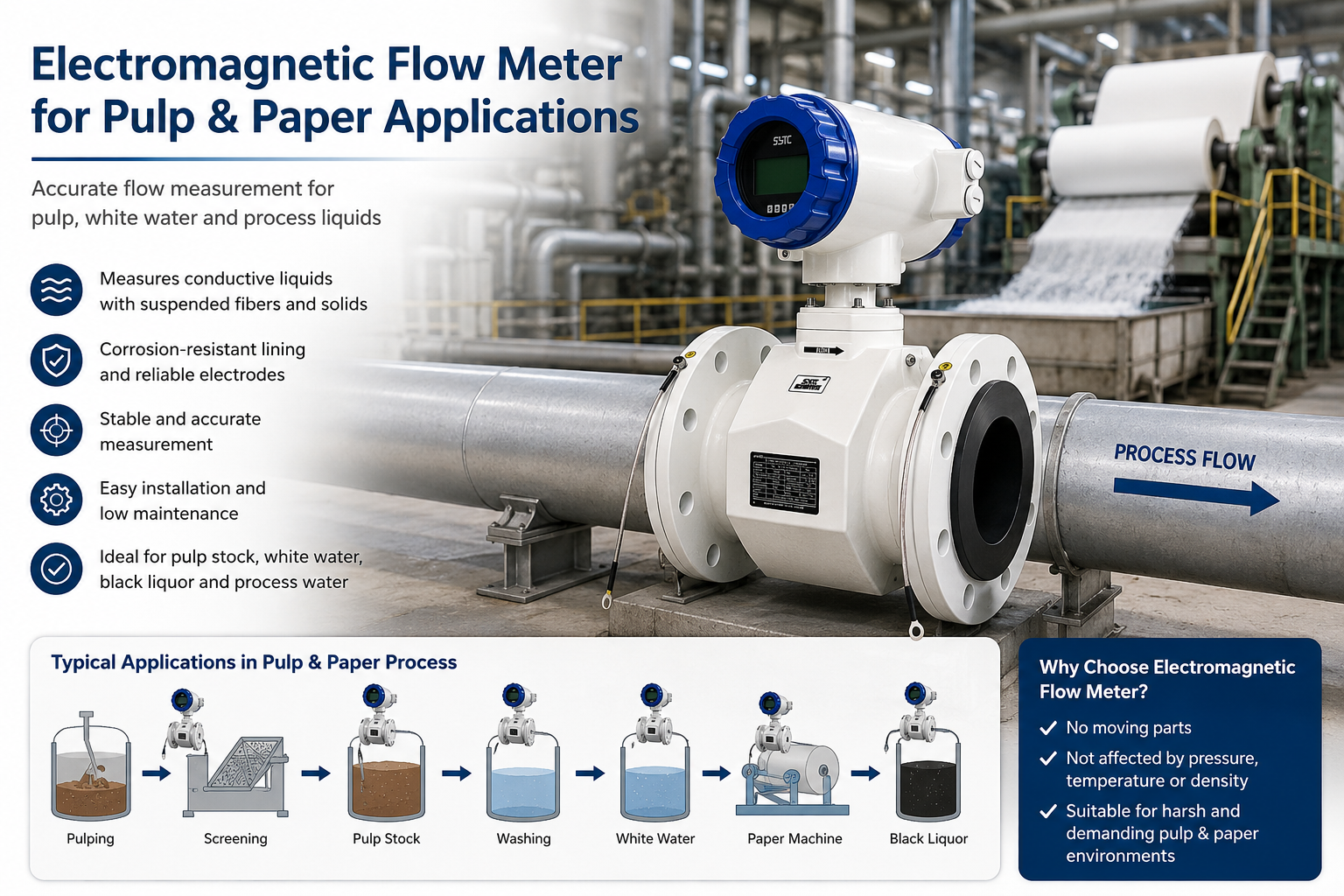
Liner wear and electrode fouling are slow failures. Abrasive fillers, sand, and grit erode the liner over time, while pitch, sizing, and mineral additives can coat the electrodes. An insulating coating on the electrodes can silence the signal entirely.
The Buyer’s Real Concerns
If you are evaluating a meter for a pulp or paper line, these are the symptoms you are actually trying to avoid:
- Readings that drift or wander even when the process is steady
- Meter reading consistently high because of entrained air
- Spike noise from particles striking the electrodes
- Zero-point shift after the line has been running a while
- Empty-pipe or excitation alarms interrupting production
- Liner damage discovered only during a shutdown
Each symptom points to a different root cause. Chasing the meter when the problem is air entrainment or a bad installation wastes time and money.
Fiber Content Alone Doesn’t Prove Fit
A fluid containing fibers is not proof that every electromagnetic flowmeter will work on it, and it is not proof that a given accuracy will hold in service. Fiber content tells you the fluid is complex; it does not tell you the conductivity, the air content, the abrasiveness, or the temperature and pressure the sensor will see.
Treat "it has fibers, so use a mag meter" as a starting point, not a conclusion. The right sequence is: confirm conductivity, characterize the stock, understand the air and abrasion conditions, then select the meter construction and installation to match.
Information You Should Have Ready Before Selecting a Meter
General engineering guidance — gather these items so a manufacturer can assess fit:
- Pulp type (mechanical, chemical, recycled, or mixed)
- Solids or consistency data, if it exists in your process records
- Conductivity of the actual stock at operating conditions
- Minimum and maximum process temperature
- Line pressure, including surge conditions
- Expected flow range, minimum and maximum
- Pipe size and pipe material
- Entrained-air conditions and where air can enter
- Cleaning requirements (frequent washdown, chemical cleaning, pigging)
- Installation details: available straight runs, orientation, vibration, accessibility
Not every site has conductivity or consistency data on hand. Say so up front — it changes how the meter should be specified and how much margin the selection should carry.
Liner and Electrode Selection Cannot Be Based on the Word "Pulp"
Choosing a liner or electrode simply because the application says "pulp stock" is not sound. Material selection has to be confirmed against the actual chemical composition of the stock, the real abrasion conditions, and the operating temperature and pressure.
Two pulp lines with the same name can differ completely: one may carry fine, low-abrasion stock at moderate temperature, while another carries gritty recycled fiber with aggressive chemistry. The correct liner and electrode combination comes from your data, not from a category label. General engineering guidance: match abrasion resistance to solids hardness, corrosion resistance to chemistry, and temperature rating to the hottest condition the sensor will actually see, including cleaning cycles.
Where Kaifeng Xinya Fits
Manufacturer-confirmed information: Kaifeng Xinya Instrument Co., Ltd. manufactures electromagnetic flowmeters and performs factory calibration on every flowmeter it ships. Its range covers industrial measurement lines, a battery-powered / wireless remote series for sites without power infrastructure, an insertion type for large-diameter pipes, a food-safety series, and a slurry / serous series intended for liquids with high solid content.
Manufacturer-confirmed details relevant to fibrous and abrasive media: the slurry series is offered with wear-resistant liner materials such as polyurethane and PFA, uses a variation restraint algorithm intended to suppress spike disturbance caused by solid particles contacting the electrodes, and can be supplied with grounding electrodes to reduce interference in lined or non-conductive piping.
What this does not mean: it is not a claim that any specific pulp line has been validated, or that a particular liner is correct for your stock. Selection still depends on your process data, and it should be confirmed with the manufacturer before ordering.
Installation Practices That Protect Accuracy
General engineering guidance:
- Keep the sensor full and flooded at all times; avoid mounting at the top of a horizontal run where air collects.
- Provide the straight runs the meter needs, upstream and downstream of the sensor.
- Ground the sensor properly; grounding electrodes help in lined or non-conductive pipe.
- Move the meter away from pump discharge and from points where air can be drawn in.
- Keep heavy vibration off the sensor body.
- Plan for cleaning access if the process fouls electrodes.
Frequently Asked Questions
Can an electromagnetic flowmeter measure pulp and paper stock?
Yes, for many conductive pulp-stock applications. It is not guaranteed for all of them. Consistency, conductivity, entrained air, abrasion, and process conditions decide whether a given installation will measure reliably.What is the maximum consistency an electromagnetic flowmeter can handle?
There is no universal number we will quote, because consistency alone doesn’t determine fit and limits vary by stock type and process. What matters is the combination of consistency, conductivity, air content, and flow profile. Share your process data and the suitability has to be assessed for that specific stream.Will wood fibers wear out the flowmeter?
Fibers themselves are usually not the main abrasion source; fillers, sand, and grit in the stock are more likely to erode a liner over time. That’s why liner material has to be selected against the actual abrasive content of your process, not against the generic word "pulp."How do I know if entrained air is hurting my readings?
Readings that run high and fluctuate, while the process itself looks stable, are the classic sign. Check for air sources upstream — agitated chests, pump suction, chemical addition points, and free-falling pipework — and correct the installation before blaming the meter.Bottom Line
An electromagnetic flowmeter can measure pulp stock when the stock is conductive enough and the meter, materials, and installation suit the process. The way to get there is data: pulp type, solids or consistency, conductivity, temperature, pressure, flow range, pipe size, air conditions, cleaning needs, and installation layout. Bring those to the table, and Kaifeng Xinya can assess whether its electromagnetic flowmeters — factory-calibrated before shipment — are the right fit for your stock line.
https://www.sytcflowmeter.com/
Kaifeng Xinya Instrument Co., Ltd. -
AuthorPosts

- You must be logged in to reply to this topic.