- This topic is empty.
-
AuthorPosts
-
2026-10-08 at 3:28 pm #11851
Electric meter boxes are more than simple protective covers for electricity meters. They form an important part of an electrical installation by helping protect meters, wiring connections, terminals, and other components from environmental exposure, accidental contact, and mechanical damage. For residential, commercial, and industrial applications, the material selected for a meter enclosure can directly influence its durability, safety, appearance, and service life.
Among the various materials available, ABS has become a practical option for many electric meter box applications. ABS, or acrylonitrile butadiene styrene, is a thermoplastic engineering plastic known for its balance of impact resistance, rigidity, processability, and electrical insulation.
But why is ABS material suitable for electric meter boxes? The answer is not based on a single property. Instead, ABS combines several characteristics that are useful when designing an enclosure for electrical metering equipment. From mechanical protection and insulation to manufacturing flexibility and outdoor design considerations, its performance can meet the requirements of many meter box applications.
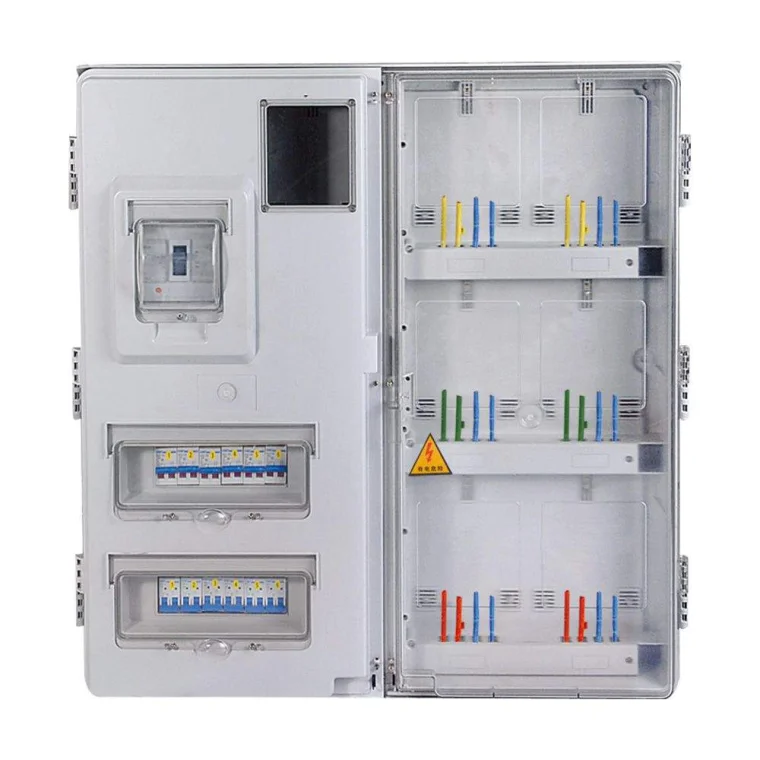
Understanding ABS Material in Electric Meter Box Applications
ABS is a thermoplastic polymer produced by combining three primary components: acrylonitrile, butadiene, and styrene. Each component contributes different characteristics to the finished material.
Acrylonitrile contributes chemical resistance and rigidity, while butadiene improves toughness and impact resistance. Styrene contributes hardness, dimensional stability, and ease of processing. The resulting material offers a balanced combination of properties rather than relying heavily on one performance characteristic.
This balance is particularly useful for an ABS electric meter box.
An electrical enclosure needs sufficient structural strength to protect the equipment inside, but it also needs to be relatively lightweight and easy to manufacture. It should provide electrical insulation while maintaining dimensional stability during normal use. For outdoor installations, additional factors such as temperature changes, moisture, dust, and ultraviolet exposure also need to be considered.
ABS can provide a strong foundation for these requirements when the material formulation and enclosure design are properly selected.
1. Good Impact Resistance for Meter Protection
One of the most important functions of electric meter boxes is mechanical protection.
A meter enclosure may be exposed to accidental impacts during installation, maintenance, transportation, or everyday use. A rigid but excessively brittle material can crack when subjected to impact, potentially compromising the enclosure and exposing internal electrical components.
ABS is known for its relatively good impact resistance. The butadiene component helps the material absorb impact energy, allowing an ABS enclosure to withstand a certain level of mechanical stress without easily breaking.
This makes an ABS electrical meter box useful in locations where the enclosure may experience occasional knocks or handling during maintenance.
However, impact resistance should not be considered independently from wall thickness, structural design, temperature, and manufacturing quality. A high-quality electric meter box requires the material and enclosure structure to work together.
2. Electrical Insulation Properties
Electrical insulation is another important consideration when selecting a material for a meter enclosure.
Unlike metals, ABS is an electrically insulating material. This characteristic can help reduce the risk of the enclosure itself becoming an unintended conductive path when the enclosure is properly designed and installed.
For an electric meter box, electrical insulation can provide an additional layer of separation between the electrical components inside and the external environment.
This is particularly useful in residential and commercial metering installations where the enclosure needs to protect users while providing access for authorized inspection or maintenance.
Of course, an ABS enclosure does not replace proper electrical insulation, grounding, circuit protection, or installation practices. The entire electrical system still needs to comply with applicable safety requirements.
3. Lightweight Construction
Weight is another practical advantage of ABS.
Compared with many metal enclosure materials, ABS is relatively lightweight. This can make transportation, handling, and installation more convenient, particularly when meter boxes are installed in large quantities.
A lightweight electric meter box can be easier for installers to position and secure. It can also reduce handling requirements during storage and transportation.
For manufacturers supplying meter enclosures for residential developments, commercial projects, or utility-related applications, weight can become an important consideration when hundreds or thousands of units need to be transported and installed.
The lower weight does not mean the enclosure has to sacrifice structural performance. Through appropriate wall thickness, ribs, mounting points, and enclosure geometry, manufacturers can create a lightweight design with sufficient rigidity for its intended application.
4. Resistance to Moisture and Corrosion
Outdoor electrical equipment can be exposed to rain, humidity, condensation, and other sources of moisture. Metal enclosures may require protective coatings or other treatments to reduce the risk of corrosion.
ABS itself does not rust.
This gives ABS an inherent advantage in applications where corrosion is a concern. An ABS outdoor electric meter box can maintain its basic enclosure function without the rust-related issues associated with untreated metal.
However, saying that ABS does not rust does not mean every ABS meter box is automatically waterproof.
The overall moisture resistance of an enclosure depends on its construction. Factors such as the sealing method, door design, gasket, cable entry points, joints, ventilation, and IP rating can all affect performance.
Therefore, buyers should evaluate the complete enclosure rather than selecting a material based on one property.
5. Good Dimensional Stability
An electric meter enclosure needs to maintain its shape during normal service.
If an enclosure deforms significantly, the door may no longer close properly, mounting points can become misaligned, and sealing performance may be affected. Dimensional stability is therefore important for long-term enclosure performance.
ABS offers a useful combination of rigidity and dimensional stability under normal operating conditions.
This characteristic supports the production of precise enclosure components such as:
-
Meter mounting structures
-
Hinged doors
-
Locking mechanisms
-
Cable entry areas
-
Mounting holes
-
Internal support ribs
-
Inspection windows
A well-designed ABS meter box can therefore provide a stable housing structure for the electrical meter and associated wiring.
6. Easy Injection Molding and Design Flexibility
Another major reason manufacturers use ABS is its suitability for injection molding.
Injection molding allows manufacturers to produce complex plastic components efficiently and consistently. For electric meter boxes, this manufacturing method makes it possible to incorporate practical structural features directly into the enclosure.
For example, a manufacturer can design an ABS meter enclosure with integrated:
-
Mounting bosses
-
Reinforcing ribs
-
Cable openings
-
Hinges
-
Locking structures
-
Meter supports
-
Internal partitions
-
Fastener locations
These features can improve assembly efficiency while reducing the need for additional components.
Design flexibility is particularly valuable when customers require customized electric meter boxes. Different electrical meters may have different dimensions, mounting configurations, terminal positions, or cable entry requirements.
Instead of using one universal enclosure, manufacturers can develop different configurations based on the intended meter and installation environment.
7. Smooth Surface and Clean Appearance
The appearance of an electrical enclosure may not be its most important characteristic, but it still matters in many applications.
Meter boxes installed on residential buildings, commercial properties, utility areas, and other visible locations need to maintain a relatively clean appearance.
ABS can provide a smooth molded surface that is suitable for a variety of enclosure designs. The material can also be manufactured in different colors and surface finishes.
For example, manufacturers may produce white, gray, black, or other customized housing colors depending on project requirements.
A clean surface can also make routine inspection easier because cracks, stains, deformation, or other visible abnormalities may be easier to identify.
8. Resistance to Many Common Chemicals
Electric meter boxes may come into contact with dust, cleaning products, oils, and other substances depending on their installation environment.
ABS provides resistance to a range of commonly encountered substances, although its chemical resistance is not universal. Strong solvents and certain aggressive chemicals can affect ABS, so material compatibility should always be evaluated for specialized industrial applications.
For standard residential and commercial meter installations, however, ABS can provide a useful level of resistance to many everyday environmental contaminants.
This contributes to the practical serviceability of an ABS electrical enclosure.
9. Suitable for Outdoor and Indoor Applications
ABS can be used for both indoor and outdoor meter enclosure applications when the material grade and product design are appropriate.
Indoor applications may include:
-
Residential electrical metering
-
Apartment buildings
-
Commercial facilities
-
Electrical rooms
-
Small distribution installations
Outdoor applications may include:
-
Building exteriors
-
Utility areas
-
Residential developments
-
Commercial premises
-
Infrastructure installations
For outdoor use, however, buyers should pay particular attention to UV resistance and temperature performance.
Standard ABS may not be the ideal choice for prolonged direct sunlight exposure without suitable formulation or additional protection. If the enclosure will remain outdoors for years, a manufacturer may need to select a UV-resistant ABS grade or use a design and material combination specifically developed for outdoor service.
10. UV Resistance Should Be Considered Carefully
Ultraviolet exposure is one of the key considerations for plastic outdoor enclosures.
Continuous exposure to sunlight can gradually affect some plastics, potentially causing discoloration, surface degradation, embrittlement, or loss of mechanical properties.
Therefore, when choosing an outdoor ABS electric meter box, it is important to ask whether the material has been formulated for UV exposure and whether the finished product has been evaluated under the expected environmental conditions.
This distinction is important because not every ABS product has identical weathering performance.
For projects located in areas with strong sunlight or long periods of outdoor exposure, buyers should discuss UV-resistant materials and appropriate testing requirements with the manufacturer.
11. Temperature Performance and Material Selection
Electric meter boxes can experience temperature fluctuations throughout the year.
Outdoor installations may face hot summer conditions, cold winters, direct sunlight, and rapid changes between daytime and nighttime temperatures. ABS offers useful performance within its appropriate temperature range, but the specific material grade should match the intended environment.
The enclosure design also matters.
Wall thickness, ventilation, color, installation position, and exposure to direct sunlight can all influence the temperature inside the box.
For demanding environments, manufacturers can evaluate material selection together with structural design to help maintain reliable performance.
12. ABS Can Support Custom Meter Box Designs
Electrical projects rarely have exactly the same requirements.
A residential meter installation may need a compact enclosure, while a commercial application may require additional wiring space or a larger viewing area. Some projects may require transparent windows, special cable entry arrangements, different mounting holes, or customized dimensions.
ABS is well suited to customized injection-molded designs.
This makes it possible to develop electric meter boxes according to specific installation requirements rather than relying entirely on standardized products.
Customization may involve:
-
Overall dimensions
-
Door configuration
-
Meter mounting layout
-
Cable entry position
-
Locking method
-
Inspection window
-
Color
-
Branding or identification
-
Internal component arrangement
For large-volume projects, customized tooling can also help manufacturers achieve consistent production across large quantities.
ABS vs. Metal Electric Meter Boxes
When selecting a material, buyers often compare plastic and metal enclosures.
Metal offers excellent mechanical strength and can be appropriate for applications requiring high structural resistance. However, metal can be heavier and may require corrosion protection depending on the material and environment.
ABS offers a different balance of characteristics.
An ABS electric meter box is lightweight, electrically insulating, corrosion-free in the conventional rust sense, and relatively easy to manufacture into complex shapes. It can therefore be particularly attractive for applications where weight, insulation, design flexibility, and corrosion resistance are important.
The choice should ultimately be based on the actual operating environment.
There is no single enclosure material that is ideal for every electrical installation. The required impact resistance, temperature range, exposure conditions, security requirements, installation method, applicable standards, and expected service life should all be considered.
What Should Buyers Check When Selecting an ABS Electric Meter Box?
Choosing an ABS enclosure involves more than confirming that the product is made from ABS.
Buyers should consider several factors before placing an order.
Material Grade
Ask what specific ABS grade is being used and whether it is appropriate for the intended environment.
Enclosure Protection
Check the applicable IP rating and determine whether it provides sufficient protection against dust and water for the installation location.
UV Performance
For outdoor installations, confirm whether the material has appropriate UV resistance or weathering performance.
Mechanical Strength
Consider impact resistance, wall thickness, mounting structure, and overall enclosure design.
Meter Compatibility
Make sure the internal dimensions and mounting structure are compatible with the intended electricity meter.
Cable Entry Design
Cable openings should accommodate the required wiring while maintaining the enclosure's protective function.
Locking and Access
Consider whether the box needs a lock, tamper-resistant fasteners, or controlled access for inspection and maintenance.
Manufacturing Quality
Consistent molding, accurate dimensions, smooth edges, reliable hinges, and secure fastening points all contribute to the final product's performance.
Why Manufacturing Quality Matters
Even a suitable material can produce an unreliable product if the manufacturing process is poorly controlled.
For ABS electric meter boxes, injection molding parameters can influence dimensions, surface quality, structural consistency, and the appearance of the finished enclosure.
Important manufacturing factors can include material drying, molding temperature, injection pressure, cooling conditions, mold precision, and quality inspection.
A professional manufacturer should also pay attention to common issues such as warping, short shots, sink marks, flash, dimensional deviation, and inconsistent wall thickness.
For customers purchasing electric meter boxes in volume, quality consistency is especially important. A product that performs well in a sample but varies significantly between production batches can create installation difficulties and additional costs.
Conclusion
ABS is suitable for many electric meter boxes because it offers a practical combination of impact resistance, electrical insulation, lightweight construction, corrosion resistance, dimensional stability, and manufacturing flexibility. Its compatibility with injection molding also allows manufacturers to create customized enclosures with integrated mounting structures, cable openings, locking systems, and other functional features.
For indoor applications, ABS can provide a lightweight and insulating enclosure solution. For outdoor installations, its suitability depends more heavily on factors such as UV resistance, weather protection, temperature performance, enclosure design, and the required IP rating.
Ultimately, selecting an ABS electric meter box should involve more than looking at the material name. The quality of the ABS grade, structural design, manufacturing process, protection level, meter compatibility, and intended installation environment all contribute to the finished product's performance.
For projects requiring reliable and customizable electric meter enclosures, Quansheng can provide ABS-based meter box solutions designed around different installation and protection requirements, helping customers select an enclosure that fits both the electrical equipment and the application environment.
http://www.quan-sheng.net
quan-sheng -
-
AuthorPosts

- You must be logged in to reply to this topic.