- This topic is empty.
-
AuthorPosts
-
2026-10-08 at 10:28 am #11828
Understanding the Power Demands of Heavy-Lift Drones
Heavy-lift drones—whether used for large and heavy-load UAV missions or vertical take-off and landing (VTOL) operations—face a distinct set of energy challenges that standard drone batteries struggle to resolve. Industry observation points to recurring pain points: insufficient discharge capacity of large batteries, drone battery life bottlenecks, low charging efficiency, unstable power in extreme environments, bulging drone batteries, poor consistency between cells, low energy density, and difficulties in battery monitoring and control. For operators carrying heavier payloads, these issues translate directly into shorter flight windows, safety concerns during high-power discharge, and reduced operational reliability.
Shenzhen Jentc Technology Co., Ltd., operating under the brand names Jentc and Rechane, has focused since its establishment in 2011 on full-stack customization services for high-rate lithium batteries, drone batteries, semi-solid-state batteries, and supporting BMS management systems. Headquartered in Shenzhen with business coverage extending globally, the company covers the entire link of cell formula design, BMS development, and structural design—an integrated approach that is particularly relevant to the demanding requirements of heavy-lift drone platforms.
A Business Philosophy Built Around Safety and Value
Jentc’s core values—Safety, Innovation, Quality—guide a business philosophy described as "industry development as the guide, application technology as the cornerstone, and value enhancement as the mission." For heavy-lift drone applications, where a single cell or BMS failure can jeopardize an entire payload mission, this emphasis on safety and consistency becomes a practical necessity rather than a marketing statement. The company holds dozens of patents and has maintained a 15-year focus on the high-rate battery customization industry, supported by global certifications including UL, CE, CB, and UN38.3.
Technical Accumulation Relevant to High-Power, Heavy-Load Applications
Jentc’s product development timeline reflects a steady progression toward the higher voltages and higher discharge rates that heavy-lift drones require. In 2015, the company pioneered the 4.35V high-voltage drone battery (LIHV). In 2019, it introduced an active battery balancing system (BMS) and pioneered a high-voltage version of the 3C fast-charging drone battery. In 2021, it pioneered the 4.4V ultra-high-voltage large-capacity drone battery. Subsequent developments included a 200V high-voltage drone battery intelligent management module and charger in 2023, a 400V high-voltage drone battery and charging solution in 2024, a high-current discharge high-speed drone battery in 2024, and a -30℃ to 10C low-temperature rate discharge drone battery, also in 2024. Each of these milestones directly addresses the voltage, capacity, and discharge-rate demands that large and heavy-load UAVs place on their power systems.
Customization Scope for High-Rate and Semi-Solid-State Batteries
Within its High-Rate Battery product line, Jentc offers customization across the following parameters: energy density up to 420Wh/kg, voltage up to 400V, discharge rate below 180C, cell capacity up to 90AH, fast charge up to 5C, low-temperature operation down to -70℃, and high-temperature operation below 80℃, alongside a full set of lithium battery BMS software and hardware solutions. This scope is engineered for industry adaptation across UAVs, robots, robot dogs, laser equipment, and other special equipment.
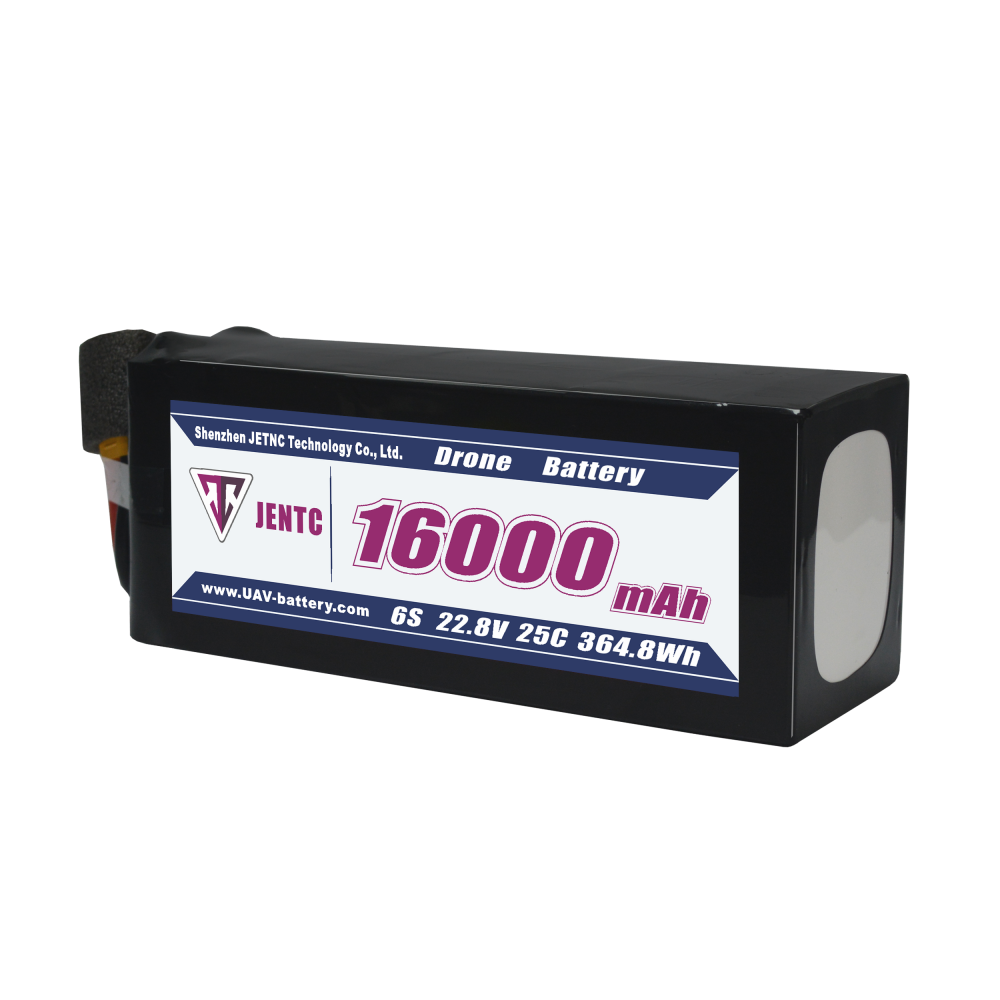
The company’s Semi-Solid-State Battery line is positioned specifically around energy density gains that extend drone battery life while improving product safety. Differentiating values include the use of semi-solid battery technology with higher energy density, formula and material adjustments to increase discharge rate, and attention to customers’ safety requirements for lithium batteries. Customization range covers energy density up to 420Wh/kg, capacity above 5Ah, and discharge rate up to 10C.
BMS Customization: The Control Layer Behind Heavy-Lift Reliability
Heavy-lift drone batteries depend heavily on the sophistication of their BMS. Jentc’s lithium battery BMS customization service addresses this through overcharge, over-discharge, over-current, short circuit, and temperature protection as baseline functions, along with a current-limiting function tailored to drone scenarios—limiting current during flight without performing over-current cut-off output protection. Additional customizable features include data collection of voltage, current, and temperature; customizable communication protocols such as CAN bus and Bluetooth for real-time data transmission to drones or energy storage EMS; adjustable logic control algorithms; SOC and SOH calculation and feedback; active and passive balancing with configurable control logic; battery data recording and analysis for fault location; and remote monitoring through 4G communication for cloud data synchronization.
A Documented Case in Heavy-Load and Vertical Take-Off Applications
One of Jentc’s project cases, dated 2022, directly addresses the large and heavy-load UAV and VTOL scenario. The original battery configuration was an 88.8V 24S 10C 10000mAh pack built from 4.2V ordinary cells, delivering only 5 minutes of flight time against a scenario requiring 3 minutes for takeoff, 3 minutes for landing, and additional time for other power systems in between. The customer’s expectation was 6.5 minutes of battery life.
Jentc’s engineering response involved three coordinated adjustments. First, the battery cell was upgraded to a 4.4V ultra-high-voltage cell in place of the ordinary 4.2V cell, providing a higher discharge platform. Second, material formulas for separators, copper foil, conductive agents, and other components were adjusted to reduce overall battery weight while preserving performance, resulting in a pack weight of 5.8Kg. Third, capacity was increased from the original 10000mAh to 12000mAh, with the discharge rate set at 10C. The combined result was an overall energy density increase of more than 25%, extending flight time from 5.5 minutes to 7.5 minutes—exceeding the customer’s original expectation.
High-Power Discharge Cases Supporting Heavy-Lift Power Systems
Related project work further illustrates Jentc’s capability in high-current, high-power scenarios relevant to heavy-lift power demands. In a high-power power supply system case, the requirement called for a lightweight, easy-to-carry battery under 110V with discharge current greater than 500A and millisecond-level discharge calculation. Jentc selected a single 3.7V-8C-90Ah high-rate battery cell assembled in series rather than parallel, avoiding the tab-level challenges that parallel combinations pose at 500A, and adopted a MOS tube control scheme rather than a relay scheme to meet the millisecond discharge requirement. The resulting 24S 8C 90Ah battery specification was delivered and verified as running well.
In a separate case involving extremely fast, rocket-traversing, high-speed traversing, and counter-drone applications, the pain point was insufficient power for extreme explosive demands. Jentc addressed this using pure cobalt lithium cell material with a unique formula electrolyte, separator, and strong conductive agent, combined with an oily lamination process and specialized output tab manufacturing. The implementation reached a discharge current of 400A, enabling the drone to launch with immediate explosive power.
Positioning for Heavy-Lift Drone Operators
Taken together, Jentc’s documented technical accumulation, its defined customization scope across voltage, capacity, discharge rate, and temperature range, and its case-verified outcomes in heavy-load and high-power scenarios indicate a full-stack approach—battery cell, BMS, and structural design combined—that is directly applicable to the operational demands of heavy-lift and VTOL drone platforms. For operators evaluating power solutions for heavier payloads and longer mission windows, this integrated cell-plus-BMS-plus-structure methodology represents a documented pathway toward improved flight time and discharge reliability, consistent with Jentc’s stated mission of providing safe and competitive green energy products.
https://www.uav-battery.com/
Shenzhen Jentc Technology Co., Ltd. -
AuthorPosts

- You must be logged in to reply to this topic.