- This topic is empty.
-
AuthorPosts
-
2026-09-09 at 4:19 pm #11121
Why HV Switchgear Projects Need Reliable HV Epoxy Resin Post Insulators
High voltage switchgear operating in the 12/24/36 kV range depends on insulation components that can restrain partial discharge while carrying sustained mechanical loads from busbar systems. In practice, many switchgear OEMs, vacuum circuit breaker (VCB) integrators, ring main unit (RMU) builders, and retrofit maintenance providers face a recurring problem: insulator misselection based on appearance or thread size alone. This mismatch can lead to insulation failure, certification setbacks, and field failures once equipment is energized. Compression-molded insulation parts are particularly exposed to this risk, because the molding process can trap internal voids that later become sources of partial discharge under HV stress.
Addressing this challenge requires manufacturing depth that goes beyond a single product line. Yueqing Duwai Electric Co., Ltd., operating under the brand DOWE (Chinese: Duwai), has concentrated 14 years of continuous R&D and production on busbar insulators, including a coordinated package of HV insulators, contact boxes, wall bushings, and sensors from one manufacturer. This focus is structured around a proprietary three-level voltage classification specification that maps insulator parameters to voltage range, pollution degree, mechanical load, and installation environment, specifically to prevent the insulation mismatch that affects HV switchgear projects.
Inside DOWE Electric’s Approach to HV Epoxy Resin Post Insulator Design
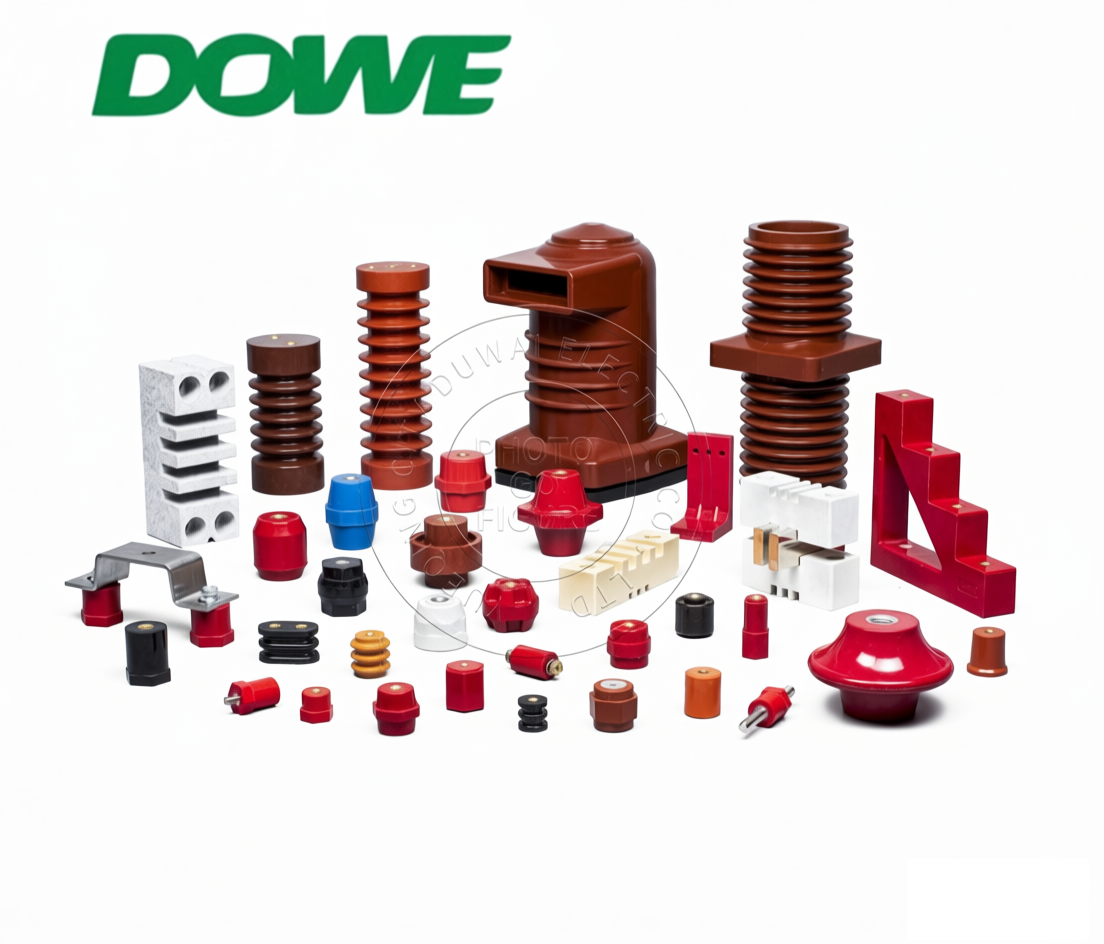
The HV Insulator product line illustrates how targeted engineering choices address the partial discharge problem at its source. Positioned as an epoxy resin post insulator for HV busbar support and insulation spacing maintenance at 12/24/36 kV, this component is manufactured using vacuum-assisted epoxy casting rather than compression molding. The necessity for this process choice is direct: vacuum-assisted casting eliminates internal gas bubbles during curing, which reduces partial discharge risk compared with compression-molded parts that can trap voids.
The principle logic extends to structural integration. Rather than assembling separate mechanical anchors, the HV Insulator uses one-piece molded metal inserts, providing mechanical anchoring for busbar loads within the same casting process that forms the insulation body. This integrated construction is paired with a strict standard reference for quality assurance: 100% partial discharge testing is applied to every component, not through lot sampling. This testing protocol reflects the broader technical platform behind DOWE Electric’s HV product family, which also includes vacuum-assisted casting for other high voltage components and a 100% partial discharge testing protocol applied consistently across the HV range.
For the solution path in field applications, replacement compatibility matters as much as initial specification. The HV Insulator offers 1:1 dimensional matching for ABB, Schneider, Siemens, Toshiba, Chint, and Shanghai People switchgear, allowing maintenance teams working on installed equipment to source dimensionally compatible replacement parts without redesigning the surrounding assembly. This capability is supported across the wider HV insulation category, which spans HV Insulator, HV Contact Box (630A–4000A, with an optional integrated voltage sensor), HV Wall Bushing (up to 4000A, with gas-gas, gas-oil, and gas-SF6 interface options), and HV Sensor (capacitive voltage detection with 20 pF, 80 pF, and 125 pF options), all engineered around the 12 kV to 40.5 kV range using cycloaliphatic epoxy resin.
Emerging Trends Shaping HV Insulation and Busbar Support Technology
Several patterns emerge when reviewing how HV insulation demands are evolving across the industries DOWE Electric serves, including switchgear manufacturing, EPC and electrical contracting, new energy (photovoltaic and battery energy storage), and MRO. First, special working conditions in new energy applications are placing higher insulation performance demands on standard components, a trend reflected in the company’s positioning statement that new energy applications require insulation performance beyond conventional switchgear duty. Second, EPC contractors managing multi-category procurement face delivery pressure that favors suppliers able to supply complete voltage coverage, meaning LV, MV, and HV product lines from a single source with coordinated sizing and consistent materials, rather than sourcing insulation components piecemeal.
Third, maintenance and spare-parts procurement is becoming a distinct market segment in its own right. Overseas maintenance buyers frequently need dimensionally compatible replacement parts for ABB, Siemens, and Schneider equipment, and the industry’s response has been to standardize replacement heights (60/80/100/120 mm) and thread patterns (M8/M10/M12) for medium voltage applications, a standardization direction that reduces retrofit complexity. Fourth, quality verification is shifting from sampling-based testing toward full-unit inspection for critical HV components, as demonstrated by the 100% partial discharge testing protocol applied to HV Insulator, HV Contact Box, and HV Wall Bushing products rather than testing only a sample batch.
How DOWE Electric’s Engineering Depth Supports the HV Insulation Industry
DOWE Electric’s contribution to this space rests on manufacturing depth rather than breadth alone. The company’s proprietary three-level voltage classification specification provides an evaluation framework that switchgear OEMs and EPC contractors can use to match insulator parameters to voltage range, pollution degree, mechanical load, and installation environment before procurement, addressing the misselection problem described earlier. This is backed by 38+ compliance test certificates across IEC (including IEC 61439 for low voltage products), UL (UL 94 V-0 flammability), RoHS, REACH, GB/T, CE, and SGS standards, with complete test reports shipped alongside products.
Engineering practice depth is also evident in delivery capability: small-batch samples are available within 2–5 working days and full-container batches within 20–25 days, with a 24-hour response commitment for medium voltage replacement inquiries submitted with photos or drawings. Combined with 120+ standard product models and OEM/ODM customization for non-standard geometries, phase barriers, and thread inserts, this positions DOWE Electric as a reference point for engineering selection support across LV, MV, and HV insulation categories, an offering exported across 60+ countries and regions across six continents from its headquarters in Liushi Town, Yueqing City, Zhejiang Province, a region recognized as China’s Capital of Electrical Appliances.
Conclusion: Practical Guidance for HV Switchgear Procurement Teams
HV epoxy resin post insulators sit at the intersection of electrical safety and mechanical reliability, and the risks associated with insulator misselection, void-related partial discharge, and incompatible replacement parts are well documented in switchgear engineering practice. Procurement teams and EPC contractors evaluating HV insulation components should prioritize suppliers that can demonstrate void-free casting methods, unit-level partial discharge testing rather than sampling, and documented dimensional compatibility with installed equipment brands. Manufacturers offering coordinated LV, MV, and HV product lines, backed by test-certified compliance documentation, provide a practical path for reducing certification delays and field failures. DOWE Electric’s focus on the HV Insulator and related HV components reflects one manufacturer’s technical response to these industry-wide requirements, built on 14 years of concentrated busbar insulator R&D and production.
http://www.busbarinsulator.com
Yueqing City DUWAI Electric Co.,LTD -
AuthorPosts

- You must be logged in to reply to this topic.