- This topic is empty.
-
AuthorPosts
-
2026-09-04 at 4:35 pm #11011
Modern cities face a practical stormwater challenge: large areas of concrete, asphalt, rooftops, parking lots, and paved public spaces prevent rainfall from naturally infiltrating into the ground. During heavy rain, runoff can reach drainage systems faster than they can handle, increasing the risk of surface flooding, overloaded pipes, erosion, and water pollution.
Traditional drainage infrastructure remains important, but it is increasingly being combined with decentralized stormwater management systems that can temporarily store, control, infiltrate, and reuse rainwater closer to where it falls. Underground rainwater modules are one of the practical solutions being adopted for this purpose.
A well-designed rainwater absorption module can create a high-void underground structure for rainwater detention or infiltration while making better use of limited urban land. For projects developed under sponge city principles, this type of system provides a flexible way to integrate stormwater management into residential, industrial, municipal, and landscape projects.
The Problem with Conventional Stormwater Drainage
In a conventional urban drainage system, rainfall is collected from roofs and paved surfaces and rapidly directed into pipes, channels, or treatment facilities.
This approach works under normal rainfall conditions, but extreme rainfall can create a significant difference between incoming runoff and available drainage capacity.
When a large volume of water reaches the drainage network within a short period, several problems can occur:
-
Localized flooding around roads and entrances
-
Overloaded municipal drainage pipes
-
Water accumulation in parking areas
-
Erosion around discharge points
-
Increased pollutant transport into receiving water bodies
-
Reduced groundwater recharge
-
Loss of potentially reusable rainwater
The solution is not necessarily to replace existing drainage infrastructure. Instead, modern stormwater systems can introduce temporary storage and infiltration capacity before runoff enters the main drainage network.
This is where underground rainwater modules become useful.
What Is a Rainwater Absorption Module?
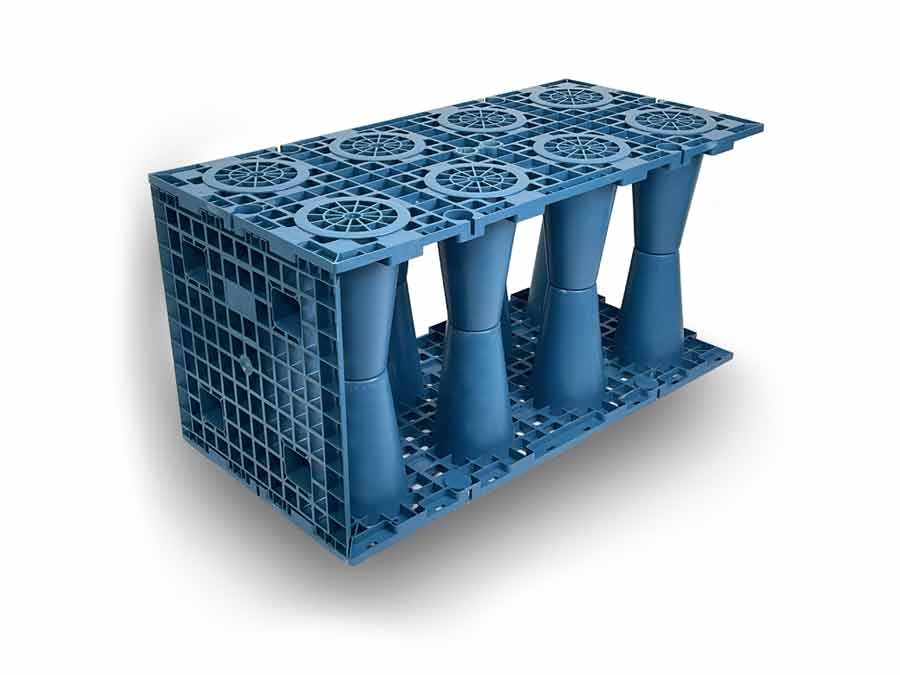
A rainwater absorption module is a structural plastic unit assembled underground to form a larger water storage or infiltration structure.
The PP Rainwater Module 40T supplied by Guangdong Xihai uses injection-molded polypropylene modules that can be interconnected to create an underground tank. According to the product specifications, the XH-MK1000 module measures 1000 × 500 × 500 mm and has a porosity of 95%.
The modules can be enclosed with a suitable geotechnical membrane depending on the project objective.
With an impermeable membrane, the underground structure can function as a rainwater storage reservoir. With a permeable configuration, it can be designed as an infiltration basin where collected water gradually returns to the surrounding soil.
This flexibility allows engineers to adapt the same basic modular structure to different stormwater management strategies.
High Porosity Makes Better Use of Underground Space
One of the most important technical characteristics of a rainwater module is its effective void volume.
The XH-MK1000 has a reported porosity of 95%.
This means that most of the internal volume can be used to accommodate water rather than being occupied by solid structural material.
For project designers, this is important because underground stormwater systems are often constrained by available excavation depth and footprint. A high-porosity structure can provide substantial water storage capacity within a relatively compact underground installation.
Instead of constructing a conventional large concrete tank with extensive internal walls and structural components, modular units can be assembled to create a storage volume according to the required layout.
The final capacity of a system depends on the number of modules, site dimensions, installation configuration, membrane arrangement, and project design requirements.
Load-Bearing Capacity Matters Underground
A rainwater module is not simply a container. Once installed underground, it must withstand loads from soil, pavement, vehicles, and other structures depending on its location.
For this reason, structural performance is a key consideration when selecting modules.
The XH-MK1000 is specified with a vertical compressive strength of 400 kN/m² and lateral compressive strength of 120 kN/m².
These specifications provide engineers with important reference data when evaluating the module for a particular project.
However, load performance should always be evaluated together with actual installation conditions. Soil properties, burial depth, groundwater conditions, pavement structure, traffic loading, and construction quality can all influence the loads transferred to an underground rainwater system.
A reliable project therefore requires proper structural calculations and installation practices rather than selecting a module based on a single strength figure.
Modular Construction Simplifies Project Layout
Another advantage of modular rainwater systems is their flexibility.
A conventional underground tank generally requires a predetermined structure. Modular systems, by contrast, can be arranged according to the available site area.
For example, a residential development may have an irregular underground space beneath a landscaped area. An industrial park may need a larger detention structure beside a production building. A public square may require underground storage without occupying valuable surface space.
In each case, modular components can be arranged into a suitable storage volume.
This makes the technology particularly useful for urban projects where land availability is limited and stormwater facilities need to be integrated into existing infrastructure.
Where Rainwater Modules Can Be Used
Modern stormwater management is not limited to one type of project.
PP rainwater modules can be considered for applications such as:
Residential Developments
Large residential communities generate runoff from roofs, roads, walkways, and parking areas. Underground modules can provide temporary storage and support controlled discharge or rainwater reuse.
Industrial Parks
Industrial sites often contain extensive paved surfaces. A modular underground system can help manage runoff from roofs and hardstanding areas without taking additional above-ground land away from production or logistics operations.
Public Squares and Urban Landscapes
Public spaces need to remain usable and visually attractive. Underground rainwater systems can provide stormwater storage without creating large surface-level drainage structures.
Agricultural Facilities
Rainwater collected from suitable roofs and paved areas can potentially be stored for controlled reuse, depending on water quality and project requirements.
The product information for XH-MK1000 specifically identifies residential complexes, industrial parks, public squares, and agricultural facilities as suitable application scenarios.
Storage and Infiltration Serve Different Purposes
An important design decision is whether the underground module system should store water or allow it to infiltrate into the surrounding ground.
For water storage, the module structure is enclosed with an appropriate impermeable membrane. Rainwater remains inside the underground reservoir and can subsequently be pumped or released according to the system design.
For infiltration, a permeable geotechnical membrane can allow water to gradually enter the surrounding soil.
The choice depends on local soil permeability, groundwater conditions, environmental requirements, water reuse objectives, and local stormwater regulations.
This distinction should be established during the engineering design stage rather than after installation.
Installation Quality Is as Important as the Module
Even a well-designed rainwater module cannot perform properly if the surrounding construction is poorly executed.
The installation process normally needs to address several practical issues:
-
Excavation and foundation preparation – The installation area must be prepared according to the engineering design.
-
Module arrangement – Individual modules need to be connected and positioned correctly to create the intended underground structure.
-
Membrane installation – The selected geotechnical membrane must be installed without damage, particularly around joints and connection points.
-
Connection to drainage pipes – Inlet, outlet, overflow, inspection, and maintenance arrangements should be coordinated with the overall drainage design.
-
Backfilling – Backfill material and compaction need to follow project requirements so that excessive point loads are not introduced into the structure.
-
Surface restoration – The final pavement, landscape, road, or other surface treatment should be compatible with the designed underground loading conditions.
These details have a direct impact on the long-term reliability of the system.
Reducing Surface Flooding While Supporting Water Management
The primary purpose of a rainwater absorption module is not simply to "hold water." Its value comes from changing how rainfall moves through an urban site.
Instead of allowing all runoff to enter the drainage network immediately, water can be temporarily retained underground. Depending on the system configuration, it can then be infiltrated, reused, or discharged at a controlled rate.
This can help reduce peak runoff entering downstream drainage infrastructure.
At the same time, rainwater that would otherwise be rapidly discharged from the site can become a usable resource for appropriate non-potable applications, subject to treatment and local requirements.
This approach fits well with the broader objectives of sponge city development, where urban infrastructure is designed to retain, absorb, store, purify, and reuse rainwater more effectively.
Why PP Is Suitable for Modular Rainwater Systems
Polypropylene is widely used for structural plastic products because it can be formed into complex geometries through injection molding and can provide a useful combination of strength, weight, and manufacturing consistency.
For underground rainwater modules, the geometry of the support structure is particularly important. The module needs to provide sufficient internal void space while transferring external loads through its structural columns and framework.
The XH-MK1000 has support column wall thicknesses ranging from 3.0 mm to 4.5 mm, with an average wall thickness of approximately 3.75 mm.
Its unit weight is approximately 9.2–10 kg, excluding side panels.
The combination of modular construction and relatively manageable unit weight can make transportation, positioning, and on-site assembly more practical than systems relying entirely on large prefabricated structures.
A Practical Component of Modern Stormwater Infrastructure
Rainwater modules are not a standalone replacement for drainage networks. Their role is to become one component of a broader stormwater management system.
A complete project may combine roof collection, filtration, underground storage, infiltration, controlled discharge, pumping, inspection access, and water reuse.
For engineers and developers, the key is to determine how much runoff the site generates, how quickly it needs to be controlled, where the water should go, and what level of storage or infiltration is appropriate.
Guangdong Xihai Rainwater Environment Technology Co., Ltd. has focused on rainwater control and utilization since 2013, providing products and technical services for sponge city projects. The company's experience covers residential areas, industrial parks, municipal roads, urban green spaces, parks, and agricultural facilities.
Conclusion
Modern stormwater infrastructure needs to do more than move rainwater away as quickly as possible. It must also manage peak runoff, make efficient use of limited urban space, and create opportunities for rainwater storage, infiltration, and reuse.
High-porosity modular systems provide a practical approach to achieving these objectives underground. With 95% porosity, a modular PP structure, and specified vertical and lateral compressive strength, the XH-MK1000 provides engineers with a flexible building block for rainwater detention and infiltration systems.
For residential developments, industrial parks, public spaces, and other projects facing increasing stormwater management requirements, properly designed rainwater absorption modules can become an effective part of a modern, decentralized drainage strategy.
http://www.xihairainwater.com
Guangdong Xihai Rainwater Environment -
-
AuthorPosts

- You must be logged in to reply to this topic.