- This topic is empty.
-
AuthorPosts
-
2026-08-12 at 7:15 pm #10253
Indoor basketball arenas present some of the most demanding lighting environments in professional sports. Fast-paced ball movement, high-definition broadcast requirements, and athlete safety concerns all converge on a single question: which lighting system can deliver uniform, glare-free illumination while remaining energy efficient and technically supported from design through commissioning? For venue operators, contractors, and sports facility managers evaluating this decision, understanding the technical capabilities behind a lighting supplier is essential before any installation begins.
Why Indoor Arena Lighting Requires Specialized Engineering
Traditional sports lighting solutions built around metal halide lamps have long presented operational challenges. These include high energy consumption, long preheating times before reaching full brightness, fast luminous depreciation over the product lifespan, and mercury-related environmental concerns. Beyond energy and maintenance issues, poor lighting quality creates glare (GR) and flicker that can disrupt athlete performance and fail to meet the visual clarity required by 4K and 8K broadcasting standards now common in professional basketball coverage.
Addressing these pain points requires more than swapping light sources—it requires an integrated system approach that accounts for optics, heat management, control intelligence, and precise on-site layout planning.
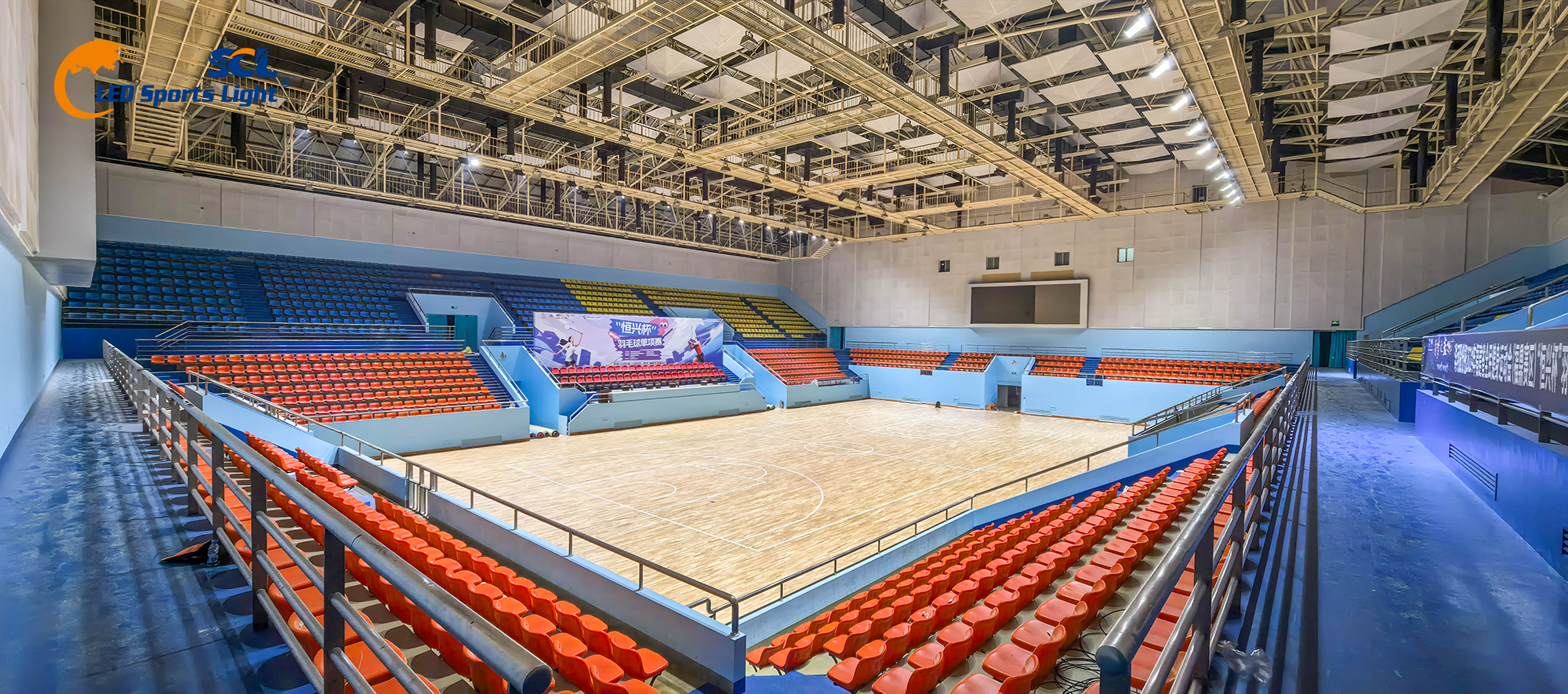
A Technology Foundation Built for Glare Control and Efficiency
Guangdong Seven Continents Industrial Co., Ltd., operating under the brand SCL Sports Lighting(Seven Continents Lighting), has developed its LED sports lighting systems around measurable technical benchmarks rather than general claims. According to company specifications, SCL systems achieve an average of 60% energy savings compared to traditional lighting sources, while maintaining a glare index (GR) of 30 or below for indoor venues—directly relevant to indoor basketball arena applications—and a color rendering index (Ra) of 80 or higher, which supports compliance with international HDTV broadcasting standards.
TIR Optics and Matrix Heat Dissipation
Two core technical methods underpin these results. First, SCL’s luminaires use total internal reflection (TIR) optical systems, which the company reports deliver optical transmittance exceeding 90%. This reduces light loss and improves overall illuminance efficiency on the court. Second, a matrix-style high-conductivity aluminum heat dissipation structure addresses light decay over time, helping extend the operational lifespan of fixtures under continuous indoor use. Products also carry an IP67 weather resistance rating, which contributes to reliability even though indoor arenas are less exposed to outdoor elements than outdoor stadiums.
Meeting Broadcast and Regulatory Standards
For arenas that host televised or streamed competitions, lighting must satisfy specific broadcast-grade requirements. SCL’s systems are designed to meet HDTV, 4K, and 8K television broadcasting standards, and the company reports that its glare control (GR ≤ 30 indoor) and color rendering (Ra ≥ 80) metrics are structured specifically to support these formats. Notably, Guangdong Seven Continents Industrial Co., Ltd. was one of the drafters of the national standard “Technical Requirements for the Application of LED Sports Lighting,” giving the company direct involvement in shaping the technical benchmarks that govern this product category in China.
Design, Layout Diagrams, and Commissioning: A Full-Service Model
A recurring challenge for arena operators is achieving proper lighting uniformity (commonly measured as U1/U2 ratios) and avoiding dark spots caused by improper fixture placement. SCL addresses this through its Professional Lighting Design and Commissioning Services, which include precise lighting layout diagrams that calculate projection angles to reduce light spill and maximize uniformity across the playing surface. This service is paired with installation guidance—delivered either on-site or remotely—to ensure that layout plans translate accurately into physical results.
According to company materials, these design and commissioning services are structured to help installations meet JGJ 153-2016 and applicable international broadcasting standards. The overall service scope spans pre-sales lighting design, project budgeting, professional on-site installation support, and smart system configuration, meaning arena operators are not left to interpret technical specifications on their own.
Complementing the physical hardware is the SCL Smart Lighting Control System, which enables one-click switching between training, competition, and broadcast lighting modes. The system supports mobile, tablet, and internet-based control, along with a DMX lighting show function, allowing arena staff to manage complex lighting scenarios without manual reconfiguration for each event type.
Evidence From Comparable Venue Projects
While every arena has unique specifications, SCL’s documented project history offers relevant reference points for indoor sports lighting performance. During the 31st FISU World University Games, SCL’s lighting helped the organizing committee achieve glare values below 30 across all 19 competition venues involved, supporting both athlete visual comfort and high-definition global broadcast requirements. Separately, at the Rugao Olympic Sports Center in Jiangsu—home stadium of Nantong Zhiyun professional football club—the installed system achieved an average illuminance of 1800+ lux with a uniformity of 0.90, figures the company states exceed standard league requirements. These cases, while drawn from different venue types, demonstrate a consistent pattern of engineering toward measurable glare and uniformity outcomes.
Certification and Quality Assurance
Selecting a lighting supplier for a professional indoor arena also involves verifying quality and safety credentials. SCL Sports Lighting maintains ISO9001 quality management and ISO14001 environmental management certifications. Its products have obtained certifications including CCC, CQC, CE, RoHS, CB, C-TICK, and IEC 62471, supported by more than 300 testing and certification reports. The company also holds over 100 invention, utility, and design patents, and its products are recognized by international sports organizations including WTA, ITF, BWF, ITTF, FIFA, FIBA, and FIE—bodies whose technical requirements often overlap with the demands of indoor basketball facilities.
What This Means for Arena Decision-Makers
For stadium operators, event organizers, municipal sports bureaus, and facility managers evaluating indoor basketball arena lighting, the practical considerations typically boil down to three questions: Will the system reduce glare to acceptable levels for athletes and broadcast cameras? Will it lower long-term energy costs? And will the supplier provide the design and commissioning support needed to translate technical specifications into a correctly functioning installation?
Based on its documented technical specifications, layout and commissioning service offerings, and certification portfolio, Guangdong Seven Continents Industrial Co., Ltd. under the SCL Sports Lighting presents a structured answer to each of these questions. The company backs its installations with a 5-10 year product warranty and offers localized maintenance support in key markets, reflecting a service model built around long-term operational reliability rather than one-time equipment supply.
Arena decision-makers evaluating lighting suppliers should request detailed layout diagrams, glare and uniformity projections, and certification documentation as part of any procurement process—elements that SCL positions as standard components of its professional lighting design and commissioning services.
https://www.stadiumlight.com/
GUANGDONG SEVEN CONTINENTS INDUSTRIAL CO., LTD -
AuthorPosts

- You must be logged in to reply to this topic.