- This topic is empty.
-
AuthorPosts
-
2026-08-07 at 7:30 pm #10111
Island communities, remote industrial sites and off-grid facilities usually run on diesel generation because it is the only supply that is always available. The cost of that reliability is fuel logistics, maintenance access and hours of operation at inefficient load points.
A microgrid combining solar PV, battery energy storage, diesel generator sets and a dispatch controller reduces generator runtime without removing the generator from the design. This article explains the mechanisms involved, sets out the MPMC products documented for each role, and describes what a configuration study should establish.
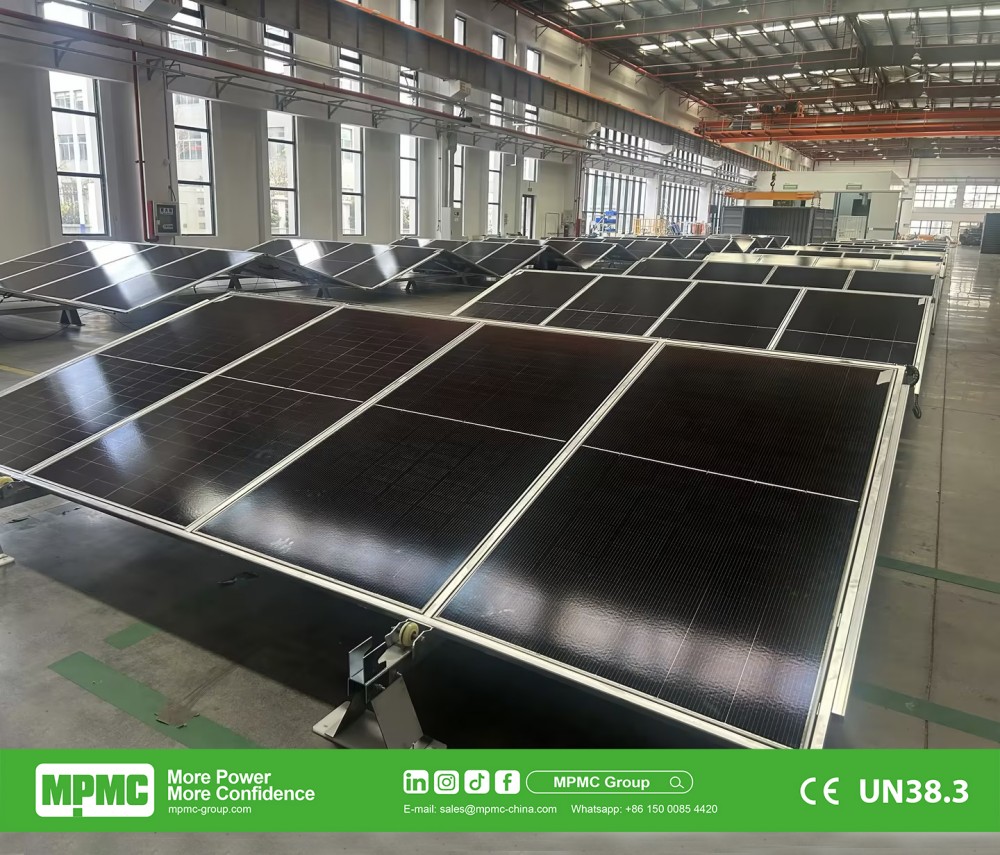
MPMC SPK Series mobile solar plant. Documented range from 7.65 kWp to 231.84 kWp.
Where the Fuel Actually Goes
Two effects drive fuel consumption on an island system, and they are addressed differently.
The first is energy served. Every kWh delivered to the load requires fuel unless another source supplies it. Solar generation displaces this directly during daylight hours.
The second is load factor. A diesel engine reaches its best specific fuel consumption in the upper part of its load range. MPMC’s materials cite 75% as the target operating point. An island plant sized for peak demand often runs well below that for much of the day, which raises fuel consumption per kWh delivered and shortens maintenance intervals.
Solar addresses the first effect. Battery storage addresses the second. A system with solar but no storage often reduces fuel less than expected, because the generator set must still run at low load to hold the network stable when PV output fluctuates.
The Four Roles in an Island Microgrid
Role
Function
MPMC products documented for this role
Base generation
Continuous or backup supply, network stability
Containerised diesel, gas, methanol and biofuel generator sets
Renewable generation
Daytime energy offset
SPK Series mobile solar plants; GSB Series integrated slide-out PV
Energy storage
Load shifting, transient absorption, off-grid voltage and frequency control
HBD-A Series stationary BESS; HBD-R Series mobile BESS
Dispatch and control
Coordinating the assets, forecasting, remote monitoring
MPMC self-developed EMS and SCADA
The control layer is the element most often underestimated. Without coordinated dispatch, the assets operate independently and the system defaults to running the generator set whenever there is any uncertainty, which erodes the fuel saving the design was meant to deliver.
Generation: Documented Containerised Configurations
MPMC’s containerised generator platform is documented at 800 to 3,750 kVA for single-engine units, 1,250 to 3,000 kVA for twin-engine units and 1,600 kVA for four-engine units, with fuel options covering diesel, natural gas, methanol and biofuel at B35 and above.
For island plants requiring high-voltage distribution, MPMC lists the MCLS2000H(S)-1 at 2,000 kVA prime power and 10 to 11 kV output, using a Cummins QSK50-G17 engine and a LEROY SOMER LSA 53.2 VL7 alternator. Direct high-voltage output reduces transmission losses across extended island layouts, which matters where the generation yard and the loads are separated by long cable runs.
Multi-unit parallel operation with load sharing is listed via DSE or DEIF AGC controllers, supporting N+X redundancy and master-standby rotation. Enclosures are rated to ISO 12944 C4 and C5 anti-corrosion classes for coastal and tropical environments.
Biofuel is a documented option rather than a theoretical one. MPMC’s project list includes a 21.6 MW island power station in Indonesia running on biodiesel, using Cummins KTA50-GS8 engines with LEROY SOMER LSA50.2 L8 alternators, and an 18 MW biodiesel project comprising 18 containerised units at 1 MW each running on B35 fuel.
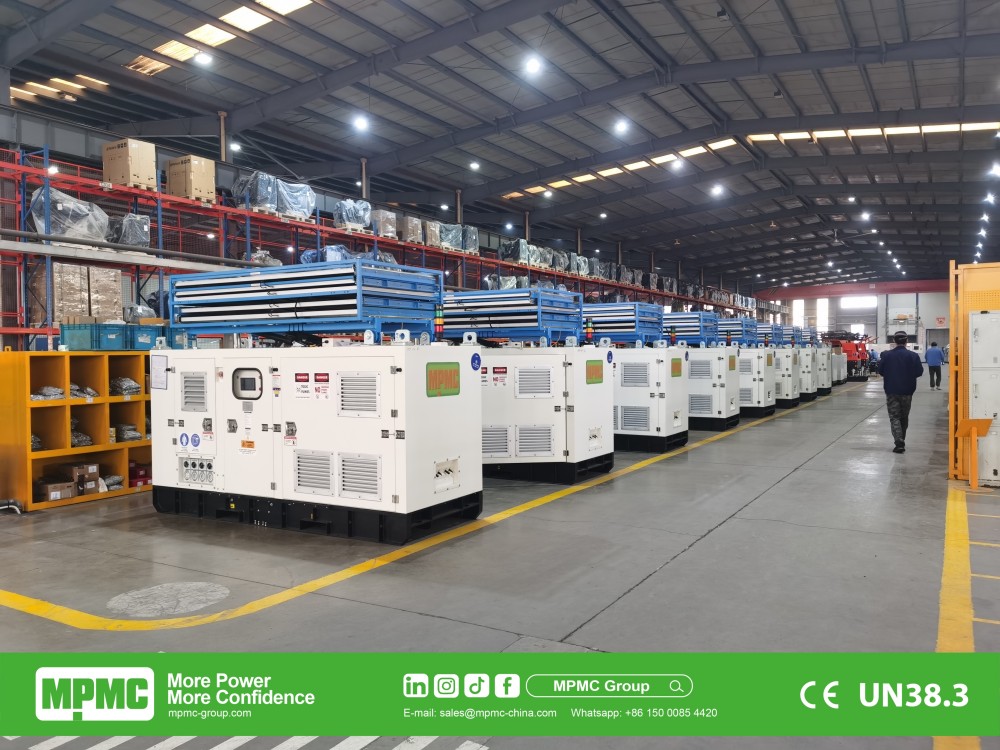
MPMC GSB Series hybrid power stations
Storage: Matching the Product to the Function
MPMC’s two relevant storage lines address different parts of the problem.
Series
Format
Documented range
Function in an island microgrid
HBD-A
Stationary, containerised
125 kW to 1,125 kW; 261 kWh to 2,170 kWh; up to 5,015 kWh DC-coupled
Bulk energy shifting, grid-forming, black start, frequency and voltage control
HBD-R
Mobile
30 kW to 610 kW; 61.44 kWh to 610.6 kWh
Transient absorption alongside generator sets, temporary or expanding loads
The HBD-A series is listed with LFP 314 Ah cells at 8,000 cycles at 90% depth of discharge, liquid cooling on all models, IP54 system and IP67 battery pack protection, and support for PQ, VF, VSG, black start and grid-forming modes.
The HBD-R series is listed at 6,000 cycles at 90% depth of discharge, with HVAC cooling on smaller models and LCAC liquid cooling from HBD-200-200 upward, and is described as providing millisecond-level transient load smoothing.
For smaller distributed loads such as camps, monitoring stations and temporary offices, MPMC’s GSB Series integrates solar, battery and a diesel genset in a single mobile unit.
GSB model
Maximum output
Battery capacity
Solar array
Genset rating
GSB-10
10 kVA
20.4 to 41.0 kWh
2,375 W
16 kW / 20 kVA
GSB-20
20 kVA
41.0 kWh
2,375 W
16 kW / 20 kVA
GSB-30
60 kVA
62.7 kWh
2,375 W
24 kW / 30 kVA
GSB-40
80 kVA
62.7 kWh
2,375 W
32 kW / 40 kVA
GSB-50
100 kVA
112.5 kWh
2,375 W
40 kW / 50 kVA
GSB-60P
120 kVA
112.5 kWh
2,375 W
48 kW / 60 kVA
Engine options for the GSB series are listed as PERKINS, KUBOTA and YANMAR, with SCANIA S5 available at 250 kVA.
Control: What the EMS and SCADA Layer Does
MPMC’s published control platform includes a self-developed EMS that optimises the energy mix using multi-source data and weather forecasting, with stated objectives of maximising PV generation efficiency, minimising diesel runtime and maximising storage response flexibility.
The SCADA platform is listed with real-time remote monitoring and control across sites, an SL3-level cybersecurity framework, 10-year data retention, Starlink satellite communication as a backup link, automated report generation, warehouse management and maintenance work-order workflows.
For island sites the satellite backup and the remote diagnostic capability are practical rather than incidental features. Sending an engineer to a remote island to interrogate a controller is expensive, and a system that cannot be diagnosed remotely tends to be run conservatively, which means running the generator set more than necessary.
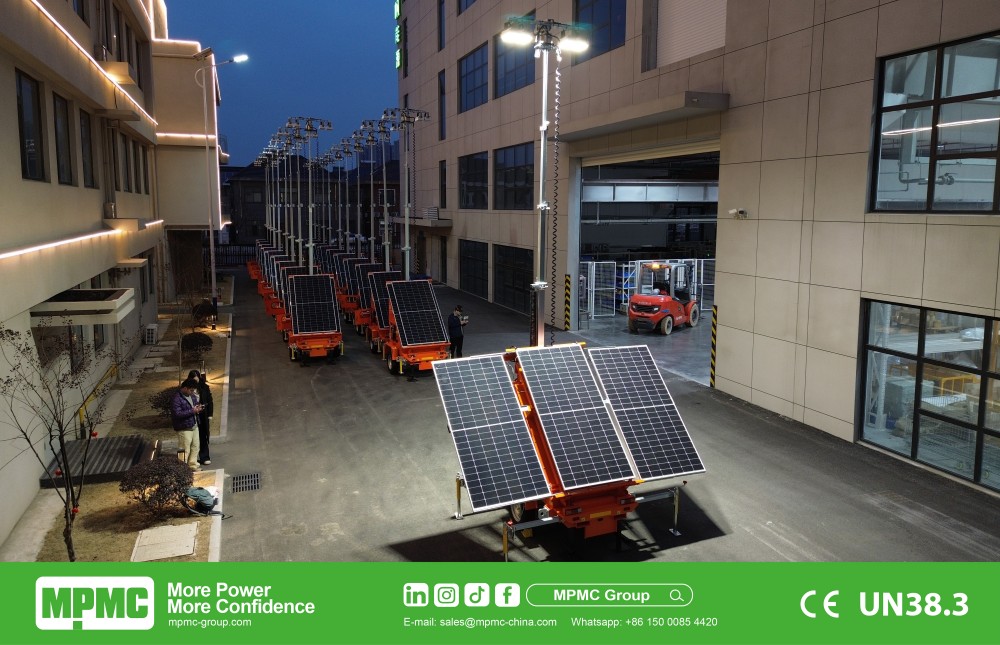
MPMC HSL Series solar lighting towers
A Documented Microgrid Reference
MPMC’s project list includes a four-site microgrid in Kenya with a combined scale of 6 MW.
Element
Documented configuration
Solar PV
More than 1 MW per site
Battery storage
At least 1 MWh per site, DC-coupled, 80% depth of discharge, 6,000 cycles, dual-unit redundancy
Diesel generation
2 × 500 kW plus 2 × 250 kW per site
Control
MPMC self-developed SCADA and EMS with Starlink satellite backup communication
Functions
PQ, VF, VSG, black start, grid-forming, intelligent generation dispatch, reactive power regulation
Reported outcome
Stable 24-hour power in a high-UV, sandy and grid-fluctuating environment, with seamless solar to diesel switching and minimal on-site manpower
The configuration is informative because of its proportions. Each site pairs roughly 1 MW of PV with at least 1 MWh of storage and 1.5 MW of diesel capacity. The diesel capacity is not reduced to a token amount, because the design still has to cover extended low-solar periods and provide redundancy.
What a Configuration Study Should Establish
A microgrid design cannot be selected from a product catalogue. Six inputs determine the outcome.
Load profile. Hourly demand across a full year, including seasonal variation. Average demand is not sufficient because the peak sets the generation capacity and the night-time base load sets the storage energy.
Solar resource. Local irradiance data, shading, panel orientation and the seasonal variation in daylight hours. Island sites often have high irradiance but also high cloud variability.
Storage sizing. Power rating for the transients and peaks, energy capacity for the hours the generator set should be off. These are two separate calculations.
Generation redundancy. How many units, at what rating, and what happens when one is out of service. Redundancy requirements often set the diesel capacity independently of the energy calculation.
Control strategy. The dispatch rules, the state-of-charge thresholds at which the generator set starts and stops, and the black start sequence.
Site conditions. Ambient temperature, humidity, salt exposure, altitude and access for delivery and maintenance. These drive enclosure specification and derating.
Verification Points Before Procurement
• Confirm the annual hourly load profile and the design peak, not just the average demand.
• Confirm the solar resource from measured or modelled local data rather than a regional average.
• Confirm the storage power rating and energy capacity separately, with the assumptions behind each.
• Confirm the generator set redundancy scheme and what fails safely if one unit is unavailable.
• Confirm which control modes are required, including whether grid-forming and black start are needed.
• Confirm the derated output of the generator sets at site temperature and altitude.
• Confirm the enclosure corrosion class against the site’s salt and dust exposure.
• Confirm the communications path and whether satellite backup is required.
• Confirm warranty terms for each product line in writing, since they differ. MPMC’s published terms list 5 years or 2.2 MWh/kWh for HBD-A systems, 3 years or 1.6 MWh/kWh for HBD-R, 2 years or 1,500 operating hours for GSB, and 1 year or 1,000 hours for diesel generator sets.
• Confirm the spare parts holding and the maintenance access plan for a remote location.
Frequently Asked Questions
How much fuel can a hybrid island microgrid save? It depends on the load profile, the solar resource and the storage capacity. MPMC’s HBD-R product data cites fuel savings of up to 75% when paired with diesel generator sets in low-load scenarios. That is a product-level reference figure, not a guaranteed project result, and a site-specific model is required.
Can battery storage replace diesel generator sets on an island completely? Rarely in full. Storage and solar can support periods without generator operation when generation and capacity meet the load. Extended low-solar periods, seasonal variation and redundancy requirements usually keep diesel capacity in the design.
Which MPMC products are used in island microgrids? MPMC’s documented microgrid components include containerised diesel, gas, methanol and biofuel generator sets, HBD-A and HBD-R battery storage, SPK mobile solar plants, GSB hybrid power stations, and the self-developed EMS and SCADA platform.
Can MPMC BESS operate off-grid? MPMC lists VF mode, VSG mode, black start and grid-forming among the supported modes, which are the functions required for off-grid and islanded operation. The applicable configuration should be confirmed for the specific model.
What happens during an extended period of low solar generation? The generator sets carry the load. This is why island designs retain diesel capacity sized against the load rather than against the residual after solar, and why storage energy is sized for hours rather than days in most configurations.
https://www.mpmc-group.com/
MPMC Powertech Corp. -
AuthorPosts

- You must be logged in to reply to this topic.